Marcus Capone was a soldier with the United States Navy’s Ground, Sea, and Air Teams (commonly known as Navy Seals) until 2013. He enlisted after the terrorist attack on the Twin Towers in 2001. He served in Afghanistan in 2005 and spent around 300 days away from home from mission to mission. During that time, like many combatants and veterans, he developed post-traumatic stress disorder. He self-medicated. He suffered from depression, anxiety and had nightmares. He knew he hit rock bottom when his wife, Amber Capone, found him one early morning in their living room with an empty whiskey bottle and a loaded gun while watching old videos of his soldier training on television. When he thought there was no longer a solution for his condition, he found a light in Tijuana, Mexico, through a treatment with ibogaine, an alkaloid with hallucinogenic and stimulant effects that, in recent years, athletes and artists from the neighboring country to the north have begun to access to supposedly cure their addictions.
Tourist paradises in Mexico such as Tulum, Cozumel, Rosarito, Tijuana or Los Cabos, in the Yucatan Peninsula, Baja California or Baja California Sur, respectively, have become oases where this type of psychedelic substances are offered. Ibogaine comes from iboga, a shrub native to the rainforests of Central Africa. This drug comes from the bark of the root, which is crushed and consumed in powder form or administered in the form of an extract.
In countries such as Gabon, Republic of the Congo or Cameroon it is used for medicinal purposes and for rituals. Over the past 10 years, small studies have echoed the effects of ibogaine in treating opioid addiction, suggesting that between one-third and two-thirds of patients who undergo its treatment achieve sobriety. There is even research at Stanford University in the United States, in which scientists have studied the potential of this drug to treat traumatic brain injuries and post-traumatic stress disorder (PTSD).
Famous personalities such as Jordan Belfort, the former stockbroker convicted of stock market manipulation and money laundering, whose life inspired the renowned film The Wolf of Wall Street (2013), or the former basketball player who played 14 seasons in the NBA, Lamar Odom, are some of those who claim that ibogaine helped them overcome their addiction to opiates.
Carlos Rius, an academic at the UNAM Faculty of Medicine, states that there is still no scientific way to verify that these statements are true. He talks about the existence of a small study that was done in New Zealand a few years ago, where 20 people who were opioid users started taking small doses of ibogaine. “After a year, it turns out that more or less 14 people managed to reduce the use of opioids. One of them died in the middle and the others fell back into their consumption,” he explains by telephone.
The most recent case to join the list has been that of the Irish mixed martial arts fighter, Conor McGregor, who in the last year was accused of sexual assault and who was described, in the trial against him, as leading a lifestyle with parties, alcohol and drug use. In a publication on his account on the social network X, he claims to have “seen the light” thanks to a “hallucinogenic treatment” in Mexico.
“They showed me what my death would have been like. How soon it would happen and how it would have affected my children. He looked down on me as it happened, and then I looked down from the coffin. Then God came to me in the Holy Trinity. Jesus, his son. Mary, his Mother. The Archangels. All present in heaven. I received the light. Jesus came down from the white marble steps of heaven and anointed me with a crown. I was saved! My brain. My heart. My soul. “Healed!” he elaborates in his tweet.
Hey guys, I’m back. ❤️
I was blessed to meet the most forward thinking doctors from Stanford University and undergo a series of treatments to address trauma.
I traveled to Tijuana Mexico and underwent Ibogaine treatment at AMBIO.
Watch the @netflix documentary just…
— Conor McGregor (@TheNotoriousMMA) November 23, 2025
The Irish fighter says that he was treated at the Ambio clinic in Tijuana, where Capone and other former US Navy Seals have told, in the documentary In Waves and War, who also healed their PTSD thanks to ibogaine. These types of centers charge between $3,000 and $20,000 for treatment that can last between 7 to 10 days. Famous people and war veterans from the neighboring country to the north have begun to go to Mexico for these types of solutions, since this drug is illegal in the United States. Only in countries such as Australia, New Zealand and Finland, its possession, transportation and cultivation is legal, while the sale is carried out in a supervised manner.
On the other hand, in Mexico, as Rius explains, ibogaine is not regulated, so it is in legal limbo, which means that it is not prohibited, but it is not subject to standardized government supervision either. “The problem with ibogaine is that it is highly toxic, it affects and produces arrhythmias to the heart and can also cause death if consumed in larger quantities. Each person will have a slightly different response to this. Not many studies have been done because it is not accepted in most countries,” he adds.
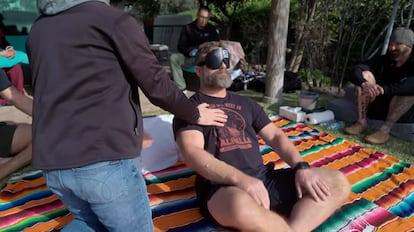
In Tijuana, according to what the documentary shows In Waves and Warpatients are accompanied by a therapist, an emergency doctor and a nurse. The therapy consists of two main steps. On the first day they are given ibogaine, a heart monitor is connected and they enter the psychedelic trance. Capone, he says, carried the blame for the death of Josh, one of his colleagues who perished during a mission in Afghanistan.
“I remember at one point I heard like chainsaws whirring and complete chaos. Like you were being kicked in the balls over and over again with no escape. I saw thousands of photos that went by quickly. From my childhood. From my father. I also saw a vision of Josh happy, smiling. It made me realize that none of that was my fault. I felt a relief, like my brain was being defragmented,” Capone recalls in a fragment of the documentary.
The consumption of ibogaine is complemented by the so-called toad ritualwhich consists of smoking the toxin of this amphibian from the Sonoran Desert, which secretes a milky white poison aimed at deterring predators that contains 5-MeO-DMT. The main use they give it in therapy in these centers is through the vaporization of these toxins. “It’s like accessing the ocean of the self. I think it’s very effective in breaking down the psychological barrier between ourselves and everything else. I like to say that the ibogaine exfoliates you from the inside out and then the 5-MeO-DMT gently polishes you,” says Trevor Millar, psychedelic facilitator and co-founder of the Ambio clinic.
Rius is convinced that in Mexico there is not much regulation of different substances that, for him, have a placebo effect. “There are a large number of clinics that promote all types of treatments for cancer, for diseases that have no cure and they give them different substances that sometimes don’t even do anything. They get and put ibogaine as a nutritional or natural supplement. It doesn’t have to go through the Ministry of Health or Cofepris (Federal Commission for the Protection against Health Risks). The legislation is very relaxed in that sense,” he complements.
However, Capone is cautious about the benefits of ibogaine for his PTSD. He admits, in a fragment of the documentary, that his depression comes and goes. He says that we should not carve in stone that “wrong idea” of psychedelics, “that you consume them once and recover forever.” “It opens you up and gives you a new canvas to paint what you want (ibogaine). You need to think about plans, go step by step or you can get worse,” he reflects.
For more updates, visit our homepage: NewsTimesWire