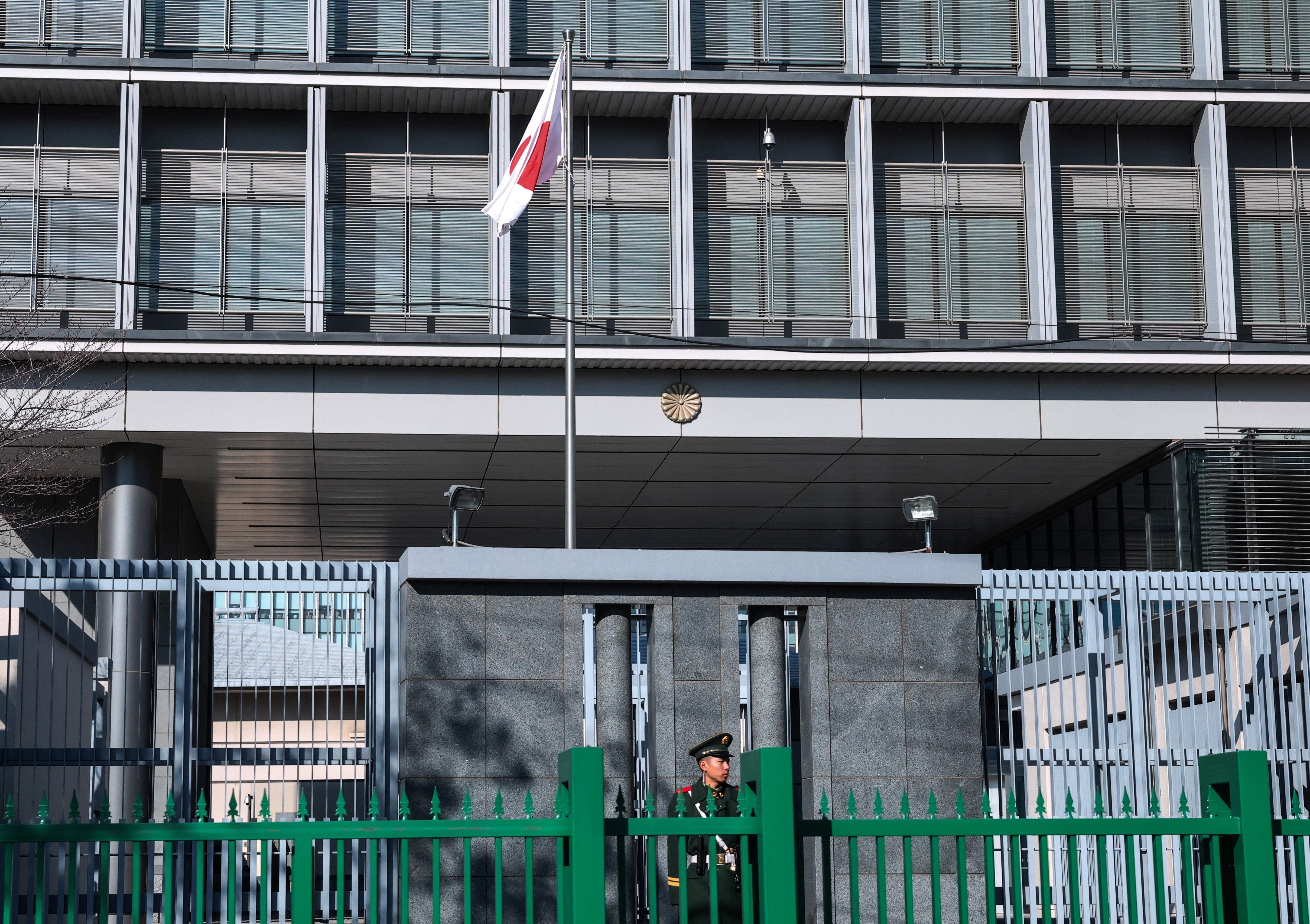
Tensions between China and Japan due to comments by the new Japanese prime minister, the ultranationalist Sanae Takaichi, about Taiwan continue to escalate, burning hectares of the fragile diplomacy between Beijing and Tokyo. Faced with the risk that the dispute goes beyond the verbal terrain, and that it becomes even darker, the Japanese Embassy in Beijing issued a security notice to its citizens in China on Monday, asking them to be careful on the street.
“Following recent local media coverage of relations between Japan and China,” reads the notice posted on the embassy website, “when leaving, we ask that you be very aware of your surroundings, including the presence of suspicious people, and do everything possible to ensure your safety when traveling in groups.” The note calls for “additional precautions” to be taken if traveling with children; It asks that you avoid crowded public spaces and “areas frequented by Japanese”, and that you leave the area immediately if you detect “suspicious” people or groups.
With the thermometer of bilateral tension at red hot, and the nationalist rhetoric inflamed on social networks and Chinese media, it is impossible not to read the warning keeping in mind other attacks that Japanese residents in China have suffered in recent times. Last year, a 10-year-old Japanese boy living in the Asian giant was murdered by a Chinese citizen while he was going to school. The stabbing took place during the anniversary of the so-called September 18 incident, which began the Japanese invasion of Manchuria in 1931 and opened the door to the subsequent Sino-Japanese war.
The notice comes after ten days of tensions between China and Japan. The spark has its origin in a response from Takaichi in parliament on November 7, in which he assured that a possible attempt by China to block or seize Taiwan could pose “an existential threat” to his country, justifying the deployment of the Japanese Self-Defense Forces.
Although Takaichi assured that his government’s position had not changed, that his comment was nothing new, the statement came as a blow in Beijing. China considers the self-governed island of Taiwan a true red line of its foreign policy: a rebellious province, an inalienable part of its territory, and for whose reunification it has never renounced the use of armed force, despite the fact that Taipei has military support from the United States. At the same time, Taiwan is located just over 100 kilometers from Japanese territory and is located on vital sea routes for Japan.
Beijing, which has criticized Takaichi for “severely damaging bilateral relations and challenging the post-war international order,” last Friday recalled Japan’s ambassador in Beijing for consultations, announced live-fire military maneuvers in the Yellow Sea for Monday, and on Sunday carried out coast guard patrols near some disputed islands administered by Tokyo.
In an attempt to calm things down, the Japanese Government sent Masaaki Kanai, director general of the Asian and Oceanian Affairs Office of the Japanese Ministry of Foreign Affairs, to Beijing this week. The senior official met this Tuesday with his Chinese counterpart, Liu Jinsong, although no details of the meeting have been revealed at this time.
Meanwhile, the struggle transcends the diplomatic, descends into daily life, and reveals a serious situation. Among other things, the Tokyo-Beijing Forum, a meeting between academics from both sides that was scheduled for this weekend, has been postponed. And tourism has suffered since last week, the Chinese Foreign Ministry asked its citizens to avoid traveling to Japan “due to the deterioration of the security environment.”
Cancellations
Chinese airlines recorded around 491,000 cancellations of tickets to Japan between Saturday and Monday, almost a third of total reservations, according to an aviation analyst cited by the Hong Kong newspaper South China Morning Post.
The Japanese agency Kyodo has reported that several of the large Chinese travel companies have suspended the sale of tourist packages to Japan, and sources in the sector added that all products related to trips to this country (whose market is largely fed by Chinese tourists, the first nation of origin) have been on pause since the 16th, due to the situation between the two countries.
The dispute has reached the movie screens, with the postponement of the release of Japanese films in China Crayon Shin-chan the Movie: Super Hot!, Scorching Kasukabe Dancers and Cells at Work!as collected Global Times, linked to the Chinese Communist Party. “The adjustment is a prudent decision made after a thorough evaluation of the market performance of imported Japanese films and the opinion of the Chinese public, as reported by film importers and distributors to the media,” says the aforementioned newspaper.
The current struggle is fueled by historical misgivings, unhealed wounds from the past, unresolved territorial disputes and a renewed arms race. Relations have never really healed since the end of World War II, which in China is known as Japan’s surrender in the Second Sino-Japanese War (1937-1945). Beijing marked the 80th anniversary in September with a parade of biblical proportions and an intense campaign on the “correct view of history.”
It was foreseeable that the clash between both countries would come at some point with the new head of the Japanese Executive at the helm. It may have happened sooner than expected. Takaichi, with a strong patriotic inclination and inclination to break the pacifist ties to the Army in the country’s Constitution, promised as soon as he took office, at the end of October, to accelerate the expansion of military spending to reach 2% of GDP next year and not in 2027.
The first woman to govern Japan also considers herself a disciple of the murdered former Japanese Prime Minister, Shinzo Abe, also of nationalist nature, and under whose mandate the diplomatic seams between Beijing and Tokyo creaked as they were stretched to the limit. Abe even made similar comments in 2021, unleashing the anger of the People’s Republic, although by then he was no longer leading the country.
For more updates, visit our homepage: NewsTimesWire