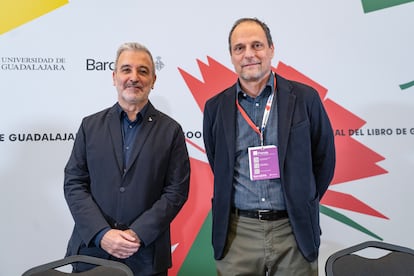
The mayor of Barcelona, Jaume Collboni, and the director of EL PAÍS, Jan Martínez Ahrens, spoke this Saturday on the opening day of the Guadalajara International Book Fair (FIL) about the ties between the Catalan city and Latin America. “Barcelona has always had a strong vocation as a bridge with Latin America, for historical reasons, for reasons of migrations that have occurred from one place to the other and in different stages. The bond is very deep,” Collboni summarized in a talk that revolved around readings, personal anecdotes, politics, gentrification, shared cultural wealth and the controversy over the colonial heritage in Mexico. “It is very exciting to see how a fair focused on books can mobilize so many feelings, so many people and so much economic activity as they do in Guadalajara,” said Collboni.
It is the third time that the mayor of Barcelona travel to Mexico. He had previously visited the country at the invitation of a friend to be his son’s godfather at a baptism. Then he returned as a tourist, but he confesses that he intends to return in the future. “It is a fantastic country, with which I am in love,” he said. Collboni stated that the idea of joining the FIL was conceived several years ago while he was working at the City Council, and before taking office as mayor of the city.
Martínez Ahrens delved into the reflection on that cultural and social bridge between both shores, starting with the boom Latin American, which in the sixties and seventies brought to Barcelona the great names of regional literature who wrote, edited and created some of their great works while living in the city. Collboni wanted to mark the temporal distance with the literary movement and insisted on the importance of presenting the ins and outs of contemporary Barcelona at the fair.
The director of EL PAÍS took the opportunity to ask the mayor about the current political tensions in the Catalan capital. Regarding the hangover from the independence process, Collboni stated that this “has conditioned political and cultural history” and that he detects “a certain release of energy” since the issue has ceased to be central in the conversation. However, he also recognized that the tensions between Spain and Catalonia “are not going to disappear, another thing is how the debate is formulated,” said the mayor, who also stressed that his position, like that of his party, the Catalan Socialist Party, is a federal model.
With respect to the Catalan language, a cause of concern in Barcelona due to its continued decline, the mayor highlighted as a success the fact that the number of authors translated from Catalan has continued to increase at the FIL. “We are a minority language that coexists with a great language and in that sense we have to make an extra effort from the public powers to protect and promote books in Catalan,” said Collboni, who listed the books he is reading, in both languages. “The one I am reading, which my bookseller has recommended to me, is Pedro Paramo, which I confess I had not read (…) Also The madman of God at the end of the worldby Javier Cercas and “Un cor furtiu: Life of Josep Pla, and The Battles of Barcelona, by Jordi Amat.”
Martínez Ahrens also drew parallels between the conflicts related to gentrification in Barcelona, Mexico City and even, more recently, Guadalajara, host of the FIL. In the Catalan capital, the unrest over tourism and real estate speculation has unleashed significant social discontent and political concern about ways to solve a problem that seems to be getting worse.
Collboni spoke of “the defense of the right to stay in cities,” and outlined specific policies such as intervention in rental prices, the ban on tourist apartments — “in 2028 there will be zero,” he assured — or the promotion of protected housing. “Gentrification is not irreversible, it is not the law of gravity, otherwise we are giving up the right to decide about our lives.” Asked about the pressures from companies like Airbnb, Collboni said that “there are oligopolies that determine the way of living in the city, and it doesn’t have to be that way, that’s what democracy is for.”
In addition to political and social issues that worry on both sides of the Atlantic, the conversation also touched on the issue of reconciliation between Spain and Mexico and the approaches that have been made in relation to the conquest and the request for forgiveness.
In this regard, Collboni pointed out: “I think there has to be a recognition of the injustice, which is colonialism in general, and a recognition and empathy with the pain that could have been caused to the people who inhabited these lands before the arrival of the Spanish. And I think that doing it normally is also recognizing the chiaroscuros of history. I am very happy that this measured diplomatic approach has occurred, but very appropriate to walk together in that reunion that must occur.”
For more updates, visit our homepage: NewsTimesWire