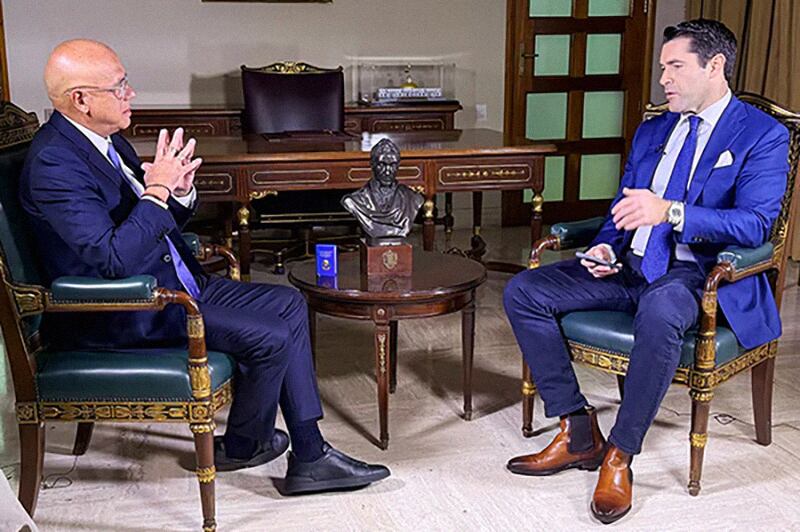
The elections are not a priority issue on the agenda of the Chavista leaders who have been left in charge after the forcible departure from power of Nicolás Maduro, captured by US military forces on January 3. In an interview with the conservative American media Newsmaxthe president of the National Assembly, Jorge Rodríguez, assured that it is not planned to call elections in the short term, since the priority for the Government is to achieve “full stability” which, in his opinion, is the prerequisite for elections. “The only thing I can say is that there will be no elections in this immediate period, when stabilization must be achieved,” Rodríguez said in Rob Schmitt Tonightrecorded this Saturday in Caracas. This is the first interview that a Chavismo leader gives to an international media after Maduro’s capture.
Rodríguez pointed out that, although the electoral process is not closed permanently, its implementation depends on the existence of a solid political agreement. “If progress is made in national stabilization and an agreement on electoral guarantees is finalized, then the elections could occur,” he said. This approach contrasts with what happened in 2023, when the Government and the opposition reached commitments for the presidential elections in the Barbados Agreement that were later breached by Chavismo. The failure of that pact led to a new crisis of legitimacy, marked by allegations of electoral fraud by the opposition.
After the fall of Maduro, the political situation changed, but a huge question arose about when Venezuela would go to the polls again. Delcy Rodríguez was sworn in as acting president on January 5 thanks to an interpretation made by the Supreme Court of Justice, according to which Maduro’s absolute absence has not been declared, but rather his “forced absence.” Under this formula, the Constitution is not being applied, which establishes that elections must be called after a maximum of 180 days of the presidency in charge.
“What we have agreed on at this moment, what we are working on, is what we call the re-institutionalization of the country so that each institution can regain its full power and the full recognition of everyone,” Rodríguez said in the interview.
Most of the conversation Rodríguez had with Schmitt focused on oil and relations with the United States. The journalist traveled to Caracas with Chris Rudy, owner of the Newsmax network and member of the inner circle of friends that Donald Trump meets at Mar-a-Lago. This television network is one of the few media outlets that has had exclusive access to a senior Chavista official in a long time. The Venezuelan Government maintains a veto against international journalists and persecutes journalists critical of its management. The last attempt by an international media to speak with Maduro was from the CBS network, but the regime canceled its participation and expelled the team that had traveled to the country last December.
In this case, Rudy dared to compare the Venezuelan hero Simón Bolívar with the president of the United States, during a small promotional excerpt from the recording broadcast this Monday night. From Caracas Plaza, in front of the equestrian statue of the Liberator Simón Bolívar, Rudy stated: “President Trump, almost miraculously, overthrew a regime. Chávez Maduro’s regime had been entrenched for more than 25 years. Nobody thought we could overthrow it. And he did it without an invasion. With a single military attack. Boom!” In addition, he assured that the “Transitional Government” headed by Delcy Rodríguez was “working very well,” but that “at some point elections will be needed and President Trump is in favor of holding them.”
A week after Maduro’s capture, Trump invited various US energy companies to invest $100 billion to rebuild Venezuela’s oil infrastructure. For this, Caracas has already reciprocated with a modification of the hydrocarbon law that gives generous conditions to the private sector to operate in the country, reversing the process of nationalization of the industry that Chávez began.
“Here in Venezuela, underground, we have the largest oil reserves in the world, but that underground oil is of no use to anyone,” Rodríguez stated during the interview. “We probably also have the largest gold reserves in the world, and we are also among the largest gas reserves in the world. We have a lot of joint work ahead of us. And as President Donald Trump recently mentioned, there is a lot to do. And what we seek is to take advantage of that underground oil and turn it into hospitals, schools and goods for the Venezuelan people,” he added.
For Rodríguez, the relations of the last 25 years with the United States have been “intense” and with ups and downs, but in recent days they have had a “very good understanding.” “Right now we have a golden opportunity,” he said. “In the last 36 days, the situation has advanced very quickly, it has been very intense. But we now have opportunities for mutual respect, for cooperation, to build a situation in which everyone wins, both countries, both peoples,” he said.
For more updates, visit our homepage: NewsTimesWire