The work of North Korean soldiers supporting Russia near the war front with Ukraine has been shrouded in mist and secrecy from the beginning. In a rare intervention, the country’s supreme leader, Kim Jong-un, stated during a speech on Friday that the troops sent to the Russian Kursk region this year carried out demining tasks, according to state media reported this Saturday.
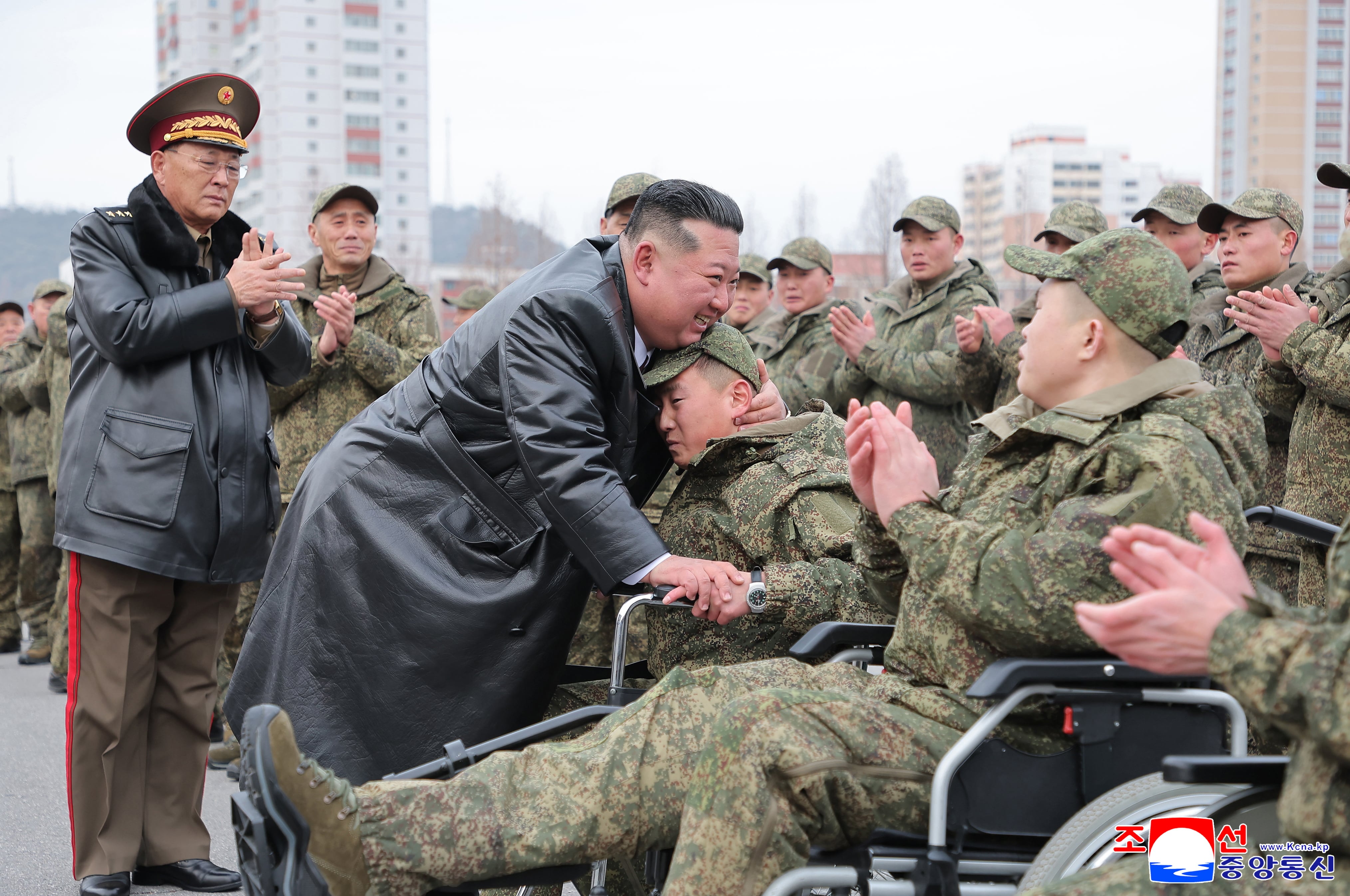
During the welcome ceremony for the return of a unit of Korean People’s Army engineers, Kim acknowledged that he had been impressed, among other things, to learn that they wrote “letters to their hometowns and villages during breaks during demining hours.”
Throughout the mission, which began in August and lasted 120 days, nine members of the unit died, Kim said. In his speech, he stated that he had decided to decorate both the 528th Engineer Regiment and the “fallen combatants” with numerous titles in order to “add eternal splendor to the bravery demonstrated by the unit and its brilliant war feats.”
The images published of the event, held in the square of the April 25 House of Culture, in Pyongyang, show Kim hugging soldiers who are in wheelchairs, while other soldiers applaud around him. In another photograph, he comforts relatives of dead soldiers. A broken-looking man buries his disconsolate face into the leader’s shoulder.
“You fought in a life-or-death situation, facing grave unseen dangers here and there, and your faith and willpower were tested every step of the way,” the leader said in his speech. He thanked them for their efforts to turn the Kursk region — “which your comrades in arms had recovered at the cost of their lives — from “a vast danger zone” to “a safe zone in less than three months.”
It took Pyongyang months to officially recognize its direct participation, with soldiers on the ground, in the war in Ukraine, something that the Western media loudly chanted, citing intelligence agencies from the United States and South Korea. These also consider that the Asian country would be receiving from Moscow, in exchange, financial aid and military technology in the ballistic and nuclear field, in addition to energy supplies. The exchange is especially interesting for what is probably the most secretive nation in the world, diplomatically isolated due to international sanctions imposed over its atomic program.
Some 15,000 North Korean soldiers have deployed there since October last year and around 2,000 have died, according to estimates by South Korean intelligence services. Pyongyang did not confirm the sending of troops until April, although it has never revealed many details about the number of troops or their missions. In July, state media published images of Kim standing in front of coffins draped in North Korean flags, presumably of returning dead soldiers. In August, North Korea held an official ceremony for the first time in its history to honor soldiers who have fought outside its borders.
During a meeting in Beijing last September, Russian President Vladimir Putin “thanked” Kim for the participation of North Korean troops “in the joint fight against modern neo-Nazism,” and stressed that Moscow “will never forget” the casualties suffered by the North Korean army on the Russian Kursk front. The collaboration is the result of almost two years of strategic rapprochement between Moscow and Pyongyang: in June 2024, their leaders sealed an association agreement that includes a mutual defense treaty in case of aggression.
For more updates, visit our homepage: NewsTimesWire