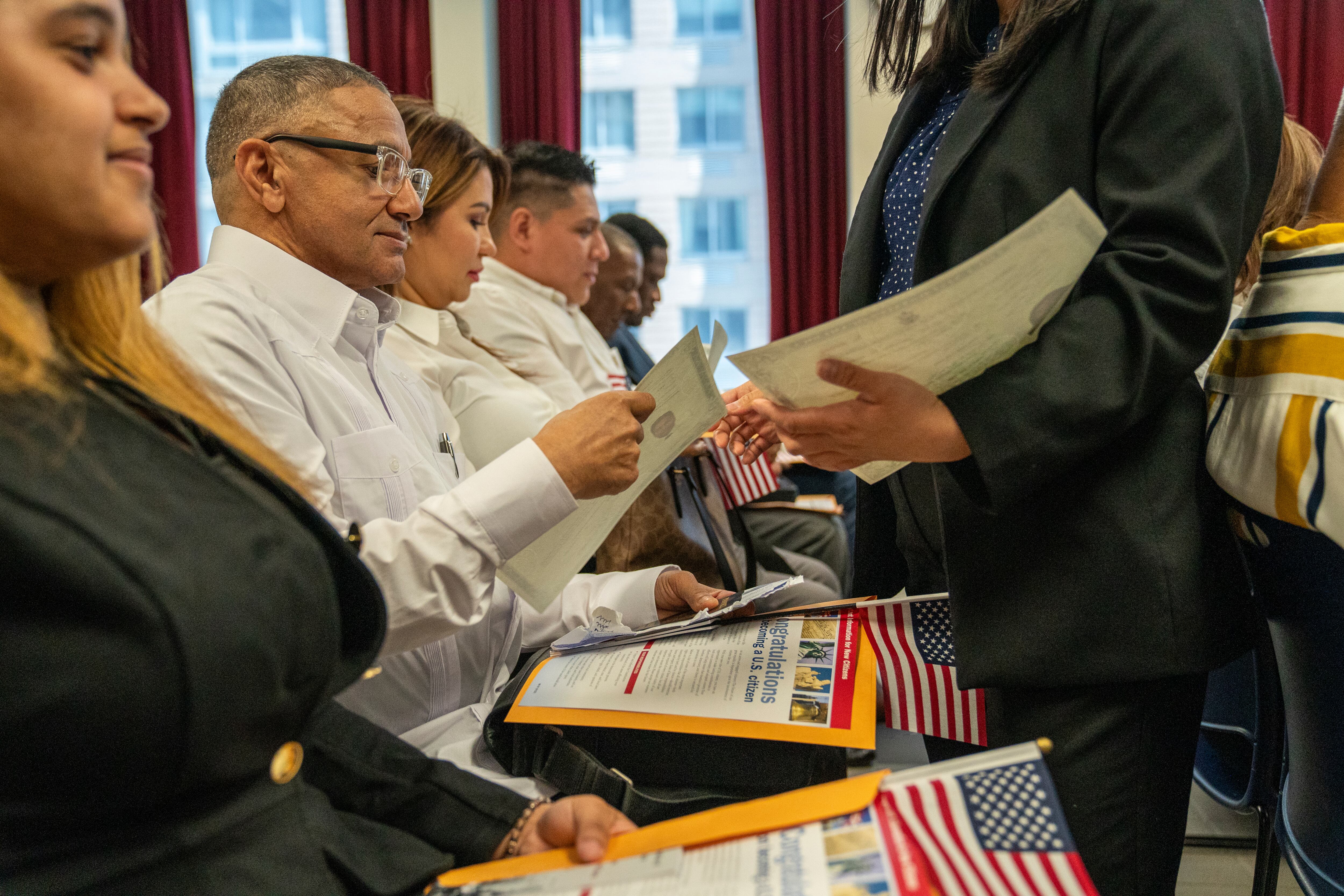
The Trump administration has announced a new and broad immigration policy that orders officials of the United States citizenship and immigration service (USCIS) to thoroughly examine applicants to residence cards, work permits, probation and certain visa. Specifically, the guideline goes in search of indications of opinions or associations “antiestadounidenses” (or “anti -American”) when deciding whether they are granted migratory benefits.
The directive, announced this week, represents a vast expansion of the discretionary authority of the USCIS judges, and has raised concern between legal experts and defenders of migrants, who warn that the definition of the “antiestadounidense” is very vague, and that it could attack against freedom of expression.
What does the new guideline do
According to the USCIS updated policies manual, judges that review the requests for migratory benefits have instructions to weigh any evidence that an applicant has “backed, promoted, supported or defended in any other way antiestado uniestadounidenses ideologies.” This includes the activity on social networks, which has become increasingly a focus of migration research during Trump’s second mandate.
The guide specifies that the anti -American will be considered an “overwhelmingly negative factor” in discretionary cases, even if the applicant meets all legal requirements. This gives the USCIS a wide freedom to deny requests for subjective reasons.
The policy also focuses on associations with terrorist groups and organizations that promote opinions considered anti -Semitic, a concern of the administration due to the public perspective of Israel’s offensive in Gaza. Officials are instructed to make decisions, consider whether a applicant has participated or supported the “anti -Semitic terrorism” or has defended anti -Semitic ideologies.
The USCIS spokesperson, Matthew Tragesser, defended the changes, with the argument that they are necessary to protect the integrity of immigration in the United States. “The benefits of the United States should not be granted to those who despise the country and promote anti -American ideologies,” he said. “The benefits of immigration, including the right to live and work in the United States, are still a privilege, not a right.”
What is “AntiestadoNense”?
One of the most controversial aspects of politics is the lack of a clear definition of what constitutes the “antiestadounidense.” Historically, the United States Immigration Law has prohibited the naturalization of those who defend communism, totalitarianism or violent overthrow of the government. But critics point out that Trump has repeatedly applied the “anti -American” label to describe historians who document slavery, museums who address racial injustice and students who protest against Israel’s military actions in Gaza.
The new standards occur after months of great tension around protests on campus and visas for international students. Earlier this year, thousands of visas for students were revoked or delayed after the State Department implemented new verification protocols on social networks.
Supporters argue that the directive is a measure of sensible protection to prevent hostile people towards the United States from taking advantage of the immigration system. They indicate the growing use of probation programs, expanded under the Biden administration, as an example of policies that, according to Trump officials, have been subject to abuse. USCIS officials will now also review whether probing requests contain “false or fraudulent” information, another factor that could lead to denial.
On the other hand, the defenders of immigration and legal experts have expressed their alarm, and the policy has been compared with the tactics of the “red fear” of the 1950s, during which people who were suspected of having communist affiliations were spoiled and put in black lists.
It is also feared that the expansion of investigation into social networks can punish applicants for their political expressions, including criticism of US government policies. Given the recent efforts of the administration to suppress the proper activism, some are concerned that the directive can disproportionately affect students, academics and activists.
Politics occurs amid Trump’s broader efforts to restrict not only illegal immigration, but also legal. A few days ago, its administration expanded the evaluation of “good moral character” in cases of naturalization.
For more updates, visit our homepage: NewsTimesWire