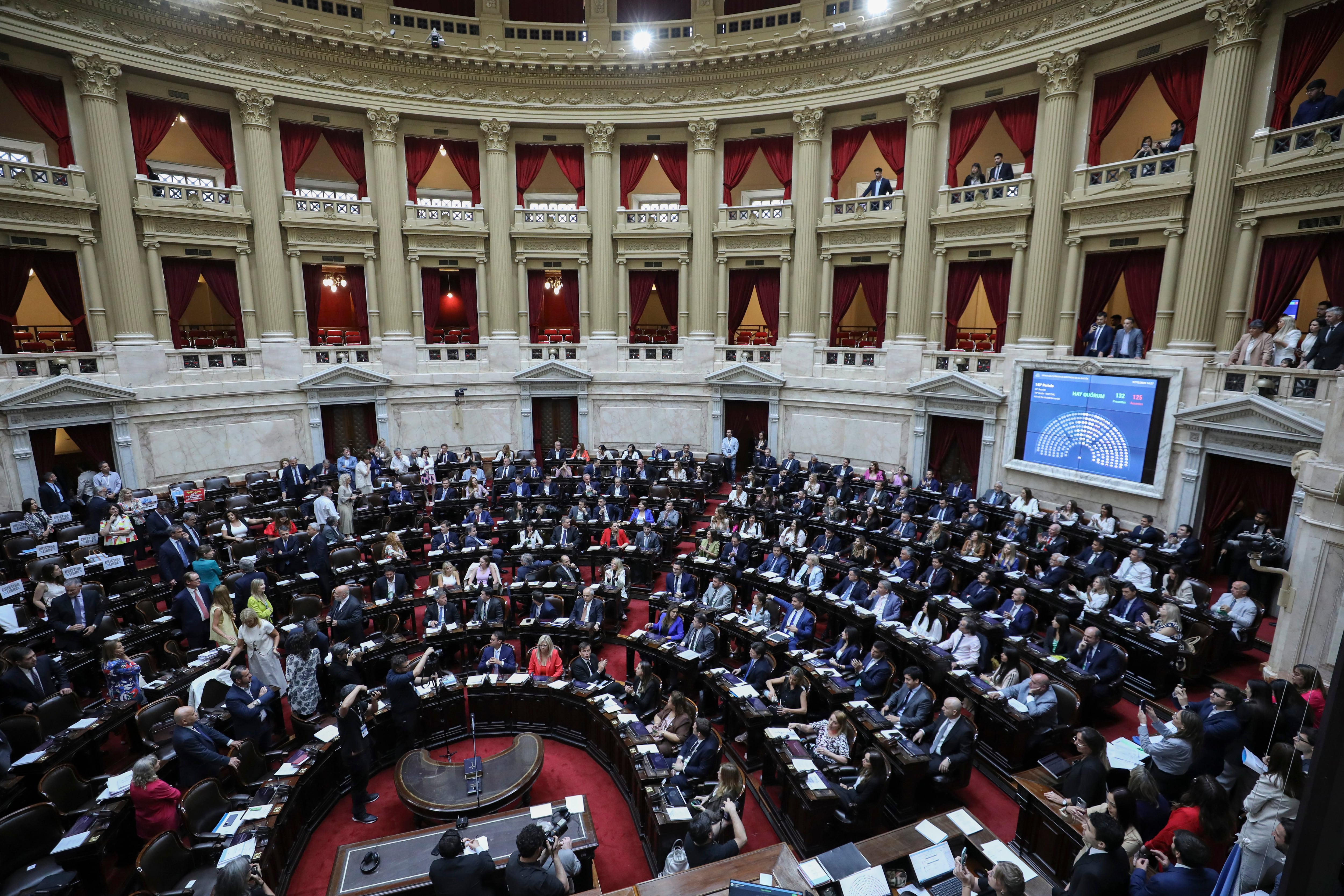
Javier Milei was prepared to begin enjoying the benefits of having won the recent legislative elections. But he couldn’t celebrate. In the debut of its new formation, the Argentine Chamber of Deputies approved in the early hours of this Thursday the budget project for 2026 presented by the far-right Government. His proposal, which must now be dealt with by the Senate, did not obtain enough support to sustain funding cuts to public universities and care for people with disabilities, his big bet of the day.
The budget debate, which lasted more than 12 hours, was the first since Milei took office: until now, the president had chosen not to negotiate with the opposition parties, so he has governed without a budget law, by dint of decrees to allocate and adjust resources. The decision to hold the discussion this time was partly determined by the change in the relationship of legislative forces: in October, La Libertad Avanza —Milei’s party— won with 40% of the votes in the midterm elections and reached the first parliamentary minority. Also influencing were the demands to seek consensus and institutional solidity required by the International Monetary Fund (IMF) and by the Government of Donald Trump, the benefactors who rescued Milei’s economic plan last April and September.
Milei’s budget foresees total expenses of 148 trillion pesos (about 100 billion dollars), with a GDP increase of 5% by 2026 and annual inflation of 10.1%. The Government’s optimistic estimates contrast with the accumulated inflation rate so far this year (27.9%) and with the growth projections predicted by private consulting firms (they expect an expansion of 3.2% of GDP next year).
The allocation of resources that the Government intends implies the continuity of the fiscal adjustment and the reduction of the State that it has been applying for two years. For example, in the area of education and culture it establishes a real decrease in resources of 1% compared to 2025 and almost 48% compared to 2023.
“This budget is the basis on which we will advance the reforms that Argentina needs,” representative Juliana Santillán, from La Libertad Avanza (LLA), defended the initiative at the beginning of the debate. “We limit ourselves so as not to spend more than what is collected, eliminating the monetary issue and, in this way, guaranteeing greater predictability,” Diego Hartfield, also from LLA, added in the same direction.
For the opposition, on the other hand, “this budget is not merely an exercise in fiscal austerity, but it is the political decision to abandon the professions of educating, healing and caring that sustain the social bond in Argentina,” according to Maximiliano Ferraro, of the centrist Civic Coalition. Myriam Bregman, from the Left Front, pointed out that the project “attacks two sectors: women and culture.” Agustín Rossi, from the Kirchnerist bench, questioned the official proposal because “it lacks a look at the real economy. It is impossible to continue governing with our backs to the reality of the Argentines,” he said.
Finally, in the general vote, Milei’s budget received 132 votes in favor, 97 against and 19 abstentions. The conservative PRO party, founded by former president Mauricio Macri (2015-2019), was the main ally of LLA, which also added support from dissident sectors of Peronism and other centrist and provincial forces.
What the Government could not obtain was the support necessary to repeal two laws approved this year at the request of the opposition, then vetoed by the president and then ratified by Congress with special majorities. These are the university financing laws and emergency care for people with disabilities, enacted with the aim of reversing the effects of the presidential chainsaw. The Executive never applied them and now, as part of the budget project, wanted them to be eliminated.
Despite the tense negotiations that lasted until late midnight, with promises of extra funds for various provinces, even minutes before the vote, the chapter of the project that included both repeals was rejected with 123 votes to 117. The opposition celebrated with shouts and applause in the room.
After discussing the budget, the Chamber of Deputies continued debating two other laws promoted by the Government: the law of national commitment for fiscal stability – prohibits the deficit of public accounts and the issuance of money without support – and a reform of the criminal tax regime – to promote the laundering of funds, raise the thresholds from which people and companies can be investigated for tax evasion. The debate will continue in the Senate and the Executive hopes that its initiatives will be converted into law before the end of the year.
For more updates, visit our homepage: NewsTimesWire