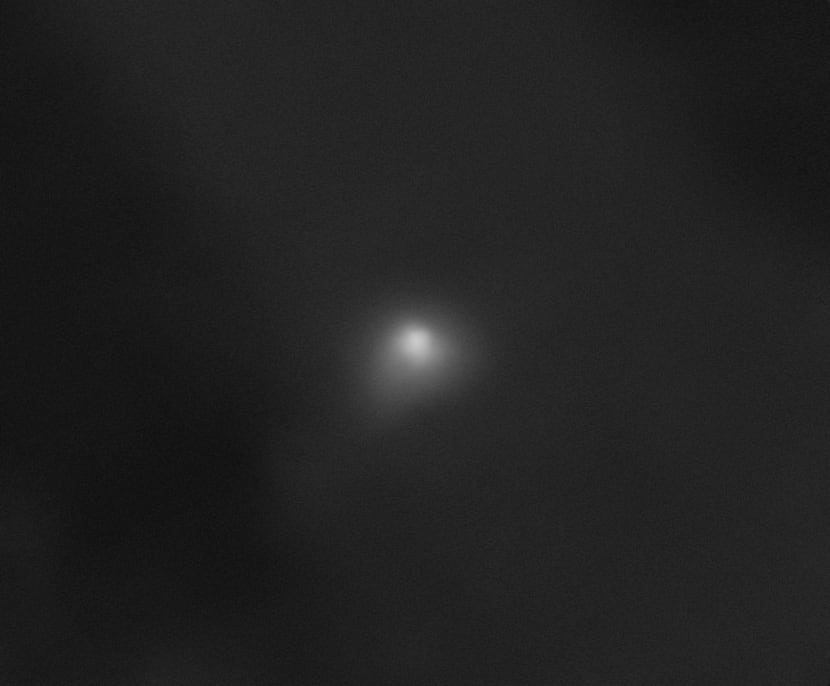
NASA has broken its silence on comet 3I/ATLAS, after more than a month and a half without disseminating information or images. This Wednesday, the US space agency shared its most recent images of the interstellar object, collected by eight of its scientific missions at different points in the solar system. From its observatories on Earth to its probes on Mars, including the space telescope Hubblethe photographs and signals captured and now revealed by NASA help the scientific community have a much better idea of what this unusual and mysterious astronomical object really looks like.
Amit Kshatriya, an associate of the space agency, spoke at the beginning of the press conference – held at NASA’s Goddard Space Flight Center in Maryland (USA) – to allude to rumors of the supposed alien origin of the comet: “This object is a comet. It looks and behaves like a comet, and all the evidence points to it being a comet. But this one has come from outside the solar system, which makes it fascinating, exciting and scientifically very important,” declared Kshatriya, who made it clear that if they had not come out before to deny other explanations, it was because of the recent closure of administrations that, like NASA, depend on the US federal government.
The comet was detected for the first time on July 1, by the Asteroid Terrestrial Impact Latest Alert System (ATLAS), a planetary defense network funded by NASA and made up of five telescopes spread across different points on Earth—one of them located in Spain, specifically on Teide. Its name comes from that warning system and from the fact that it is the third (3) interstellar object (I) detected by humanity within our own space neighborhood, coming from somewhere else in our galaxy, the Milky Way.
The first observations from 3I/ATLAS immediately ruled out that it poses any threat to the Earth: its closest approach will be at more than 273 million kilometers, on December 19, and that is almost twice the distance between our planet and the Sun. Weeks after its discovery, the space telescope Hubble He set his targets on this comet and gave a first estimate of its size: the diameter of its nucleus could be between 320 meters and 5.6 kilometers, which makes it the largest interstellar object seen in our solar system, in addition to being the fastest: it has reached 246,000 kilometers per hour.
Although this comet that is crossing the solar system at full speed has no risk of impacting the Earth – its trajectory and details can be followed in this interactive viewer presented by NASA – it has some peculiarities that have given rise to all kinds of theories about its origin. Last month, Avi Loeb, a physicist at the prestigious Harvard University, hypothesized that 3I/ATLAS was not actually a comet, but rather an alien spacecraft, and that it was approaching the center of our planetary system to, from there, launch probes toward Earth and other planets. That closest approach to the Sun happened on October 29—it passed at about 210 million kilometers—and nothing has changed since then in the behavior of this astronomical object.
Loeb already attributed alien origin to the first interstellar object detected—the asteroid 1I/ʻOumuamua, in 2017—and is a figure with a media impact based more on fueling this type of controversies than on his scientific research on comets and asteroids. The consensus among experts in this field is that their hypotheses are “far-fetched” and the result of mere speculation. But the idea of the alien origin of 3I/ATLAS has found wide echo on social networks, fostered by conspiracy theories that sought solidity in the silence maintained by NASA during the last month and a half, regarding this astronomical object.
However, NASA’s silence has been general and has to do with the recent shutdown of the US Government – the longest in its history, between October 1 and November 12 of this year. In addition to the fact that thousands of public employees did not receive their salaries during that period, another consequence is that the space agency’s social networks have been without any activity during that period, in which the agency has not published new content: neither about comet 3I/ATLAS nor even to celebrate the success of the launch of two twin probes towards Mars, carried out last week by a New Glenn rocket owned by technology magnate Jeff Bezos.
For more updates, visit our homepage: NewsTimesWire