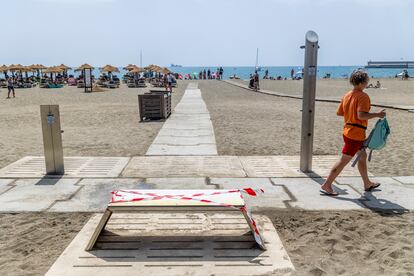
With the thermometer around 23 degrees, a slight fresh breeze and the sea totally calm, La Malagueta beach was a hotbed on Monday morning. The hammock positions did business, the kiosk sold soft drinks and groups of tourists smiled at the Mediterranean. “I prefer to refresh here, the sea is very cold,” said Tim, an American twenty -year -old who fought against heat in the showers on the sand. It was surprised to see them working after the restrictions that left them dry last summer. The capital is not the only municipality. In Mijas, Benalmádena or Torremolinos are also available while the province begins to escape the restrictions and water cuts thanks to the spring rains that have left their reservoirs above 60% of their reserves. It is more than double that a year ago and the main reason to say goodbye to restrictions.
In November, the province of Malaga looked at the sky between night cuts and numerous restrictions. In January no one knew what would happen to summer after five years of few rainfall. And in March the response came in the form of three continued rainfall that the swamps recharged. A month later the drought committee of the Junta de Andalucía relaxed its demands and the Costa del Sol rubs its hands with tourism. The city of Malaga has announced this Monday as the showers will be in service from June 15 (they clarify that those that already work in La Malagueta are those of reduced mobility) and that the Lavapiés will also do, which are already in service. Other municipalities have advanced, such as Benalmádena or Mijas, which already have them ready. “Last year they were all closed, but this year we allowed them,” explains Daniel Teruel, councilor of beaches of the Mijeño City Council. “Everything is regulated with buttons so that only water comes out 15 seconds,” insists the mayor, who does not want it to forget that the drought situation has improved but has not passed.
A side signed by the mayor of Torremolinos, Margarita del Cid, has also served to facilitate the use of the facilities “whenever they have a voltage button” – that is, they only work when the button is being pressed with the aim of saving, a system that all the showers already have. All these municipalities will also open their sources and allow private irrigation and swimming pools. Other populations are thinking about it.
“At the moment there is no decision adopted,” explain from the City Council of Estepona, where they emphasize that the measures “deciding the competent administrations” will be fulfilled for all localities. That solidarity flag is precisely the one that flies in the municipality Rincón de la Victoria, already on the eastern coast. Its region, the axarquía, is the one that is suffering the most drought and, therefore, the City Council wants to talk to the rest of the municipalities in the area to try to make a joint decision. “The intention is to open only Lavapiés, but keep the showers closed. We want to continue raising awareness of the importance of protecting such an important good with water,” municipal sources stand out, which underline that in the next few days there will be a meeting in which decisions will be taken.
For its part, the largest municipality in this coast of the Eastern Sun, Vélez-Málaga, with more than 80,000 inhabitants, works on a project in progress to try to make the showers be supplied with sea water and, for the moment, keeps the closed tap. The decision to open or not “will depend on what the Junta de Andalucía rule,” they say from the Veleño Consistory, which last year at this point suffered long cuts of night water.
Water for agriculture
The measure is a consequence of the opinion of the last drought committee, which practically left without restrictions to the Malaga province, as reported by the Minister of Agriculture, Fisheries, Water and Rural Development, Ramón Fernández Pacheco. The meeting was held at the end of March, but their decisions entered into force last Friday after the publication in the Official Gazette of the Junta de Andalucía (Boja). The text states that the region of the Western Sun Costa returns to the normality situation and that consumption per inhabitant and day is already in 250 liters. The Guadalhorce area, however, is still in moderate shortages and limits 225 liters per person per person.
The axarchy continues to be the worst has the water situation. It remains in severe scarcity (only one step below the emergency) but also allows 225 per person and, in addition, it has increased the irrigation possibilities for the field to the 12.8 hectometers from the Viñuela reservoir, which in just a few months has radically changed its appearance. Agriculture requires more water for its thousands of hectares of subtropical, but the situation is a drastic change because in the last year they could only use three hectometers and in the previous ones, nothing. All this has been possible thanks to the important rains of this spring, which have recharged the swamps up to 62% of their capacity. Today they have 378 reservoir cubic hectometers, more than double just a year ago, according to the data of the Hidrosur Network.
For more updates, visit our homepage: NewsTimesWire