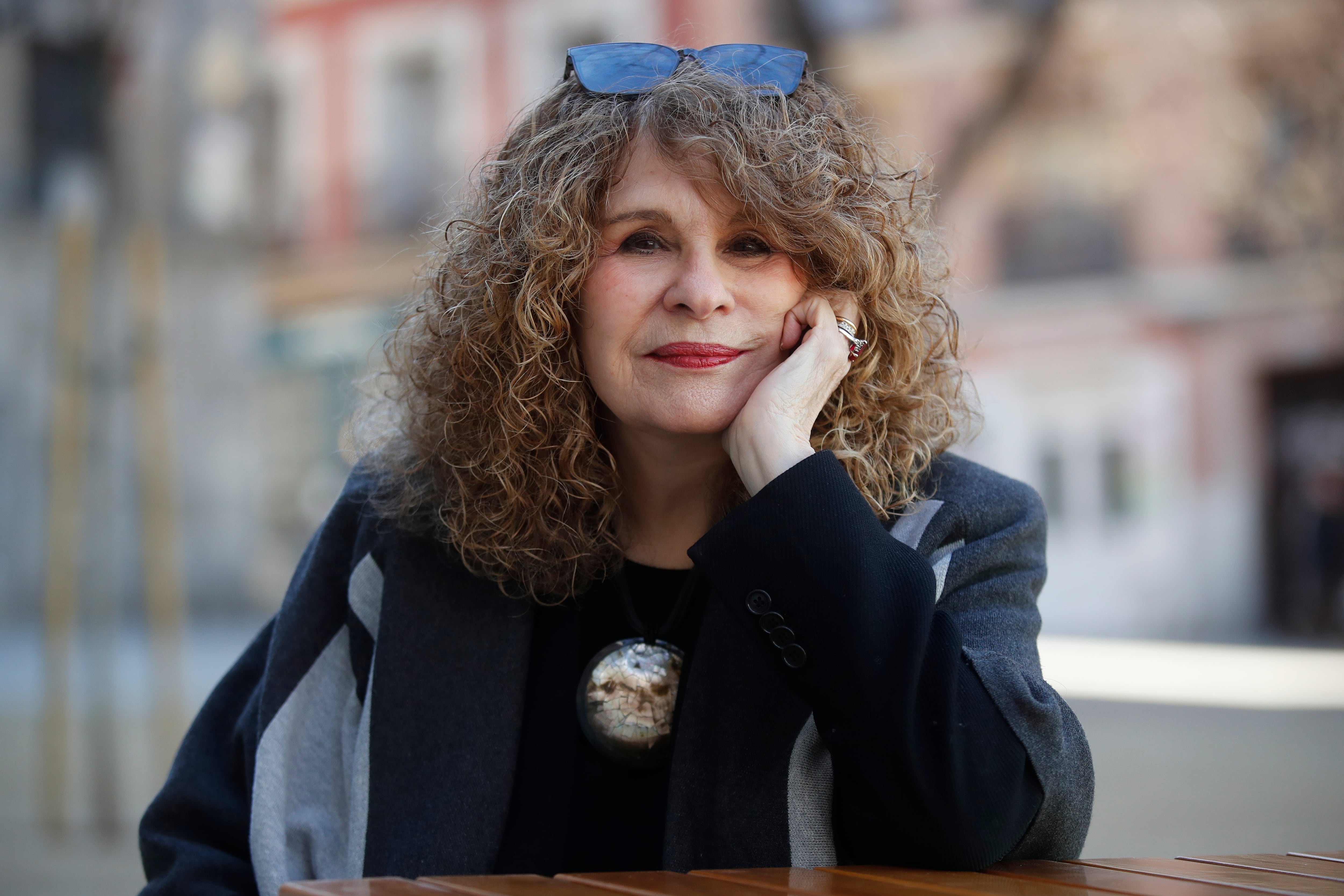
The Nicaraguan writer Gioconda Belli, exiled in Madrid, won this Friday the Carlos Fuentes International Prize for Literary Creation for “her capacity to renew Hispanic American poetry” and “for the strength of her dialogue between society, history and literature through her narrative.” The award is worth $125,000 and was awarded unanimously by the jury. “I feel enormously honored to receive this award because of how much I admire this great writer, an unforgettable friend and one of the eternal figures of Latin American literature,” says Belli in a telephone interview.
The recognition is granted annually by the Ministry of Culture of Mexico and the National Autonomous University (UNAM) to writers who, through their work as a whole, “have enriched the literary heritage of humanity.” Belli says that this award is important to her because of her literary relationship with Fuentes. “One of the brightest highlights of my life as a reader was reading The death of Artemio Cruz. Since that work, his Most transparent region and his essays, I perceived him as someone who would mark my love for the art of writing. Then I met him and as a person I was very impressed by his solid personality, but also close and supportive of Nicaragua and its anti-Somoza struggle,” explains the author of The country under my skinhis memoirs in which he narrates his participation in the guerrilla fight against the Somoza dictatorship and his relationship with Sandinismo.
Born in Nicaragua in 1948, the writer is one of the most prominent authors of current Latin American literature. In 2023 she won the XXXII Reina Sofía Prize for Ibero-American Poetry for “her creative expressiveness, freedom and poetic courage.” His poems appeared for the first time in the cultural weekly The literary press, edited by the newspaper La Prensa, from Managua, one of the media persecuted by the current regime of Daniel Ortega, which confiscated its editorial office. Ortega also cleared Belli of his nationality in 2023, along with a hundred writers, intellectuals, journalists and critical voices, among whom is the writer Sergio Ramírez, Cervantes Prize winner and also exiled in Madrid.
Belli was a member of the Sandinista National Liberation Front (FSLN), the guerrilla that overthrew the dictatorship in 1979. Her position against the Anastasio Somoza regime led her to a first exile in Mexico and Costa Rica between 1975 and 1979. In 1978 she won the Casa de las Américas Prize with the poetry book line of fire. After the triumph of the Revolution he held several positions within the Sandinista government and in the decade of the late eighties he published three copies of poetry: Thunder and rainbows, insurrectionary love and From Eva’s rib. Her poetry explores eroticism, sensuality and the female body.
“You don’t know when you write what it will mean to express at a certain moment what is new. My novelty, I think, was to speak as a woman from the female body and celebrate my sex and my way of seeing the world, no longer as an object, but as the subject of a particular emotional and sensory drive and different from the male gaze that had marked being female,” she explains to this newspaper from Madrid. “Being a woman and celebrating every letter of being one was an act of rebellion,” she says.
The jury of the Carlos Fuentes Prize, composed of the Mexican historian Rodrigo Martínez Baracs, the writer Ana Clavel, Natalia Toledo, the Colombian author Claudia Piñeiro and the Spanish poet Luis García Montero, In her ruling, she highlighted “the link of intimate reflection and shared memory” in the writer’s work. The award was established in memory of the Mexican writer in 2012, the year of his death, and according to its promoters “it recognizes the work of those who, through their letters, enrich universal literature with their poems, novels, essays and stories.” In previous editions, the Mexican writer Elena Poniatowska, the Spanish poet Luis García Montero, the Peruvian writer Mario Vargas Llosa and the Nicaraguan Sergio Ramírez have won it.
The organizers of the award have highlighted that Belli is among the most read Latin American writers in America and Europe. “From his futuristic novel Waslala One million copies have been sold in Germany, 400,000 in Spain and several editions have been made in Latin America,” they recall. Their most recent book is A silence full of murmurs.
The writer not only remains active with her literary production, but also in her political commitment as a critical voice against what she calls the “dictatorship” of Daniel Ortega in Nicaragua. In a recent article published in this newspaper under the title of Nicaragua amputatedwrote: “This new exile has been marked by cruelty. It is impossible to predict whether or not there will be a return, if I will see my house again, which, as I know, is abandoned and little by little devoured by the voracious nature of the tropics. This is the exile of resistance, of committing to life every day and turning adaptation to a new reality into daily triumph.”
For more updates, visit our homepage: NewsTimesWire