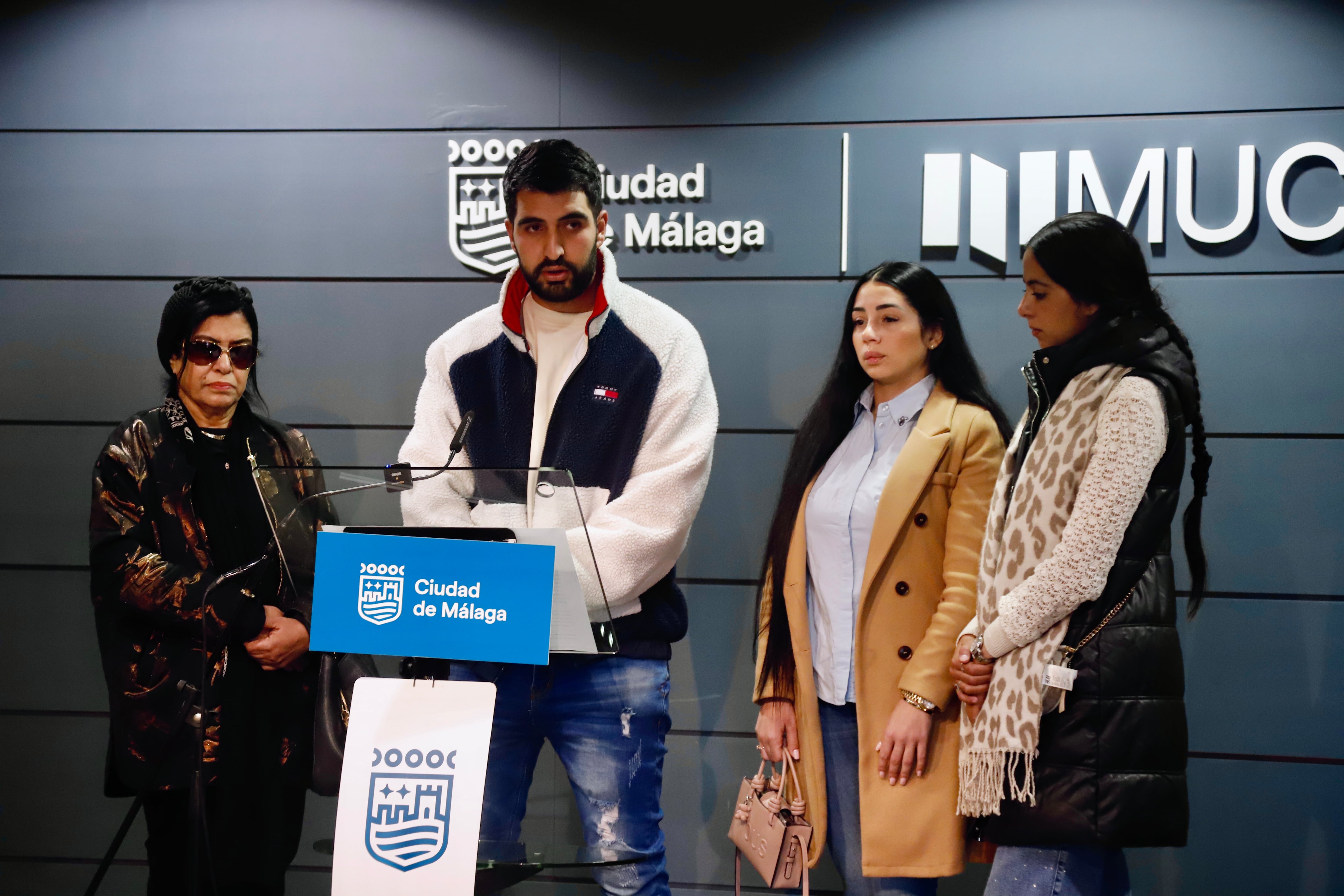
The family of Haitam Mejri, the 35-year-old man who died at the beginning of December during a police intervention in Torremolinos (Málaga, 71,329 inhabitants), has requested a second autopsy of the body to find out the causes of his death. Also, through their legal representation, the relatives of the deceased have requested that the health personnel who treated him in the clinic where he lost his life after being subdued by five members of the National Police and receiving several discharges from Taser guns be summoned as witnesses. Their lawyers, Samuel Tejada and Miriam Rosales, maintain that the images from the establishment’s security camera to which they have had access show that the victim never showed aggression towards the agents and that he obeyed their commands. Also that there was a “disproportionate and excessive use” of force and that this caused his death, hence they believe that the events should be considered intentional homicide.
The death of Haitam, who had lived in Malaga for three decades, occurred after 7:30 p.m. on Sunday, December 7. The man had entered a shop in Torremolinos, supposedly, to ask for a charger because his cell phone had run out of battery. The owner of the parlor saw him nervous and thought he wanted to assault him, so he left the premises and locked the door so he couldn’t leave there. Then he called 112 to report a robbery with violence. Three National Police patrols arrived about 15 minutes later. While one agent stayed at the door so that no one else entered, the other five ended up subduing Haitam and, once on the ground, they shocked him with electric guns so they could handcuff him. Shortly after, he died. Police sources assured that it was due to a cardiorespiratory arrest and that the action was in accordance with the law, but the family maintains that the reason is the aggressiveness and force shown by the police officers. Judicial sources have explained that the court – the case has fallen to the Investigation Section of the Court of Instance number 1 of Torremolinos, which opened ex officio proceedings – “is pending forensic reports that determine the cause of death.”
“Our only objective is the complete, objective and transparent clarification of the circumstances surrounding Haitam’s death,” the deceased’s brother, Nasser Mejri, said this Thursday during an intervention in which he wanted to summarize the feelings of his family. Together with his mother, Amina, he has insisted that the video – which shows from the moment the victim entered the parlor until he leaves, already dead – rules out the existence of an alleged robbery (because although there were bills on the table and the cash register was open, he never touched the money) and that the scissors that the man had in his hands – stationery scissors with a rounded tip – were previously inside the premises and he dropped them as soon as the police asked him to; also that there was no aggression towards the agents. “It is difficult to maintain trust in certain institutions that have made an effort to convey to public opinion a version of the events that is significantly different from that reflected in the images,” Nasser highlighted.
New errands and more images
So far only some videos released by witnesses have been made public. They last just a few seconds and are cut off, which prevents us from knowing the complete sequence from Haitam’s arrival to the police intervention. The family’s lawyers already have them in full and, although they have provided them to the media out of caution in the face of the open judicial process, they firmly maintain that the death is due to “more causes” than the cramps received with the Taser guns. They report that the man was subdued and, later, received several shocks with electric weapons and received a “disproportionate use” of force by the police. “The images rule out reckless behavior on the part of the police. This means that they knew there was a risk and that they still used means that could cause death. They have removed the risk and moved on,” said Samuel Tejada.
The lawyer emphasizes that among the procedures requested on his part is a second autopsy to add to the results of the first, which at the moment only highlight that the death is violent, but without explaining the cause. These steps seek to “prove that there has been a homicide and that it has been caused by excessive force.” Also, they claim, they would have requested the images of the recording devices that the Taser guns have built in—which begin recording as soon as the weapons are activated—but that the judge handling the case has already requested them. And they trust that the agents who carried cameras on their chests will also provide the images, although they believe that “perhaps” they will not do so because they are private devices paid for by the agents themselves and not by the National Police.
Both the family and the lawyers have requested an apology and a “public retraction” from those who have stated these days “that it was a robbery, that the deceased acted aggressively or that they have spread comments related to alleged antecedents.” Beyond the National Police itself, which considers that the actions of the agents are “subject to law,” according to sources from the force, several police organizations have defended the work of the police vehemently in recent days. From the Unified Police Union (SUP) they defined Haitam as a “criminal”, while, from Jupol, they maintained: “All our support to the colleagues who intervened against a very aggressive subject who greeted them shouting Allah is great wielding scissors.” The spokesperson for this union, Laura García, said in South Channel that Haitam “was completely out of his mind” and that the Taser guns were used directly on the detainee’s body, once on the leg and twice on the arms, something “incompatible with a death,” but they have not provided the images either. “The peace of mind we have is that everything is recorded completely without any cuts,” highlighted the Jupol representative. The same one that the family has, which defends a completely different position. “We have to wait” for the court’s investigation, judicial sources maintain.
For more updates, visit our homepage: NewsTimesWire