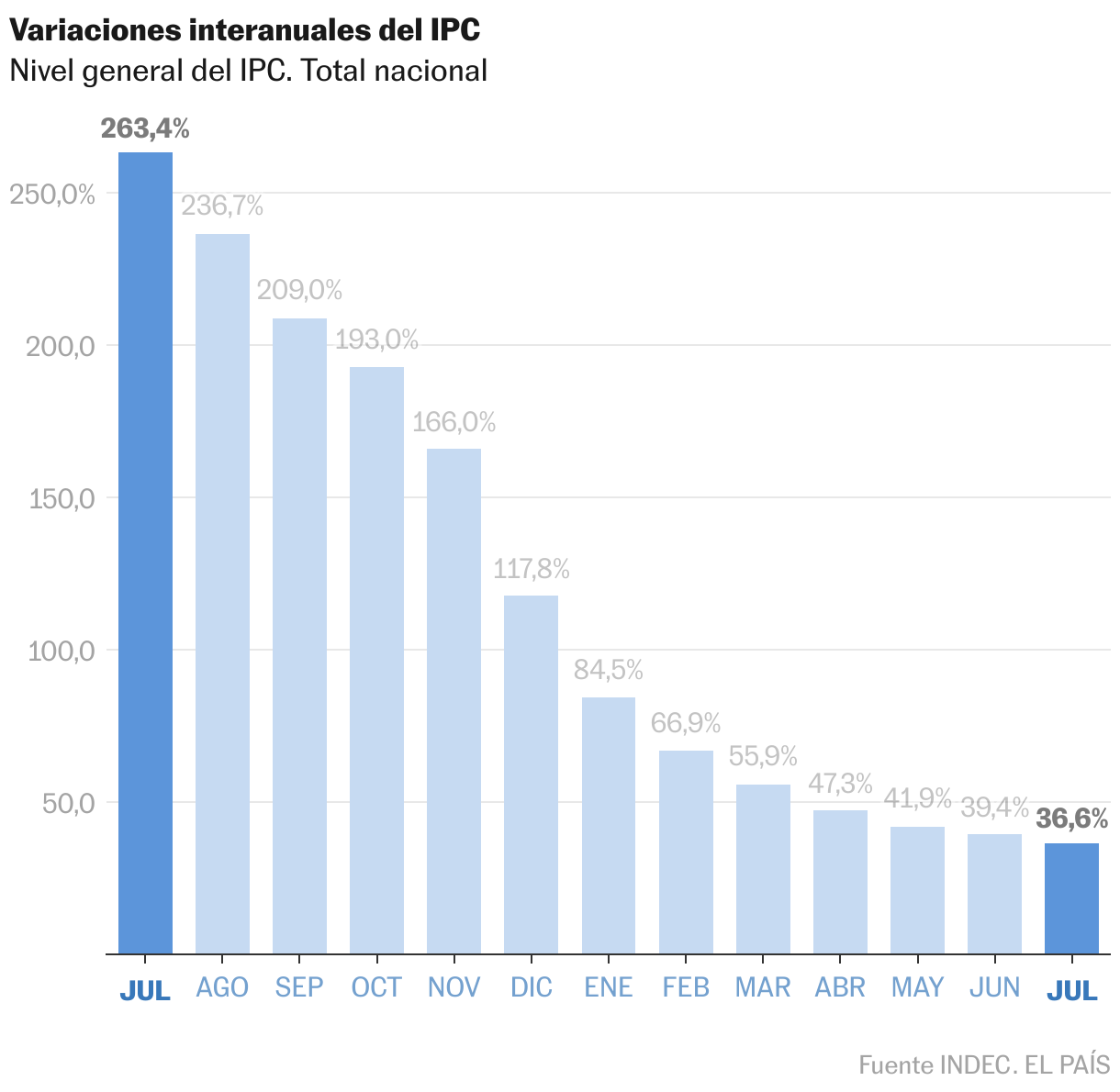
Inflation registered a small increase in Argentina, but the government of Javier Milei celebrated that it remained below two monthly points. The National Statistics Institute (INDEC) reported that in July the consumer price index was 1.9%, above the June (1,6) and May (1,5) values.
While the data allows the ultra -rightist president to continue exhibiting the fall in inflation as his main management achievement, he latent doubts about the impact that the last devaluation of the peso against the dollar will have in prices, whose local price shot himself despite the battery of government measures to contain the currency. The doubts will be clear only within a month, when the August inflation is known
The INDEC released report on Wednesday points out that, so far this year, the inflationary index reaches 17.3%, while in the interannual comparison accumulates an increase of 36.6%. During the month of July, the item that registered the highest rise was recreation and culture (with 4.8%); followed by transport (2.8), restaurants and hotels (2.8), communication (2,3) and goods and services (2,1). At the other extreme, the clothing and footwear sector showed deflation, with a price decline of -0.9%.
Milei’s celebration emphasized the result of core inflation, which measures values without seasonality or regulated prices. “The nucleus in 1.5%… !!!”, wrote on its social networks and, as usual, thanked Luis Caputo, “for being the best Minister of Economy in History by far!” Then, he justified the price increases for the “seasonal effect” and “the bill of the resaka kuka”, derogatory allusion to the Peronist government that concluded in December 2023.
Minister Caputo, on the other hand, chose to emphasize that monthly inflation was below 2% for the third consecutive month, that core inflation “was the lowest since January 2018” and that the interannual variation of the CPI already registers “fifteen consecutive months of deceleration.”
The INDEC data confirmed that, for the moment, the fall of the local currency before the dollar did not have correlation in the price index. During July, the price of the American currency increased by 14% in pesos. It was the first abrupt movement since, in April, together with the arrival of a rescue of the International Monetary Fund for 20,000 million dollars, the government partially lifted the restrictions in the change market (the so -called “CEPO”) and established a flotation regime between bands (between 1,000 and 1,400 pesos per dollar).
From that moment, Milei opted to bring the price of the currency to the lower band. But the apparent initial success vanished in recent weeks and the dollar exceeded 1,300 pesos. The Government accused banks of making speculative maneuvers and applied various measures to reduce liquidity and block the peso overturn to the dollar, such as debt tenders, the rise in bank lace and the sale of future dollar contracts.
For now, the Ultra Administration seems to have achieved its goal, but for that it had to validate high interest rates. In the public title tender on Wednesday, the annual effective internal rate (TIRA) reached 69.2%. Even so, the treasure could only renew two thirds of the planned maturities. The anxiety of financial markets has not dissipated.
Only within a month, with the August data, it will begin to be known if the devaluation of the weight hit prices and if the raptor rise fierce further to the Argentine economy, still affected by Milei’s monetary and fiscal adjustment. The result will be key to the president, which in September will be tried in the legislative elections of Buenos Aires and, a month later, in nationals.
For more updates, visit our homepage: NewsTimesWire