The president of the United States, Donald Trump, has tried to influence the result of this Sunday’s elections in Honduras by giving his support to the conservative candidate Nasry Titus Asfura, from the National Party. The president’s statements, which he described as “communists” (a word that in a conservative country like this has echoes of fear in some sectors, such as businessmen) to the other two candidates – Rixi Moncada, of the ruling Libre, and Salvador Nasralla, of the Liberal Party – have added more noise to a very polarized process, with accusations of fraud by the three candidates, who according to the polls, attend the vote with equal chances of victory.
The vote has begun without major incidents. The vote receiving boards opened at seven in the morning and the three candidates attended their voting centers early on with the call for active participation of the electorate, which must also elect the 128 members of parliament and the authorities of the 298 municipalities of the country. President Xiomara Castro voted at noon with her husband, former president Manuel Zelaya. “We have already begun a refoundation process in the country and that is what is important,” Castro told the press after casting his vote. “These elections are so important for our democracy. What the people deserve is peace and tranquility, attending the polls freely and being able to vote,” added the president.
Trump has also tried to influence this election with the surprise announcement made on Friday that he intends to pardon former President Juan Orlando Hernández, known as JOH, who is serving a 45-year prison sentence for his ties to drug trafficking. Hernández is a repudiated figure in Honduras, where in addition to his links with drug trafficking, he is accused of terrible government management, poor management of the health crisis generated by the covid-19 pandemic and embezzlement of close to 200 million dollars to social security. Asfura, however, has ridden the Trump wave and has no qualms about presenting himself as Washington’s candidate. On the social network X, where he calls by his nickname, Daddy on orderpublishes montages alongside the New York tycoon. “The pardon is a power of the president of the United States. For the family, the pardon leaves their sadness behind and allows them to recover the tranquility and happiness they deserve,” Asfura justified Trump’s decision on JOH.
Castro also referred to this decision of the US president and downplayed its importance. “What really counts is the sovereignty of the people and the importance of it being expressed today, that is what has weight above all,” he said. Zelaya expressed himself about Trump’s promise, but with more sarcasm. When asked about the American’s statements, he said: “I’m not worried at all. I thought he (Hernández) was going to come to vote today. Tell him that the people are waiting for him here to defeat him again.”
Another representative of conservative radicalism in America who has openly shown his support for Asfura is Javier Milei, who in the same X network said that “he is the candidate who best represents the opposition to the left-wing tyrants who destroyed Honduras.” It remains to be seen this Sunday whether this support gives enough oxygen to the National Party candidate, whom polls have so far placed below Nasralla and Moncada.
“The people of Honduras, especially after the 2009 coup d’état, increasingly reject interventionism in the United States. Sometimes it is thought that when the United States gives a winning candidate, that is the one everyone should vote for, but now there is a rejection and many think that, if the United States supports a candidate, the vote can go for the opposite candidate,” says Lucía Vijil, coordinator of Electoral Observation, of the Center for Studies for Democracy (Cespad).
Massive participation
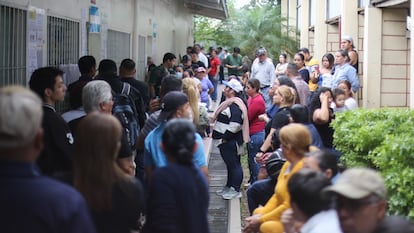
During Sunday morning there was a massive participation in voting centers visited in Tegucigalpa. Jair Rico, 22, worked as a custodian for the ruling Libre party at this voting board, in charge of ensuring the correct delivery of the electoral suitcases and ensuring that everything passed without incident, including the counting of the votes. “At the beginning we had some small interruptions with the biometric system, since the National Electoral Council system was a little slow, because they were entering data everywhere, but it could be resolved,” Rico said in relation to the devices that capture the fingerprints of people registered to vote. “Participation has been fluid, people come more in the morning,” he commented.
Nicolás Carrasco was one of those voters. He went with his wife to this center with the relief that the morning was passing calmly after a very polarized electoral campaign and constant attacks from the candidates to preside over the Government. “The candidates, instead of dedicating themselves to making proposals, also insulted each other, brought out everything bad and ugly,” he said. Carrasco went to the vote with one concern on his mind: the rampant corruption that eats away at this Central American country. “The people wanted the CICIH to be established, it was one of our priorities, because there is a lot of corruption, everything is very contaminated,” he stated in reference to the international anti-corruption commission, which is moving at a snail’s pace. It was a promise that President Castro leaves unfinished. In fact, the president resigned this Sunday after voting: “I want to be very clear with the media. Everything that was in my hands for the CICIH to come to our country, we brought here,” she said.
Honduras is also voting under the state of emergency that President Castro has imposed as an extreme measure to combat the violence that ravages the country, where gangs and drug trafficking networks exercise extensive control. Human rights organizations and local observers had asked the Government to relax the rule, because they fear that the presence of the military at voting stations would persuade the electorate. At the Peru school in Tegucigalpa, Luis Fuentes, an electoral observer from the Network for the Defense of Democracy, reprimanded the military at a checkpoint installed at the entrance to this voting center for not allowing voters to enter the premises. “I have observed five presidential elections and there has never been a military checkpoint to enter a school. The classrooms where voting is done are empty, but people are outside, under the sun, because the military has been there. That doesn’t seem right to me, it is counterproductive,” said Fuentes. The military allowed voters to enter, but the observer said their presence intimidated voters. “So much has been said in these elections that you have to be careful, use gloves to handle them cleanly, that there are no misunderstandings and the presence of the military generates this type of problems,” he explained.

The Honduras that the next president will inherit
Trump’s messages have mobilized the campaigns more, with the three candidates trying to take advantage of the Republican’s words. On Friday night, Nasralla offered a message to the country dressed in a t-shirt with the legend “JOH never again.” He recalled the former president’s links with drug trafficking and reinforced his speech as a candidate for change and against the corruption of the elites that eats away at this Central American country. Polls give him a slight advantage against his main rival, Rixi Moncada.
Beyond the noise coming from Washington, what is at stake in these elections is the continuity of the leftist model of President Xiomara Castro’s government or a more conservative turn, represented by both Nasralla and Asfura. Castro broke with a decade of conservative governments closely associated with the interests of business elites (in Honduras it is said that “ten families” control the country) and increased social spending and public investment during his mandate. “Under his Administration, the economy has grown moderately and poverty and inequality have decreased, although both remain high,” states a report from the Center for Economic and Policy Research, a progressive organization based in Washington.
This organization also highlights Castro’s pragmatism. “Despite being labeled “communist” by opposition figures and some American Republicans, the Castro government has maintained an International Monetary Fund (IMF) program during its tenure and has received praise from the IMF for its prudent fiscal management,” the report states. Castro also managed to reinsert Honduras into the so-called Millennium Challenge Account, an initiative created by the United States in 2024 to reduce extreme poverty in the world.
In addition to poverty and corruption, one of the president’s greatest challenges has been to confront the high crime rate that bleeds the country and, to do so, she has had to take controversial, heavy-handed measures. Honduras votes this Sunday in a state of exception imposed by Castro to try to control areas drowned by the violence of the gangs that control large territories and the relentless advance of organized crime. The measure, similar to that of Nayib Bukele in El Salvador, has raised alarm among human rights organizations due to the broad powers that the president has given to the Army: suspending constitutional guarantees such as freedom of movement and association, searches and arrests without a court order with the aim of facilitating the investigation of crimes. “The homicide rate has also fallen to its lowest level in recent history, but violence persists. Human rights groups have criticized Castro for maintaining a prolonged state of emergency in some parts of Honduras and for continuing his predecessor’s militarized police policy,” the CEPR report highlights.
Sunday’s election will be observed by more than 43 national and 25 international organizations, including a large deployment of observers from the Organization of American States (OAS), which has asked electoral authorities to guarantee adequate conditions for a fair election, following claims of fraud by the three main candidates. Moncada and his team have shown distrust in the so-called TREP, the system for transmitting preliminary results, which must present the first vote counts before midnight on Sunday. The Army, to which Castro has given more powers in this election—including ensuring the transmission and safeguarding of the results sheets—reported on Friday that it will not recognize any result other than the recount of the results made by the Electoral Council, a decision that generates nervousness among the opponents.
It is in this context full of uncertainty that the next years of Government in Honduras are decided, a country of 11 million inhabitants hit by poverty, natural disasters such as the infernal Hurricane Iota, unbridled violence and rampant corruption. The small country of 112,000 square kilometers is also one of the most vulnerable to climate change and the most dangerous for environmentalists. An issue, climate change, that has been overlooked by those who this Sunday aspire to take the reins of the Central American nation.
For more updates, visit our homepage: NewsTimesWire