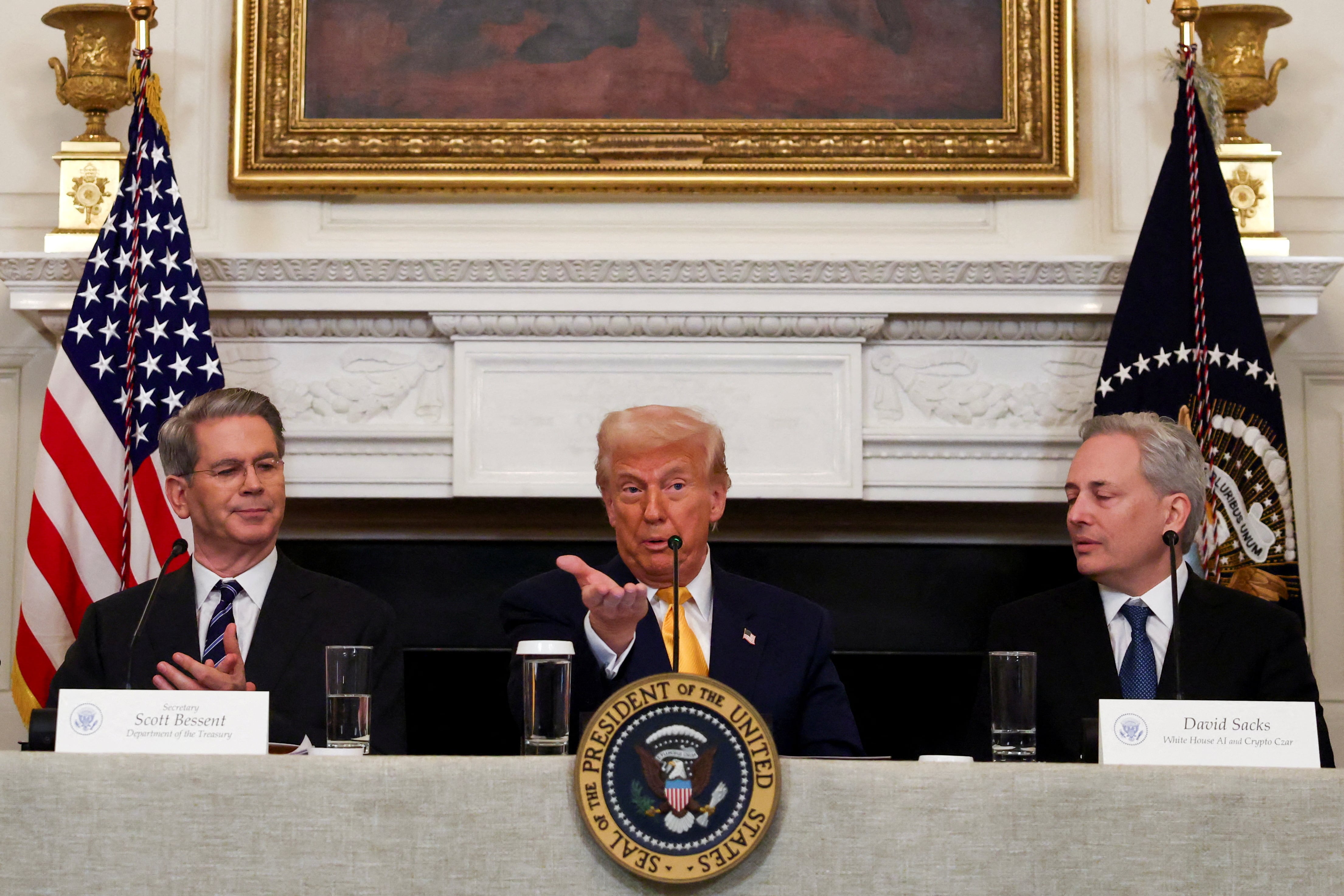
On February 4, just two weeks after the second inauguration of US President Donald Trump, the newly appointed czar of artificial intelligence and crypto from the White House, David Sacks, explained why the new Administration was betting on stablecoins or stablecoins. As he explained, the tokens Privately issued digital currencies backed by the dollar “have the potential to ensure the dominance of the dollar internationally, increase the use of the dollar digitally as a global reserve currency and, in the process, create potential demand for trillions of dollars in US Treasury bonds, which could reduce long-term interest rates.” However, the reality may be very different.
Sacks is not the only one who supports the stablecoins. Stephen Miran, recently appointed to the Federal Reserve Board by Trump, stated on the 7th in a speech that the recent US legislation changes the rules of the game not only for the Treasury Department, but also for the Fed. He points out that the widespread adoption of the stablecoins in dollars by residents abroad will not only mean a new and convenient source of financing for the budget deficit, but also a new and explosive source of capital inflows for the economy. A “global excess of stablecoins“, analogous to the famous global savings glut identified by former Fed Chairman Ben Bernanke in 2005, will flood the US balance of payments with a flood of foreign money. As with the pre-crisis savings glut, the result will be a natural interest rate (sometimes known as r-star) lowest for the country’s economy. The result is that the Fed will be able to ease monetary policy without fueling inflation any more than it does now.
Miran predicts that the effect will not be insignificant. The Fed itself foresees that the demand for stablecoins could reach $3 trillion by 2030, compared to dollar-denominated digital tokens in circulation today, which number about $300 billion, according to CoinGecko. The 2030 forecast is not far from the total amount of US Treasury securities the central bank bought under its quantitative easing program during the pandemic. Recent academic modeling suggests that widespread adoption of fully backed stablecoins could push US rates down by up to 0.4 percentage points relative to the counterfactual. Stablecoin-related capital inflows could also cause the dollar to appreciate against other currencies, which would add another disinflationary force and provide even more room to lower rates. Therefore, the upcoming global saturation of stablecoins represents “a multitrillion-dollar elephant in the room for central bankers,” according to Miran.
Stablecoins are new. Dollarization is not. There is a long history of other countries using the dollar to save and pay, whether in cash or bank deposits. Many examples from the pre-war era stablecoins They certainly corroborate Miran’s claim that dollarization has significant consequences for macroeconomic policy. But history also suggests an important reason why America’s stablecoin power play might not go as he predicts.
The basic problem is that, for every benefit to Uncle Sam, the global spread of dollar use carries an equal and opposite cost for countries whose financial systems are dollarizing. These costs may be much larger, relative to the size of individual foreign economies, than the positive effects for the United States.
As a result, dollarization has historically been far from a safe bet. Instead, it has fluctuated with the ability of foreign governments to resist it. In the 1980s and 1990s, high inflation and exchange rate volatility made using the dollar an attractive option for businesses and households in poorer economies. A 2003 International Monetary Fund (IMF) study found that at the turn of the millennium, the share of bank deposits denominated in foreign currencies in a sample of 86 developing countries ranged from just under a third in Asia to more than half in South America.
However, the uncomfortable restrictions generated a compensatory response. Policies and institutions improved in heavily dollarized economies. Governments made central banks independent, which helped control inflation, while liberalizing financial markets and consolidating their public finances. Except in the cases of a few countries known for their macroeconomic imbalances, such as Türkiye and Argentina, the incentives to use the dollar instead of the national currency decreased dramatically. A recent comprehensive survey looked at countries that had more than 10% of their bank deposits dollarized in 2000. In more than two-thirds of those cases, dollarization declined over the next two decades, often dramatically.
This historical dynamic teaches us a basic lesson. The incentives for the rest of the world to resist the loss of monetary sovereignty are very great. If other countries are proactive in ensuring that their own payments and financial systems remain competitive, and that their public finances are sustainable, the barriers to colonization by the dollar are likely to be high. In other words, digital dollarization risks the same fate as analog, making Miran’s dreams of easy money without any inflationary repercussions as unattainable as ever.
A worse scenario for the US
An even scarier scenario is also possible for the US. The Trump Administration’s bid for stablecoin supremacy could not only backfire, but also backfire.
Since the birth of the modern international monetary system at the Bretton Woods conference in 1944, other countries have resented having to use the dollar as a de facto international currency. But they have never been able to agree on a viable alternative. The British John Maynard Keynes proposed a truly supranational currency, the bancor, managed by a multilateral cooperative, but the idea was quickly rejected by the United States. The closest thing so far was the introduction in 1969 of the IMF’s special drawing right (SDR): an international unit of account linked to a basket of the five most liquid reserve currencies in the world, in which the organization denominates the reserves of its members. In 2009, the then governor of the People’s Bank of China proposed raising the SDR to the banker level. But, once again, the blow against the dollar faded.
That could be about to change. The indisputable value of monetary sovereignty means that the rest of the world has always had a reason to end the global dominance of the dollar. The IMF SDRs provide the means for this. The US’s open pursuit of a glut of global stablecoins may now create the opportunity, which would mean the dollar’s date with destiny could finally be near.
The authors are columnists for Reuters Breakingviews. The opinions are yours. The translation, of Carlos Gomez Belowit is the responsibility of FiveDays
For more updates, visit our homepage: NewsTimesWire