In September of last year, in the midst of one of the worst crises that Cuba has ever experienced, its famous singer-songwriter Silvio Rodríguez (San Antonio los Baños, 79 years old) offered a concert for his people that, as he wrote in his diary, “far exceeded what was expected.” He recognized that his people have a “need for cohesion”, to find “a point of reunion. Several generations united by the need, seemed to identify with each other.” Rodríguez, famous for singing about the leftist revolutions of the 20th century, met at least three generations on the steps of Havana that night. And with that, “on Thursday we left” he ends his note, before starting a tour of Latin America. Daniel Mordzinski, known by many as the photographer of the continent’s iconic writers and artists, has accompanied him on his tours and presents a new book at the Hay Festival in Cartagena with 143 unpublished photographs about what the Cuban represents for Latin America: Silvio Rodríguez: diary of a troubadour.
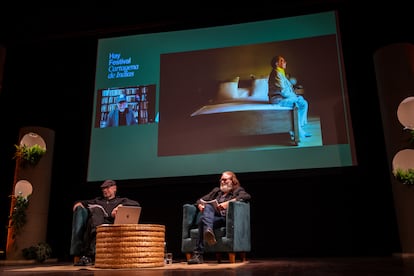
“For a photographer like Daniel to make a photography book for you, it would be stupid to say no,” says Rodríguez over Zoom, before an audience that is listening to him and where the photographer and the Cuban actor and film director Jorge Perugorría are. He admits that he doesn’t really enjoy being in front of the cameras, and that no other professional photographer had come in to photograph his family, his dogs, his house. “No one came in before because you were waiting for me,” the Argentine responded when he traveled to Havana nine years ago, and asked to start at the troubadour’s most intimate place.
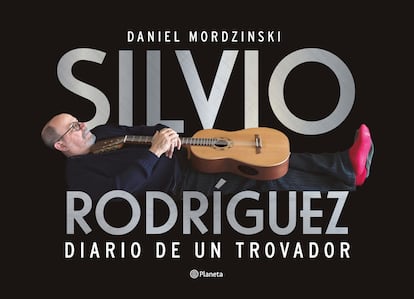
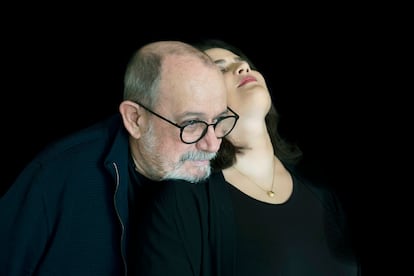
In a text he sends to EL PAÍS, the photographer explains his mission ñ. “I wanted to take a visual, emotional and necessarily sentimental journey through the life of one of the most important singer-songwriters in the Spanish language,” he writes. It is a work “that reveals the troubadour in his most human and committed dimension,” adds the photographer. “A book for all lovers of music, photography and words. A talisman for those who know that poetry, love and utopias are weapons loaded with the future.”
The book also includes international tours and in Cuba, Silvio’s meetings with musicians Luis Eduardo Aute, Vicente Feliú, Joan Manuel Serrat, Joaquín Sabina. “Aute was a defender of Cuba tooth and nail,” says the Cuban, remembering his Spanish friend who died in 2020. The conversation on Zoom focuses on the musicians and writers who touched the singer-songwriter’s heart, from Mario Benedetti to Gabriel García Márquez. “We were not very close, but we saw each other many times and we had very easy communication,” says the Cuban about the writer of magical realism. One of those times was on a plane in Mexico, in the middle of a storm, in which they drank alcohol to overcome the fear in the middle of a storm, Rodríguez said.
Silvio’s lyrics – simply put, as he is known – are in part the lyrics of Latin American history, Mordzinski insists in his book. “This is not dead, they did not kill me, not with the distance, not with the vile soldier,” he sang, for example, in Santiago de Chile, where he was photographed by Mordzinski, in 2018, in front of the Palacio de la Moneda. The place where President Salvador Allende was assassinated in 1973 in a violent coup d’état.
Many of the singer-songwriter’s photos are interspersed in the book with the lyrics of his songs and short texts from his diary.
Shortly after, Rodríguez traveled to Argentina, and wrote that he was excited to arrive in Córdoba, “one of Che’s birthplaces.” That is why he is preparing to sing in honor of his life. Tune of Will ―“Guevara the human said that no intellectual should be a salaried employee of official thought”― and The Fool in honor of his death―“I don’t know what destiny is, walking I was what I was, There God, who will be divine, I die as I lived”―.
The new revolutions of the 21st century haunt Rodríguez in the photos. At one point Mordzinski looks at the audience in Buenos Aires and finds young women there raising the green scarves that have represented the rebellious feminist movement that has fought for the right to abortion. Rodríguez grabs his diary after the concert: “The revolutionary is characterized by pulling forward. The Revolution was revolutionary because it pushed the people forward. Maybe in this century what is revolutionary will correspond to the people.”

Mordzinski, Argentine like those feminists, met Silvio Rodríguez in Paris decades ago, after moving to the capital of France at the age of 18, during the Argentine dictatorship. On his birthday in 1980, celebrating with Dominican architect Eric Genao, “I received the gift of a cassette with songs from his favorite musician’s latest album.” There were the classics like Hopefully and At the end of this journey. Mordzinski then sang it at the top of his lungs, to the point that his neighbors asked him to lower his voice. “In those times of lack and dreams, Silvio’s songs were a balm and provided me with an anchor of affection, poetry and love.” In these new times of scarcity, Silvio Rodríguez’s music, for many, continues to be the same balm.
For more updates, visit our homepage: NewsTimesWire