Gold search engines of the 21st century do not have to remove water and land or dig too much to find it: they can find it in a place in the Madrid neighborhood Salamanca, at a branch of the Diagonal in Barcelona, or on any online investment platform, to cite only some locations. And they pay it very expensive. Or cheap, as you look. Never before the ounce of this precious metal has cost more than now, above the level of $ 3,500, but its revaluation does not touch a roof, and there are already those who predict an even more dazzling future, beyond the 5,000 dollars, which makes the current levels seem affordable. Its buyers, central banks, Family officersinsurers, and more and more, private investors who seek to make profitability to their money, have been watching their balances and current accounts thanks to an millenary asset whose popularity does not age. And they continue to draw the checkbook.
“It is the shelter par excellence, with a long history of preserving value in times of economic uncertainty, inflation or volatility. It allows me to diversify and reduce the risk of my investments. It offers protection that actions and bonds cannot guarantee,” says Guillermo, 30 -year -old Sevillian programmer who does not want to give his last name, one of those who has risen to the wave.
When he began to invest, in October 2024, Gold meant 5% of his portfolio, but the strong rise in his price has made him gain weight against the rest, and already places him at 8%. Your system pulls discipline: every month you enter your account of Myinvertor and press the buy button, a very popular method known as DCA (Dollar-Cost averaging) that when based on periodicity it reduces the danger of operating at the wrong price, because they are spied on multiple acquisitions instead of releasing the capital at once.
“I think that gold is the active shelter of the past/present, and Bitcoin is the active refuge of the present/future. That is why I invest 200 euros per month in gold and 100 in Bitcoin,” says another small investor, 40 -year -old Bilbao, used in the technological sector, which prefers does not reveal its identity.
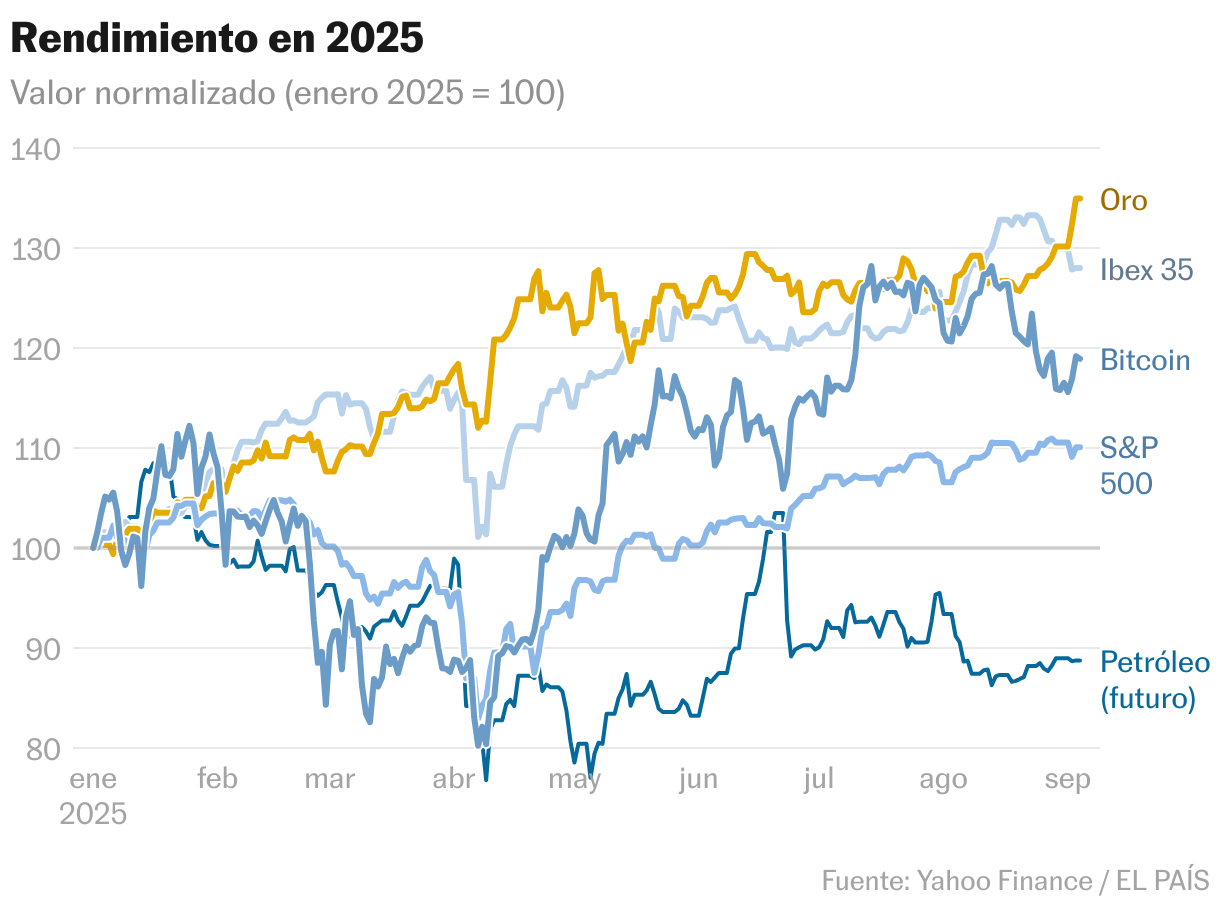
So far this year, gold has rebounded more than 35%. Neither the main bags, nor the Bitcoin reach so much. Not even the hot Spanish real estate market, where almost everything is worth more than yesterday but less than tomorrow, it approaches those vertigo. Why now? The economist Javier Santacruz explains it that way. “Gold is considered an active refuge against two scenarios: inflation and tensions of the monetary system. Although the peak of price increases has been left behind, for many it is a commitment to see a return of inflation in the coming years. That, together with the situation in the Federal Reserve, they have made it an attractive asset,” he says.
The American central bank is a polvorín. One of its governors, Lisa Cook, came to receive a letter of dismissal from Trump, which she is planting. And its president, Jerome Powell, has been the subject of an operation of harassment and demolition by the White House. With his mandate next to expire – he was in May 2026 – the market assumes that his substitute, which Trump will name, will be a puppet managed by the Republican. Without independence, the credibility of the Fed would be questioned. And the dollar, as is happening, pays the broken dishes.
This depreciation benefits gold, which usually has a negative correlation with the green ticket: the stronger one is, the weaker the other. In the summer of 2022, when a dollar asserted more than one euro, gold went through a bad time. Since then, it has doubled its price.
The same used to happen between bags and gold. When the first suffered turbulence, the second was strengthened for its condition as a refuge of the fearful money that fled the risk. And on the contrary. But with the bags around maximum and gold also simultaneously, that connection is changing. “The apparent Gold-Bolsas paradox responds to compatible narratives: the bags go up for expectations of fed cuts, while gold benefits from the weak dollar and uncertainty for Trump’s tariffs,” analyzes Judith Arnal, principal researcher at the ELCANO and CEPS Royal Institute.
All these problems are music for the ears of those who are taking advantage of the situation thanks to the precious metal. “We are facing the third great bullish cycle in the history of gold,” proclaims Solemn Gustavo Martínez, a stock exchange and heritage advisor who has been buying it in the markets for more than a decade. “In the last four years I have invested much stronger,” he says convinced. His thesis is that the great national deficits incurred by states feed the debts of the countries, devaluing legal tender (Fiat) coins. Gold, in his opinion, offers immunity to this continuous loss of value of the euro, the dollar and the rest of the currencies in which people receive their salaries, of a diminishing purchasing power.
That is why Martínez, like other staunch defenders of gold as an investment and reserve of value, deny that housing and other basic products have become more expensive, and prefer to say that it is the coins that have devalued themselves by inflation, remembering that with respect to gold the houses are worth less than once.
Physical or digital?
One of the dilemmas facing those who seek exposure to gold is the way to do it. You can buy shares of mining companies, which are multiplying their benefits as the price of what they extract grow. The titles of the Canadian Barrick Mining Corporation, for example, earn 70% this 2025, auged by the good work of their mines in Argentina, Chile, ivory cost or the Congo. And others such as Americans Newmont Corporation and Gold Fields, or the South African Anglogold Ashanti are obtaining succulent revaluation.
You can also, through an online account in any financial entity, invest in ETFs that replicate the price of gold in real time. With the comfort of being able to sell and buy instantaneously from home. And finally, it is possible to go to a branch and get out of it with coins or ingots. Even send them to you in a package that will only be delivered to you by teaching an identity document.
In that business, to sell the gold that can be touched, there is the Swiss Giulio Buoncore, 53, director of the branch in Madrid of Degussa, acronym of German gold and silver refinery, one of the largest companies of sale of precious metals in Europe. Located in Madrid’s Calle Velázquez, a stone shooting from the Retiro Park and the Wellington hotel, where this Friday the cheapest room exceeded 500 euros, the place receives a slow but constant drip of customers that look at their polls to scrutinize coins and ingots.
“We are noticing that more people are coming. There is a lot of interest from both clients who enter the street and Family officers (Investment vehicles that manage the assets of wealthy families) and people of high heritage to which we contacted, ”he says. The gold they sell bring it from Swiss Foundations, although for security reasons they prefer not ounce, which are 31.10 grams, while the wealthiest and institutions begin from 100 or 150 grams to the kilo, the largest they sell.
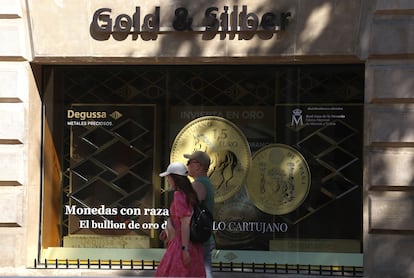
Those 1,000 grams are approaching today at 100,000 euros, so putting it under the mattress entails its risks. The establishment offers to save it in safety boxes, although banks also have that service.
Gold buyers can resell the gold to Degussa whenever they want, either because they need liquidity to buy a home, because they have earned enough money and want to make a box, or for any other reason. As with currency changes or the sale of shares, the price is usually somewhat lower than that of the market, because it is subject to the patrimonial transmissions tax and the usual transaction costs. Of course, the money does not take time to transfer: the payment is made at a maximum of 24 hours.
Advantages and disadvantages
Why do there are those who prefer physical gold? “It is independent of the banking system, if a very fat financial crisis arrives, many people prefer the security of the physical,” Buoncore argues. In favor he also plays that the bullion of more than two grams are exempt from VAT, something that for example does not happen with silver, another booming metal.
The current moment is not understood without looking back. In 1971, the then US president, Richard Nixon, ended the fixed gold convertibility, which for decades changed to 35 an ounce. “Bárbara relic,” British economist John Maynard Keynes called the gold in 1924, who hated the rigidity of the gold pattern. Its disappearance allowed its price to fluctuate freely with the forces of supply and demand, which unleashed uncertainties. “Gold does not earn interest and, unless its price rises, does not provide economic profitability,” said a study by Morgan Guaranty Trust Company, a history of the current JPMorgan, which drew a dark future for this metal.
Half a century later, those agoreras predictions have been wrong. Today is worth 100 times more than in the times of the gold pattern. And even the central banks monopolize it. The ECB was at the end of 2024 with 40.9 billion euros in gold, 10.5 billion more than a year earlier, due to its price increase in the market. And many others accumulate reserves in gold. Why do they buy it? Judith Arnal, from Elcano, sees three reasons. “First, for geopolitical reasons: the freezing of assets of the Central Bank of Russia has been a call of attention, and many emerging countries accumulate gold as insurance against financial sanctions. Second, because it is a traditional reserve asset that provides diversification against the dollar and other currencies. And third, because after the recent inflationary peak, they see it as a way of stabilizing their reserves.”
With its shooting price, a logical question is whether the correction is close or there is margin to continue uploading. The American investment bank Goldman Sachs pointed out this week that it does not rule out that the ounce reaches $ 5,000, that is, 40% higher, if distrust of US debt for Trump’s interferences in the Fed pushes investors to transfer a minimum part of what they invest in bonds. It would only take 1% to move for that.
Gustavo Martínez goes further. And resort to history to defend that the potential of gold has not yet exhausted. “In the first bullish cycle, it multiplied its price by 20, in the second by seven, and in this we barely carry a two,” compares.
Gold is not usually the main position in investor portfolios. It tends to represent a smaller portion than actions and bonds, and Bitcoin’s emergence has increased competition, with many of its followers proclaiming it as a kind of digital gold. But this traditional asset, which has been converted into an attraction, is gaining weight. Javier Santacruz compares him to the house, another physical good. “It has an ancient history as a deposit of value and a half of change. It is a metal that meets stable physical and chemical characteristics over time. All transformations that are made to gold, whether they can be bullion or currencies, do not lose mass. And that is a quality that has no other element of nature.”
For more updates, visit our homepage: NewsTimesWire