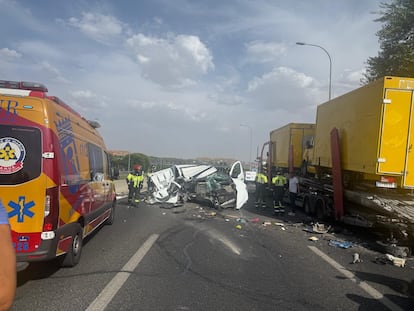
Midnight on the M-40 Circunvalación Highway, in Madrid. Three large vans circulate at high speed through the left lane with hardly any safety distance between them. In seconds they exceed all vehicles and the wake is almost lost. They only reduce the march when they pass through a fixed radar located in front of Mercamadrid. This image is repeated day after day on hundreds of Spanish roads, it is the reflection of the bum of internet purchases. The vans have become one of the objectives of the General Directorate of Traffic (DGT), which finalizes a security plan to reduce the accident rate of this type of vehicles. In 2024 and only on the roads 79 drivers or passengers of vans died, which meant almost double the previous year (40). The employer of the sector ensures that accidents is not so high and that in its area there is a lot of intrusion of illegal transporters.
Interior Minister Fernando Grande-Marlaska has already announced on January 10, during the presentation of the balance of 2024 fatalities on the roads, which the DGT was going to carry out a detailed study to analyze the causes of the increase in the accident rate of the vans and that, in addition, surveillance campaigns would be made throughout the year. The director of the National Road Safety Observatory, Álvaro Gómez Méndez, acknowledges that it is a “complex vehicle” to address, since both professionals and individuals use it. “The vans can go at a speed or another according to the use made of them,” he said. A fact that has caught the attention to the DGT is that, in 2023, of the 34 deaths to which the breathalyzer test was done, nine positive.
Civil Guard sources recognize that, when they do speed controls, vans drivers are always detected at the maximum limit of the minimum sanction (100 euros, which become 50 if they are paid in a voluntary period and without loss of points). If on highways and highways the limit is 120 kilometers per hour, they are hunted 150 kilometers or something less. If they were 151 or more, the sanction would reach 300 euros – 15, in voluntary payment – and the detraction of two points. “They know that with these speeds they will not be a great disbursement, so they risk and earn more time, without realizing the serious danger that it supposes,” says an agent of the traffic group with extensive experience.
A driver who distributes in Madrid and the surrounding municipalities, who prefers not to give his name for fear of losing their job, recognizes that companies mark very tight schedules and that they have to fulfill the delivery commitments. And all this is increasingly complicated by the big jams that occur in large cities or on the long routes that have been traveling for hours. “Either you are playing the fine or you know that you are not going to arrive on time. That is huge stress and that you always see yourself pressed by the bosses,” recognizes this professional, with several years of profession in the sector. “Sometimes, when the client is not, they make us return to two and three times when we have finished our route, with what we also pass from our schedule. They put the excuse of leaving the empty van and returning to the warehouse without any bulge, but they do not realize that they are more than more than they do not pay us and that many times force us to do enough kilometers,” he adds. All this is aggravated when certain dates such as the Black Friday Or Christmas, when shipments increase exponentially.
The image is also frequent in the municipalities, when the vans are seen uploaded to the sidewalks or in the second row with the indicators lit, and the distributors loaded with bulky boxes or carts full of shipments. And this for despair of many drivers who have to attend patients to deliveries if they are streets with a single lane or in traffic crowded. On the road, it is usual to see them at high speed on highways and highways that link the large logistics centers with the border provinces. Sometimes they go in convoys of three or four vehicles. All are characterized by being large and being very loaded.
Francisco Aranda Manzano, president of one, the Business Organization of Logistics and Transportation of Spain, with 390 associates and a representativeness of 75% of the sector, is surprised by the accident data: “With the pandemic, there was an increase in electronic commerce and accidents also uploaded. Since then we have put strategies to reduce them and are giving results”. According to data, in 2019, 538 million shipments were made and in 2024 the 1,303 million were reached, which represents 142% more. “What we have detected is that, in some areas and certain times, there are pirate, non -professional drivers, within the package sector, removals and the appliance sector. In addition to being unfair competition, they also influence security,” says Aranda.
The president of one points out that more and more technology is being applied in the sector, which allows “intelligent management of the routes”, so that the jams, the dangerous areas are avoided and the stress of the conductors is reduced or eliminated, in addition to the reduction of the number of unnecessary kilometers. They also help driving aid systems – known as Ada – with which modern vans are provided, which allow monitoring speed, being controlled at all times by GPS or the automatic brake, among others. “We are a new player in the city and some municipalities do not make it easy for us. It happened in Barcelona with Ada Colau, which eliminated many charging and unloading areas with the consequent problems for delivery,” says Aranda.
The business organization works with the DGT to try to disappear pirates and reduce insecurity. “The vans are much more accessible than trucks and just rent them to start working, which can generate insecurity in the goods distribution sector,” says the president of one. This organization has launched a school of distributors, a 60 -hour training course for future drivers. In addition to a theoretical part, it has a simulator for the professional to face situations such as those in the street. “There has also been a change in consumers. We have achieved that the customer does not want us to deliver their purchase with such speed and that we can group shipments. A process of rationalization of the purchase online is being given. If someone buys a book, it is not necessary that you receive it today if you are not going to read until the weekend,” he says.
For more updates, visit our homepage: NewsTimesWire