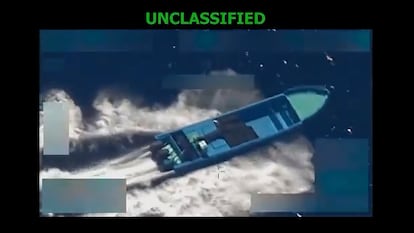
This Wednesday’s military attacks against two alleged drug boats in the Pacific Ocean, near the Colombian coast, mark a new chapter in the United States maritime offensive in the region. Since September, Donald Trump’s Administration has ordered bombings against 10 vessels that were allegedly used for drug trafficking. These new operations show the presence of North American authorities in one of the most used routes to export narcotics from South America to the north of the continent, above the Caribbean Sea, where most of the attacks have occurred, according to a source from the National Navy.
Trump has put the focus on these boats, used for years by drug traffickers for their shipments through the Pacific. Internal reports from the Navy, the Colombian naval force, record that, so far this year, they have intercepted 15 vessels similar to those attacked by the United States: with one or two powerful engines, they manage to zigzag between waves before the radars can detect them. Others are semi-submersible, handcrafted, with pipes that allow them to be kept almost hidden under water. They are not economical vehicles. “They have two or three engines, and each one costs between 50 million pesos and 200 million pesos (13,000 to 50,000 dollars), depending on the power,” explains the officer, who has asked not to reveal his name for his safety.
Furthermore, drug traffickers appear to be using new technologies. This year, Colombian authorities identified an unmanned vessel, managed through satellites and with a Starlink antenna (the satellite system created by Elon Musk), which allows for a signal in open waters. “They send signals to a program that acts as a rudder. It works like a drone,” explains the source. The first semi-submersible without people on board belonged, according to military intelligence, to the Gulf Clan, the largest illegal group in the country.
With that sophistication and those costs, the possibility that all the boats attacked by the United States belong to artisanal fishermen is minimal, explains the officer. “A fisherman does not fish at 200 nautical miles, where international waters begin. To reach such a distance it takes two days of travel, with full power, at a cost of fuel that makes the activity unsustainable,” he points out. Colombian President Gustavo Petro has said that a Colombian died in at least one of the attacks. He has taken up the information from RTVC, the public media network, which reported that the relatives of fisherman Alejandro Carranza believe that he died in one of the attacks, despite the fact that, they maintain, he had no connection with drug trafficking. The news also indicated that this bombing occurred in Colombian waters. The United States has not confirmed the coordinates of any of its operations.
The attacks increasingly have the radar closer to Colombia, the largest producer of cocaine in the world. At first, Trump’s military campaign seemed to have Venezuela in its sights. It was, according to experts, a prelude to a possible land incursion to overthrow Nicolás Maduro, or at least a way to promote a change of government from within. But with each attack, the siege tightens on the vessels that have some connection with the country. In another attack, US Defense Secretary Pete Hegseth said the ship belonged to the Colombian ELN guerrilla.
The pointing is not random. 62% of the vessels seized by the Colombian Navy in 2024 appear to have a link to that group. The premise arises from the fact that the authorities have recorded that drug traffickers mark the blocks of cocaine, usually the size of a brick, with distinctive logos of exclusive brands such as Mercedes Benz, Rolls Royce or Rolex. With these signs, and information from the Prosecutor’s Office and the Police, the Navy identified shipments that belonged to Gustavo Aníbal Giraldo, alias Pablito Araucathe third commander of the ELN, who has control of more than 2,000 men on the border with Venezuela, in the northeast of the country. Despite this, in response to Hegseth’s complaint, the last Colombian guerrilla in arms denied its links to drug trafficking. The North American Government has also not presented evidence of its accusations.
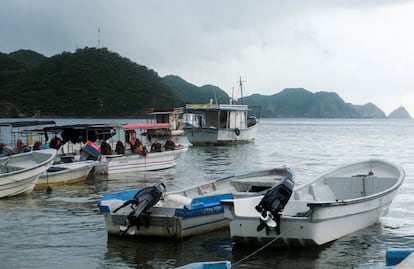
The greatest maritime drug trafficking activity occurs in the Pacific, where the geography favors illegal boats. Its estuaries, mangroves and hidden channels turn the coast into a labyrinth. “The estuaries are difficult to access for coast guard vessels,” explains the naval source. The most guarded routes start from Bahía Solano, Nuquí and Punta Soldado, in Chocó; El Naya, in the Cauca Valley; and Gorgona Island, in Cauca. From there they connect with a marine corridor to Central America and Mexico, the most active route for maritime cocaine trafficking.
Some of these seizures attributed to the ELN came from Ecuador, in Candelilla del Mar, a community on the border with Tumaco (Nariño), the municipality with the most coca leaves in Colombia. Further north, in Buenaventura (Valle del Cauca) and in the department of Chocó, another is the predominant group. “In the municipalities of Bajo San Juan, Malaguita or El Naya, the FARC dissidents have a significant influence. They usually transport cocaine from the Micay Canyon to take it out this way.” The Gulf Clan, for its part, maintains a route from Darién, on the border with Panama.
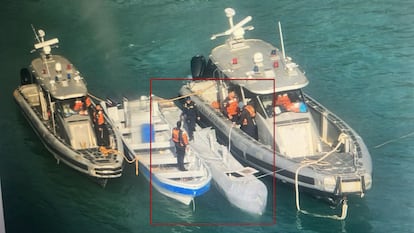
In contrast, the Navy has no records of large seizures in the Caribbean since 2006. “Drug trafficking used to leave through Santa Marta, Punta Gallinas, in La Guajira (border with Venezuela) or Turbo (Antioquia), but international controls have reduced the presence,” the source points out. Nor does it favor illegal trade that there are so many islands from various countries, with their respective navies, constantly patrolling national waters. Even so, the United States had prioritized the Caribbean route for several weeks, which has a connection with Venezuela. The military campaign, at least this Wednesday, has been transformed.
For more updates, visit our homepage: NewsTimesWire