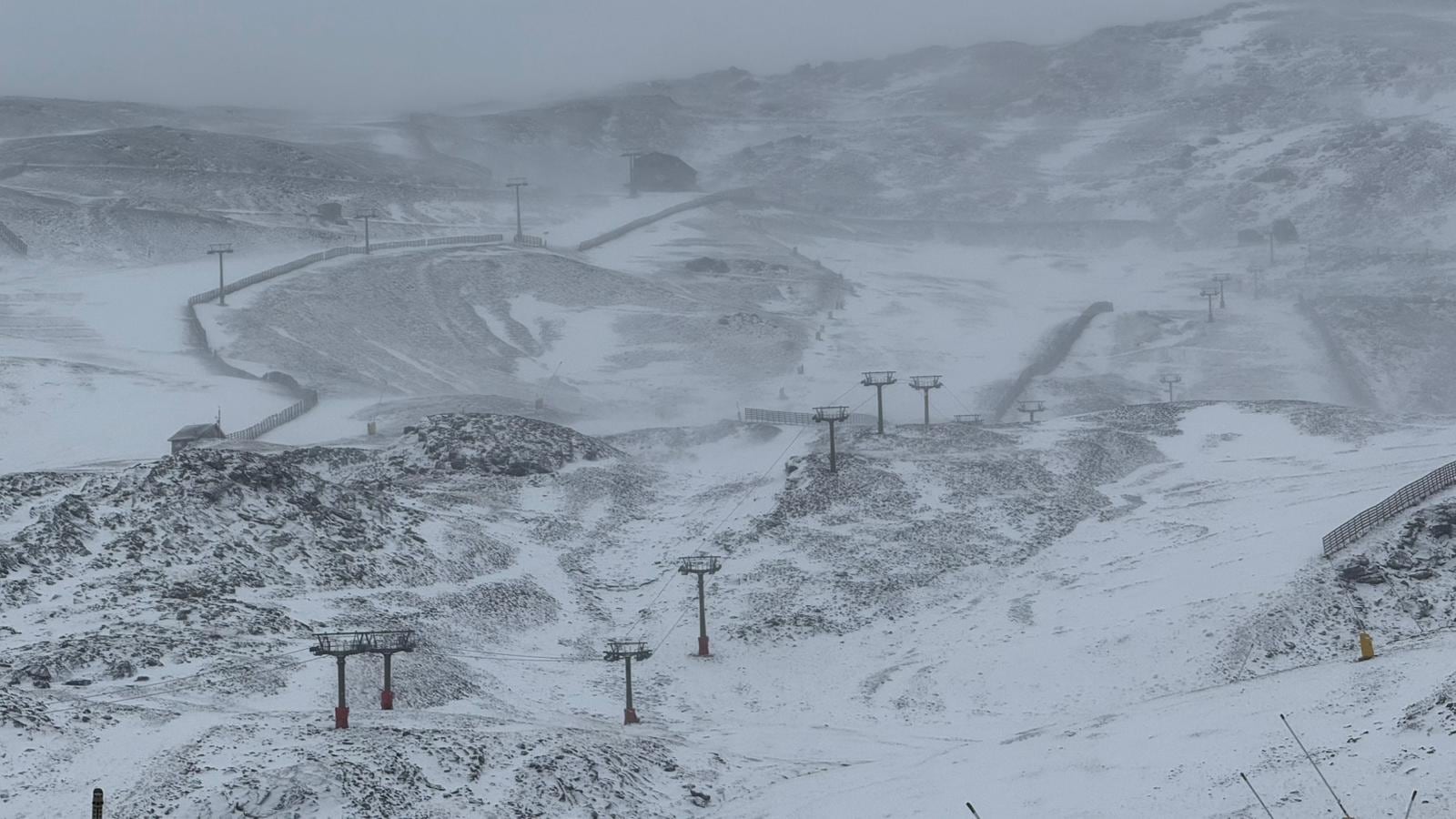
The weather will be especially cold for the time of year this Wednesday, according to the predictions of the State Meteorological Agency (Aemet). The entity foresees frosts in the early hours of the morning, and that the maximum temperatures do not exceed 10 degrees Celsius in large areas of the Peninsula, with the exception of the southwest quadrant and the coasts, where they will be slightly higher. The agency has activated the yellow warning for snowfall this afternoon, with accumulations of up to 15 centimeters, in the provinces of Huesca, León, Lleida and in the community of Asturias due to the arrival, in the next few hours, of an air mass of arctic origin, which will cause a marked temperature drop and a collapse in the snow level, according to EFE.
Starting in the afternoon of this day, an air mass of Arctic origin will arrive that will cause a generalized thermal drop and snow in the northern third of the peninsula.
In Asturias, the yellow warning (risk) affects the Cordillera and the Picos de Europa, where snow accumulations of up to 10 centimeters are expected in 24 hours. The greatest thicknesses will occur from 1,000 meters, although at higher levels they may be greater. Aemet points out that the notice will also remain in place during the following day.
In Castilla y León, the province of Burgos maintains the warning for snowfall in areas of the Cantabrian mountain range, with accumulations of up to 15 centimeters in 24 hours, also above 1,000 meters of altitude, and with extension of the warning to the next day.
The agency had also activated a special warning for snowfall at low levels for this Thursday and Friday and recommends following its updates, because it predicts that temperatures will continue to drop and intense winds will blow in the coming days.
On Thursday, this phenomenon will progressively spread to the rest of the Peninsula and the Balearic Islands, and will continue on Friday. There will be frosts in the interior of the peninsula, with the possibility of being strong in the Pyrenees and moderate in the rest of the mountainous environments of the northern half and the Baetics.
The Aemet predicts a “significant decrease in the snow level”, which will go from being “above 1,600 meters to being below 400 meters early on Friday.” The largest accumulations are expected in the Cantabrian Mountains, according to the prediction, where more than 20 centimeters thick may accumulate in 24 hours. In a weaker way, they may also extend to the rest of the mountain systems in the northern half of the peninsula. It is possible that snowfall will affect not only mountainous areas, but also surrounding low areas from midday on Thursday, such as the interior of the Basque Country, Navarra and the north of the Northern Plateau.
As reported by the entity, “the peak moment of the episode is expected between the late hours of Thursday the 20th and the morning of Friday the 21st, when the snow level will be around 300 meters in the eastern Cantabrian Sea and upper Ebro.” The agency warns that “the impact could be significant in this area, affecting important communication routes.” In addition, during Friday more than 10 centimeters could accumulate again in mountain spots in the northern third of the peninsula. Less relevantly, snowfall will also affect the Iberian and Central systems, without ruling it out in the Catalan pre-Pyrenees.
Aemet’s statement highlights that “the wind will be another significant phenomenon during this episode.” Very strong gusts are expected in the northeast of the peninsula, the Balearic Islands and also in mountain areas of the eastern third, with possible blizzards in the Pyrenees, especially during Friday and Saturday. An “intense maritime storm that will affect the Balearic Sea and Empordà” is also expected.
Starting on Saturday, and “in an environment of growing uncertainty”, according to the forecasts, the most likely scenario is the beginning of an increase, both in temperatures and in the snow level, and which would continue in subsequent days. Snowfall and frost will be “progressively restricted to mountain areas.”
For more updates, visit our homepage: NewsTimesWire