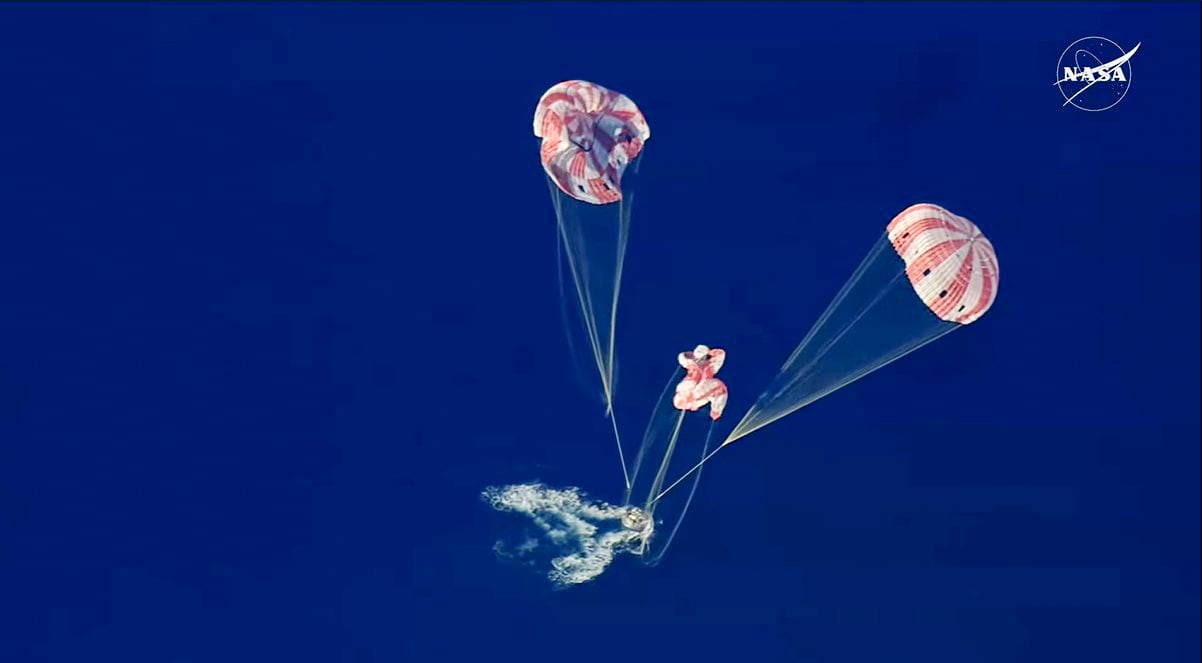
They are already back. The four crew members of the first mission to the Moon in more than half a century have returned safely from their trip to the satellite, in which they have made history. The Orion spacecraft has successfully fallen into the Pacific Ocean, near the coast of San Diego, after 2:07 in the morning, peninsular time. It was the end of a mission that has taken the first woman, Christina Koch, the first African-American, Victor Glover, and the first person from outside the United States, Canadian Jeremy Hansen, to the Moon. Traveling with them was their commander, Reid Wiseman.
“Stable and upright,” said Commander Reid Wiseman, the message that meant that the Orion ship had successfully landed, and had inflated the four balloons that keep it in position. A perfect landing.
For six long minutes, communication with the ship was lost while it crossed the atmosphere at about 40,000 kilometers per hour and the outside reached temperatures of more than 2,500 degrees.
“Houston, Integrity, we hear you loud and clear,” the commander was heard saying just as the ship emerged from the communications blackout. Minutes later, the parachutes were deployed to slow the descent of the ship, which landed safely in the Pacific.
After a perfect splashdown over the Pacific Ocean, the commander of the Artemis 2, Reid Wiseman, has reported that the four crew members are in perfect condition. The exact time of arrival was 2.07.47, after a trip of 1,117,659 kilometers.
These astronauts have been not only “perfect professionals,” said Jared Isaacman, NASA administrator, aboard the rescue ship, but also “great communicators, even poets.” “They were ambassadors of humanity in the stars,” he added. Isaacman has recognized the importance of collaboration with partners such as Canada and Europe, which has built the service module of the Orion ship that has been responsible for propelling the astronauts to the Moon, and also on their return (in addition to providing them with oxygen, water and air conditioning).
About four hours before landing, the exterior cameras of the Orion ship in which the Artemis crew travels showed the capsule’s thrusters and a bright blue Earth almost in crescent.
The Artemis 2 astronauts, Commander Reid Wiseman, pilot Victor Glover, and specialists Christina Koch and Jeremy Hansen, woke up today at 11:35 a.m. East Coast Time of the United States — 5:35 p.m. Spanish Peninsula Time — and began preparing the ship for the return to Earth, the most dangerous moment they had left in their mission.
For almost 10 days, the four crew members of Artemis 2 have become the humans who have traveled the furthest in space. They have also been the first to observe with their own eyes some areas of the far side of the Moon, which they have flown over at an altitude of 6,500 kilometers without landing before returning to our planet. At the center of that lunar flyby, they lost communication with Earth for 41 minutes and, an hour after reappearing on the other side of the satellite, they experienced a rare and exclusive total solar eclipse, which for pilot Victor Glover offered “the strangest and most unreal view we have ever had, with the glow of the Earth illuminating almost the entire Moon.”
Koch is the first woman in history to go to the Moon, Glover the first African-American, and Hansen, an astronaut for the Canadian space agency, the first non-American. Their trip is the first step in a project to land on the satellite in 2028 and colonize it starting in 2029. The Artemis program is the United States’ attempt to return to the satellite before the arrival of China, which plans to land its astronauts in 2030.
Minutes before arriving on Earth, the crew of the Orion spacecraft faced the most dangerous moment in the remainder of their mission. The capsule in which they traveled to the far side of the Moon had to land in just about 13 minutes in which it reached more than 2,500 degrees due to the pressure and friction of the air.
Along with takeoff, the return to Earth was the most dangerous moment of a mission like Artemis 2. The capsule reached our planet at 38,275 kilometers per hour, its maximum speed throughout the trip. It was essential that the ship enter at the correct angle of inclination to avoid any accidents.
“We will be riding a fireball that passes through the atmosphere,” Glover said in a press conference from space before docking. This 49-year-old naval officer, test pilot and astronaut said he has been thinking about the moment of falling in the Pacific since April 2023, when he was chosen for this mission. “It’s something profound,” he highlighted.
About 35 minutes before falling to Earth, it disengaged from the European Service Module. This component, built by European companies, including some Spanish, has been essential for the mission, as it has provided air, water, air conditioning and propulsion on the journey from Earth to the Moon and all the way back.
All attention was on the heat shield that protects the Orion spacecraft and its occupants from the very high temperatures reached during reentry into the atmosphere. After unhooking, the ship turned on itself so that the rear part, where the heat shield is located, was in front. This protection is made of materials that absorb heat and protect the ship from high temperatures. The entire landing is automatic and the astronauts were sitting with their backs to the direction of travel.
During the unmanned test flight of Artemis 1, in 2022, serious defects were detected in the shield. NASA astronaut Charles Camarda, 73, has been one of the most critical voices on this issue, and has even warned that Artemis 2 should not take off with a crew on board, as he believed that NASA was exposing itself to problems as serious as the one that caused the shuttle disaster. Columbia in 2003, in which seven astronauts died, and which was due to failures in the heat shield.
NASA analyzed the problem and changed the entry angle of the spacecraft. These changes and the reanalysis of the tiles that form the shield made them trust in a safe arrival of the astronauts, as Debbie Korth, one of the people most responsible for the Orion capsule, explained to this newspaper during an interview held at NASA’s Kennedy Space Center.
“Everything will start quickly and end even faster,” engineer Rick Henfling had explained in a press conference before the arrival of the mission. The descent began when the ship Integrity It was about 120 kilometers high and began to cross the upper layers of the atmosphere. By then, the service module, a technological marvel worth around 22 million euros, was already disintegrating far from the ship.
Twenty-four seconds after reentry, Orion was enveloped in plasma, a brilliant fourth state of matter that arises when air is ionized by the intense compression and friction exerted by the ship. At this time all communication with land was lost. The blackout lasted about six minutes, until the ship was already at an altitude of about 45 kilometers above the sea. With six kilometers remaining, the first parachutes dropped, reducing the speed to about 300 kilometers per hour, and then the three main parachutes deployed. The Orion spacecraft hit the water at about 30 per hour.
Once the Orion landed in the Pacific Ocean, navy divers planned to approach the ship and open the hatch. Several doctors would then come in to check on the crew and then they would leave in a fixed order: Koch, Glover, Hansen and, lastly, Commander Wiseman.
Several helicopters will take them to the ship John P. Murtha. From there it is possible for the astronauts to fly to earth, explained the person responsible for the rescue, Liliana Villarreal. There will be up to seven aerial vehicles for the rescue, and the possibility of activating additional equipment from the Pearl Harbor base in Hawaii, in case the Orion does not fall at the fixed landing point.
It has been the end of a historic mission in which humans have returned to the Moon more than half a century after the Apollo missions of the 1960s and 1970s. Unlike then, the objective is to colonize the satellite. The first step will be a landing planned for 2028 with Artemis 4 and Artemis 5 and, just four years later, having permanently inhabited settlements. All this is waiting for China, which wants to deploy astronauts on the satellite before 2030.
For more updates, visit our homepage: NewsTimesWire