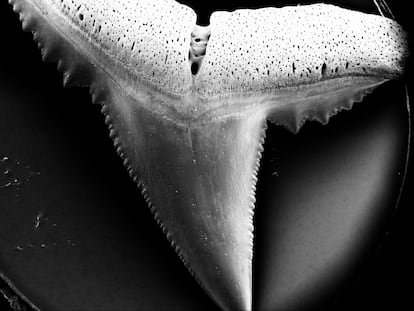
Shark teeth are one of the most developed weapons of nature. 400 million years ago that evolution has been perfecting biological precision one of the most fearsome dentures in the animal world. However, there is a future scenario in which things could change. A new study, which is published this Wednesday in the magazine Frontiers in Marine Science, It proposes that oceanic acidification – direct console of human emissions of carbon dioxide – alters the structure of the reef shark teeth of Punta Negra (Carcharhinus melanopterus).
The researchers designed an experiment in which they collected from an aquarium in Germany pieces that the sharks had naturally lost and subjected them to artificial pH conditions 7.3, the level that some studies project of acidification in the sea for 2300. The alterations were notable: the corrosion of the roots increased, cracks and perforations in the enamel appeared and changed the serrament of the crowns. The authors interpreted that these wear weakens the structures and make the teeth more fragile and prone to break.
Maximiliam Baum, a scientist at the University of Düsseldorf and author of the research, explains that “the most surprising thing was that the exposed surface of the tooth increased” with acidification. And follow: “At first I thought it was a mistake in the images, but it was something different.” The teeth did not grow, but became more rough and expanded. “That greater surface implies more corrosion,” he says. The researcher proposes a metaphor to explain the effect: seawater of the future would be for the teeth of sharks, something similar to how coca-cola for humans. “It is a dramatic example, of course, because the drink has a pH of 3, much more acidic, but gives us an idea of the effect that the ocean acidification for these animals can have in the long term,” illustrates Baum.
For Claudio Barría Oyarzo, Doctor of Sea Sciences and Specialist in Sharks, the study, like all, has limitations. “The most important is that it was made with teeth already detached, without the performance of physiological processes,” he says. Therefore, the results reflect only the effects of chemical corrosion on an inert tissue and not the response of a living organism.
The same points Eric Clua, principal researcher at the Université Paris Sciences et Lettres, who also points out that the study “is very theoretical and the results must be taken with caution.” The capacity of sharks to adapt to new stressors is immense, the expert remarks. For example, in some species of shades, when females do not find a male, they turn to the parthenogenesis to reproduce without fertilization, using only their ovules. Others have demonstrated an unusual ability to maintain a stable pH balance in their blood and tissues, even in acidified waters, suggesting some adaptation potential. “Although interesting, this study shows a possible detrimental effect, but it does not demonstrate it at all,” he adds.
The author of the new publication details that there are two possibilities of variation in the results of his work if the experiment will be tested in living specimens. “One is that sharks can repair or remineralize the damage. But in more acidified waters it is more difficult to obtain calcium carbonate, and the energy cost would be greater,” he says. While shark teeth are more than anything by fluorapatite, a material in theory more resistant to acidification than calcium carbonate, obtaining these components in acidified waters is more energetically expensive and equal to be degraded in this type of environments. As sharks replace their tooth every few weeks, they would need a lot of material. “Maybe they can adapt, but at the expense of a great energy effort, or they may simply lose their teeth ahead of time and have to produce more, which is also a challenge for them,” Baum mentions.
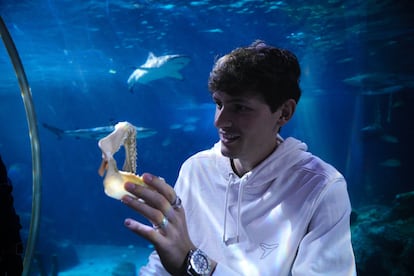
That’s not all. Barría also questions that “the experimental conditions were extreme”, since some studies point out that the ocean pH will not change to such radical levels. The author of the new study defends his choice: “No one had ever done such an experiment and we wanted to see the general effects.” Baum does not coincide with forecasts on sea acidification and believes that “what will happen in 200 years can be advanced to 100”.
The future will put the tiburons tested. “These animals depend on their teeth to capture and process dams, if they do not work properly, they could translate into a lower energy intake, growth reduction and, ultimately, less survival and reproductive success,” Barría prepares.
The latter, Baum adds, is because “the teeth not only serve to hunt dams: in reef sharks, males use them to hold females during reproduction.” The dentures of the males are specially adapted for this task, so a wear could have much more than food problems.
Other more immediate threats
Sharks are key species in many ecosystems. If their teeth lose their effectiveness, there could be a great ecological impact. “I do not believe that sharks die just because of this, but we must consider the accumulated effect of overweight, ocean heating, habitats and acidification degradation, which also affects their skin,” says Baum.
“The teeth could be an Achilles heel for sharks, but in a fairly long term,” says Clua. “I suppose,” he continues, “that they will have to face more critical, existing and future problems.” Barría trusts that this will not be so: “Sharks carry more than 400 million years on the planet, which speaks of their great resilience to the changes.” Of course, these movements had never been so drastic and accelerated before.
For more updates, visit our homepage: NewsTimesWire