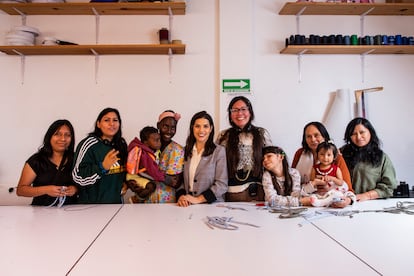
In a large room surrounded by fabrics, threads, measuring tapes and clothes hanging on hooks, a group of women braids cords with care and patience. After a few minutes, it begins to take the shape of small keychains of different colors. Zeneida Avendaño, a 58-year-old woman from Caracas, enthusiastically shows each step of the production of one of the many items that are created in this workshop. “I am excited about this project that allows us a safe space and at the same time personal and professional growth,” she says. Along with six other migrant artisans from Peru, Haiti, Guatemala and Venezuela, she is part of Weaving futuresan initiative by the clothing company Básicos de México supported by the International Organization for Migration (IOM) that seeks to make this small macramé product venture become a livelihood for women who, like them, seek to get ahead in an unknown country.
The idea for the project originated three years ago in a workshop with migrant women organized by the Cafemin shelter in which Valerie Benatar, co-founder of Básicos de México, participated, an entity created seven years ago to promote responsible consumption of clothing. From that approach, Benatar understood “the complexity of incorporating them into the labor market” and wanted to support them by giving their products a commercial outlet. “That’s where the conversations with IKEA begin,” he explains. By then, Básicos de México had been collaborating with the Swedish company for three years, so it used that platform to sell the items made by the artisans of Weaving futures ranging from fanny packs and cushions to suit holders. But it all started by taking advantage of a very particular need that the Scandinavian chain had in the country. “A product that is widely consumed in Mexico is tortilla makers and there weren’t any, so we started making tortilla makers for IKEA,” he says.
Shnaynise Joseph, who prefers to be called Nunu, is one of the women who make up this initiative. He landed in Mexico in search of opportunities and a better life for his family. This 30-year-old Haitian woman remembers her arrival in the country pregnant and with her husband in 2024. Without losing sight of her small and restless one-year-old son, she narrates the obstacles that migrants face, especially if they are mothers. “With children it is very difficult because, sometimes, there are companies where you have to work 10 hours. Imagine taking care of the child, the family and yourself too. It is very hard,” he says. For Nunu, being part of this project “is a blessing” because it allows him to have economic growth and learn new things. She already sewed before starting Weaving futures because in Haiti she made uniforms to pay for her school expenses, but she says that, at first, she was afraid because she didn’t know how to make key chains. The fear dissipated after a classmate showed her how easy it was, and now Nunu can make them in a matter of minutes.
Benatar explains that the objective is to consolidate the project as a sustainable business that generates job opportunities for this group. The mission is that in two years more people will join to reach a group of 30 migrant women. “It has several stages. The first is this crochet products workshop, which is very flexible, so they can go home and work as long as they want. Then the idea is that it ends up in a textile cooperative, where they own the machinery and have all the training so that they can be one of our suppliers. There we guarantee that they have a job and that they can get other clients as well,” he says.
For Zeneida, who arrived in Mexico in 2016 with her husband and three children, the most important thing is to be able to provide a good life for her family, for which having a job is essential. At 58 years old, it was not easy for him to find a job and his sudden departure from Caracas did not help either. “I spent two years paralyzed, with one foot here and one foot in Venezuela, thinking (that) this is going to change. The shock you have when things happen so abruptly is so great that you are not prepared for the journey. For me, to assimilate that we had no more food, that there was no food, that people lost their humanity… That is living to believe it,” she says. Zeneida says that she found the strength to overcome this ordeal in her family, the same pillar for which she had decided to leave her country. “Now is the time for my children, for them to grow up, to have a future and a tomorrow in their power. What one is fighting is simply so that they do not lack anything. (…) I believe that the principle of every person for things to work is a job,” he assures.
A great ally of this initiative is the IOM, an organization that, in addition to providing advice, seeks to channel women in the future to other jobs outside the textile industry to provide them with more employment options. With this model, if any of them prefers to venture into another field after having been trained, they will be able to obtain another decent and fair job. In the midst of the twenty people who gather one December morning in the Basics of Mexico workshop, where he is staying Weaving futuresIOM Goodwill Ambassador America Ferrera listens carefully to the stories of the seven women and what it means to them to belong to this project. For the American actress Barbie and Betty, my ugly beautythese types of initiatives contribute to changing the narrative “making migration positive for local governments and the private sector.” The activist of the Latin community in the United States also highlights “how host countries can treat migrants with dignity and provide security to people who, many times, have suffered very traumatic and dangerous situations.”
Ferrera, born in Los Angeles and of Honduran origin, is no stranger to these realities, but she emphasizes that the important thing is to be able to connect as a human being with these stories. “Any of these people could be us in a different situation. For me, having the experience I have coming from a migrant family rebuilding their lives in a new country, and being a mother, I feel a lot when I come to see all these women who are trying to improve their own lives, but also to give their children good lives and more opportunities to move forward. (…) They are not asking for charity. They are asking for an opportunity to rebuild their lives, express themselves as human beings and heal,” she concludes.
For more updates, visit our homepage: NewsTimesWire