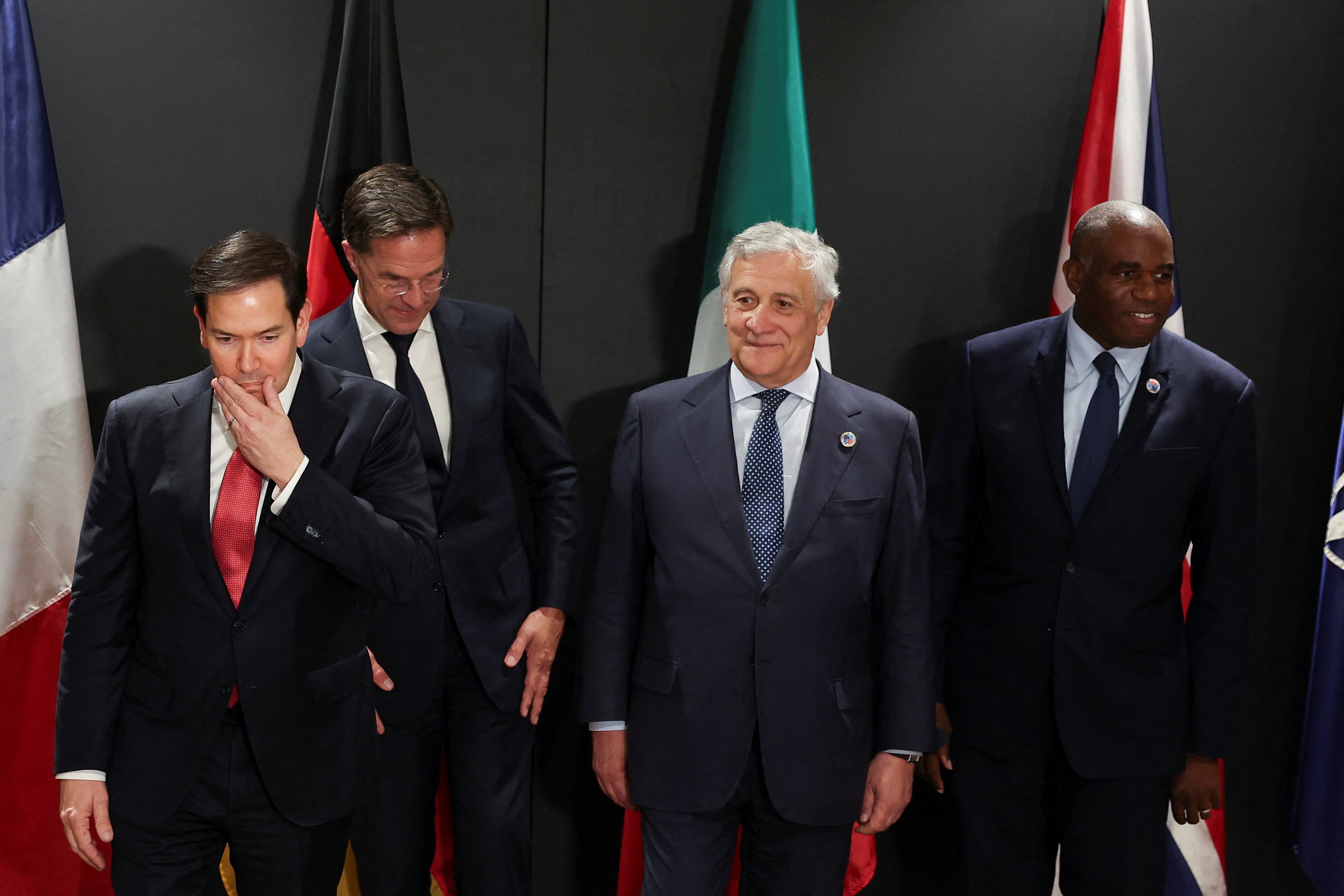
The NATO general secretary, Mark Rutte, has urged this Thursday from Turkey to allied countries to significantly increase their defense expenditure, with a view to reaching the annual alliance summit in The Hague, at the end of June, with a new agreed objective, which the United States insists to be 5% of GDP. Although several countries already speak openly of the Dutch plan to reach that goal – which is increased in the net defense expenditure up to 3.5% and the other 1.5% is committed to broader security expenses – by 2032, Routte has rejected officially confirming a figure and calendar, limiting himself to talking about a double spending route and a “much more ambitious” goal.
What has made clear during the informal meeting of NATO Foreign Ministers in the Turkish city of Antalya is that this must be much higher than the 2% agreed in 2014 in Wales and that countries like Spain will only meet this year, a decade later. The Spanish Government states that in 2024 it spent 1.4%and this year it will reach 2%, although the latest official NATO statistics attribute 1.28%, which places the queue of the alliance. “2% is clearly insufficient,” Routte has risted at the end of the appointment, in which he has celebrated that more and more countries announce their arrival to that commitment, which a year ago only met 22 of the 32 Member States.
The last one has been Italy, whose foreign minister, Antonio Tajani, has announced in Türkiye that his country arrived at 2% spending. As Rutte has revealed, also Luxembourg and Slovenia confirmed in the past days that this year will reach that commitment, as soon as Spain or Belgium did.
“We are on the right track,” said the former Dutch prime minister, who has still been emphatic when insisting that not only that level must be raised, but that a “credible path” is required to reach it in the coming years, predictably by 2032.
The appointment in Turkey, where a key encounter between Russia and Ukraine was also prepared that in the end has been reduced by the absence of Russian president, Vladimir Putin, is the penultimate great meeting – there will still be another of defense ministers in Brussels at the beginning of June – so that the alliance leaders arrive at Hague with a new expense expense plan.
The idea is that an agreement is achieved that can meet the demands of the Donald Trump government – and thus avoid that the US is disconnected from NATO, the great shared fear – but that is also assumed by the countries that are still far from the figure of 5% raised, which are the majority, especially the great Member States.
Given this dilemma, Rutte has raised a double approach: on the one hand, increase strict 3.5%defense. And, on the other, dedicating another 1.5% to expenses related to a broader concept of security, such as infrastructure and military mobility – in Turkey it has evoked the need, for example, that European bridges are able to support the passage of a tank -, cybersecurity, resilience or “support for partner countries”, as it has also said in Antalya.
The Turkish meeting has been the first time that the Foreign Ministers, including the US Secretary of State, Marco Rubio, have been able to discuss this scheme, raised at the beginning of the month and that Dutch prime minister Dick Schoof, publicly confirmed last week.
Without explicitly alluded to the 5%figure, which, however, did reaffirm the new US ambassador to NATO, Matthew Whitaker, on the eve of the appointment, Rubio has made it clear that Washington expects spending commitments very closely up to all allies. “NATO has the opportunity to become stronger.
Several countries have already collected the American glove. The new German Foreign Minister, Johann Wadephul, has been willing to “follow” the US lawsuit, which has earned him a public applause of Rutte, who has celebrated that Germany, which has even approved a constitutional reform to increase its defense expenditure, “be taking the lead” in the matter. Also its French couple, Jean-Noël Barrot, has considered more feasible to reach 5% in a fractional way. “3.5% is the right objective for basic defense spending,” he said in Antalya. “But this is accompanied by expenses that will contribute to increase our defense capacity, which are not direct defense expenses, but that must be done,” such as cybersecurity or military mobility, he added.
However, no one is fooled that “difficult discussions” remain ahead, as said the head of the Dutch diplomacy, Caspar Veldkamp, to reach what Routte already calls the “Hague Investment Plan.”
“It is clear that we must increase defense spending in the coming years,” Veldkamp summarized. Something necessary, he has indicated, because the alliance must “reinforce its deterrent capacity.” But also, he has recognized, “because the United States has made it very clear to Europeans” to “assume more responsibilities” for their own security.
For more updates, visit our homepage: NewsTimesWire