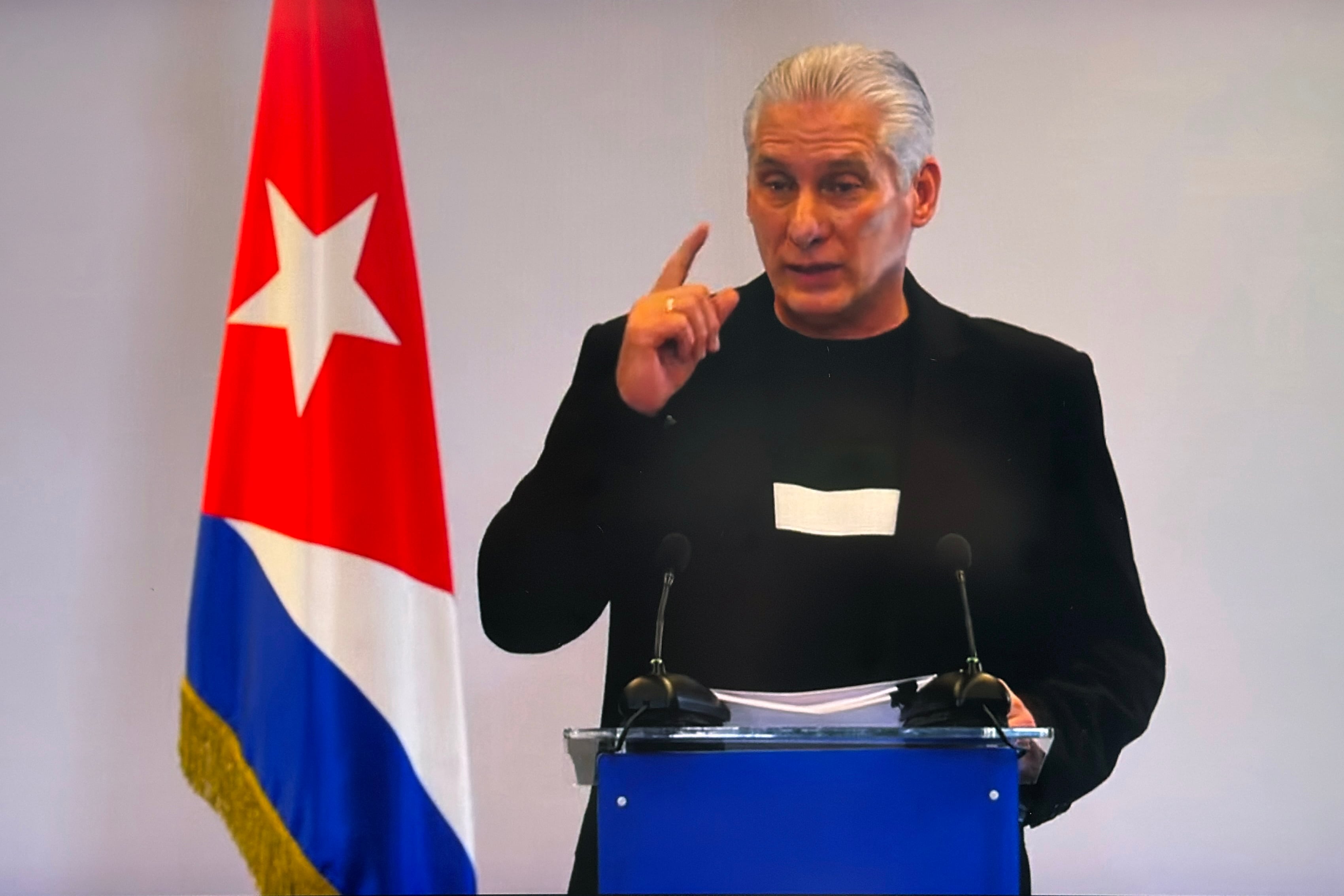
Cuban President Miguel Díaz-Canel made it clear, in the midst of tensions with Washington, that “Cuba is willing to engage in dialogue with the United States,” a position of “continuity” that, according to him, was first defended by Fidel Castro, and later by his brother Raúl. His appearance this Thursday morning is the first televised address to the people of Cuba after the capture of Nicolás Maduro on January 3, after for several weeks the Cuban authorities limited themselves to sending quite moderate messages on X, where they had already made clear their willingness to dialogue with the Americans. However, the Cuban president insisted that any negotiation would be done “without pressure”, “without preconditioning, in a position of equals, of respect for our sovereignty, independence and self-determination.”
“There are many things we can work on together, without prejudice,” insisted Díaz-Canel, who arrived at a press room dressed in black, and stood on a podium alongside the rest of a young Fidel. “Of how many things we deprive both peoples of because of this decadent, arrogant, criminal blockade policy.” He also insisted that any dialogue would be a function of “building a civilized relationship between neighbors that can bring mutual benefit to our people.”
Although President Donald Trump recently declared that his Government would already be holding talks with Havana, Cuban authorities have until today denied this statement. In his speech on Thursday, Díaz-Canel did not allude to the fact that they are already maintaining a dialogue with the United States, but his Vice Minister of Foreign Affairs, Carlos Fernández de Cossío, assured in an interview with the EFE agency that “that dialogue has not started.”
Díaz-Canel’s public appearance comes at a time of total uncertainty for the country, which has already begun to feel the weight of the lack of the almost 40,000 oil that arrived from Venezuela and the restrictions on a supplier like Mexico. The lines to buy fuel are kilometers long on the island, the sale of gasoline on the black market has doubled, and blackouts, which were already the order of the day, have intensified, accumulating up to more than 20 hours a day. According to the Cuban president, the rhetoric of the United States government continues to be “the theory of collapse” betting on economic asphyxiation, to promote the idea of the “failed state.”
Certainly, the Republican administration has not given any indication of carrying out a military operation in Havana like the one it carried out in Caracas at the beginning of the month, but rather betting on an economic drowning of the regime, especially now that they have decreed a “national emergency” and the imposition of an increase in tariffs on goods from those countries that supply oil to the island. To this panorama, Díaz-Canel has responded with a rather ethereal concept that he has repeated in previous days, even in other moments of the extreme crisis that the country has been going through most strongly for at least five years: that of “creative resistance”, which has translated into more hunger and vicissitudes for the Cuban family. “I am not an idealist, I know that we are going to live through difficult times, but we are going to overcome it together, with creative resistance,” he said.
Other questions were answered in the press room where only journalists related to the Cuban Government were present. Regarding the question of monitoring relations with Venezuela, now that Cuba has even begun to return some of its health professionals to the island on medical missions, Díaz-Canel warned that the agreements will be maintained to the extent that the Government of the South American country is open to collaboration. “We do not impose collaboration, we share it when governments or nations ask us to,” he said. “Collaboration will be maintained to the extent possible, under these restrictions.” And he added that “Cuba will be willing to collaborate” as long as the Venezuelan government is open.
For more updates, visit our homepage: NewsTimesWire