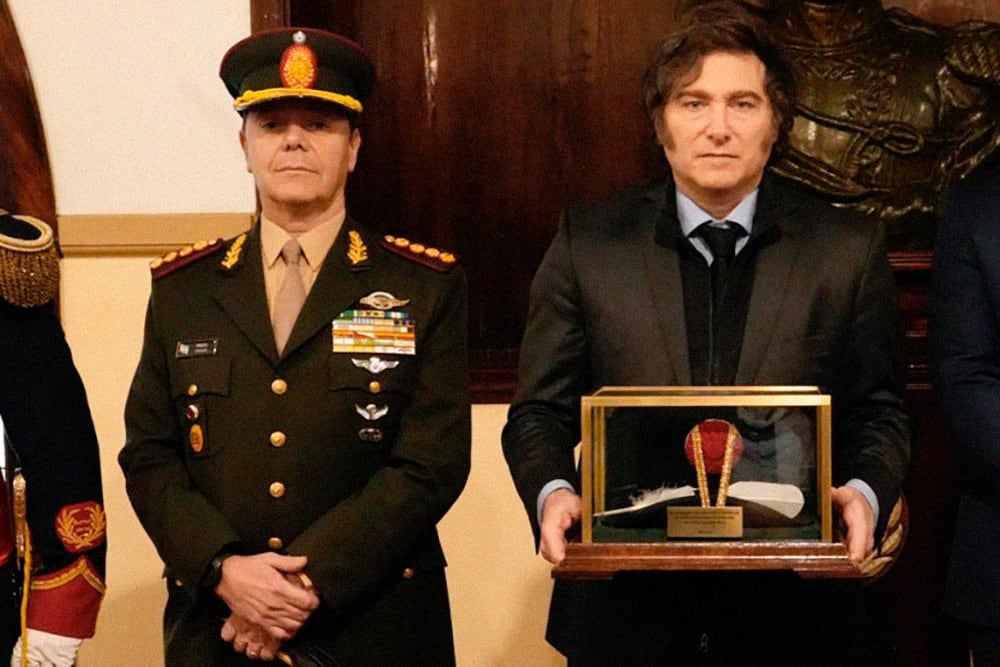
A military man will be Minister of Defense of Argentina for the first time since the end of the dictatorship, in 1983. The president, Javier Milei, announced this Saturday that the head of the Army, Lieutenant General Carlos Presti, will replace Luis Petri, who on December 10 will assume a seat as a national deputy. The decision has enormous symbolic weight and this was made known by the Government in the statement with which it confirmed the appointment.
“For the first time since the return of democracy, a person with an impeccable military career, who has reached the highest rank in his ranks, will be at the head of the ministry that will be in charge of national defense and the Armed Forces, inaugurating a tradition that we hope the political leadership will continue from now on and ending the demonization of our officers, non-commissioned officers and soldiers,” says the official text.
The last military officer in charge of the Argentine Ministry of Defense was Rear Admiral Norberto Couto. The sailor was fired in December 1981 and the military junta appointed a civilian to replace him, the lawyer Amadeo Frúgoli, until then Minister of Justice. Frúgoli lasted less than nine months in office and was replaced by another lawyer, Julio Martínez Vivot, minister until the end of the dictatorship on December 10, 1983. The successive democratic Argentine governments reserved the Ministry of Defense to a civilian, a tradition that no one dared to break, while the convictions against military leaders accused of crimes against humanity continued. For Milei, the tradition was evidence of a “demonization” of the Armed Forces that he has proposed to end.
Along with the position of new Minister of Defense, the Casa Rosada announced that the current number two in the Ministry of Security, Alejandra Monteoliva, will replace Patricia Bullrich, senator-elect for La Libertad Avanza. “Monteoliva has been a fundamental piece of the Bullrich Doctrine, which establishes as a priority the frontal fight against narcoterrorism and criminal organizations, and the maintenance of the rule of law and order in the streets of Argentina,” says the statement of his appointment.
That the names of the new ministers have been known simultaneously demonstrates the effort to show continuity in the management of two areas that the Government considers essential, so much so that they have been safe from Milei’s chainsaw. Last year, the Ministry of Defense invested more than 300 million dollars to purchase 16 used F-16 combat aircraft from Denmark, an expense unthinkable in other areas of the Administration.
Milei was forced to change the Ministers of Security and Defense because both were elected on October 26 to occupy legislative positions. They were not, however, the only movements in the Cabinet. Three weeks ago, Milei lost its chief minister, Guillermo Francos, the friendliest face of the Government. Francos left his position fed up with internal pressures. The Minister of the Interior also left with him, a man he trusted.
For more updates, visit our homepage: NewsTimesWire