After a tough defeat in the Chamber of Deputies, and while a protest was taking place by the country’s large union federations, the Government of Javier Milei backed down and decided to postpone until 2026 the labor reform that, until yesterday, it intended to approve before the end of the year. The triumphant momentum that propelled the far right since its victory in the midterm elections last October found an abrupt halt in public universities and the health care system for people with disabilities.
The new attempt by the Executive to adjust these sectors once again met with parliamentary rejection, ratified again and again during the year. In the early hours of this Thursday, the deputies approved the national budget sent by Milei, but rejected his intention to repeal two laws passed a few months ago to replace part of the university and disability funds devastated by the presidential chainsaw. The Government hoped to have support in a renewed Chamber where, after the last elections, it is the first minority. But the rejection was majority, accompanied, even, by some of his allies.
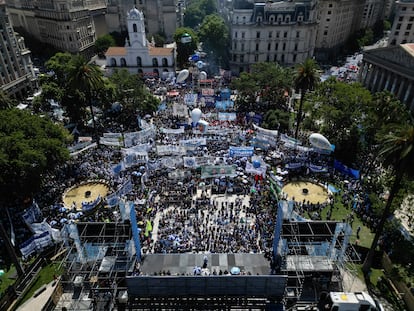
Hours later, the unions of the General Confederation of Labor (CGT) protested in the Plaza de Mayo to express their disagreement with the reform of the labor regime promoted by Milei. The initiative proposes reducing severance pay and employer contributions, making salary negotiations more flexible, repealing current agreements and limiting the right to strike, among other things.
“Defeated are those who stop fighting.” “I would rather die standing for a just cause than live on my knees and die of hunger.” “We do not want slave labor and pension reforms.” That’s what some signs, many handwritten, that the protesters carried said. “No to labor reform” was the most repeated legend.
Under an oppressive sun that brought forward the summer in Buenos Aires, the columns of workers spread out through the center of Buenos Aires from midday. The groups arrived with flags and clothing that identified their unions: there were oil workers, state workers, teachers, commercial employees, truckers and transporters, among many others. Bass drums, snare drums and trumpets put rhythm to the calls; The smoke from the flares drew traces of color.
In addition to the CGT, the two branches of the Central Workers of Argentina (CTA) also called for the protest, with their own columns and a joint flag: “No to the Milei reform.” Social organizations and left-wing parties also participated in the mobilization, which had expressions in other cities in the country.
The stage set up in the middle of the Plaza de Mayo, with its back to the Casa Rosada, bore the slogan: “In defense of work and dignity.” Under its protection the central act of the mobilization was carried out. First, a document was read where the labor reform was defined as “regressive and precarious.” “Under the discourse of modernization and competitiveness,” the CGT stated, “the aim is to advance individual and collective rights, weaken (…) union organizations and impose a model of labor relations that deepens precariousness, informality and inequality.”
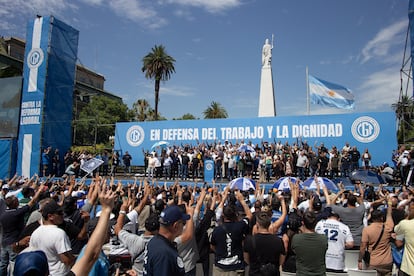
Then the main leaders of the CGT spoke. “The labor reform is maliciously written in favor of the large corporations in Argentina,” said Cristian Jerónimo, one of the leaders of the center. “276,000 jobs have already been lost and 20,000 SMEs (small and medium-sized businesses) have closed. What successful model are they talking about?” he asked.
The closing was in charge of Jorge Sola, another union leader. “This is the first step of a fight plan. Continue not listening to us and we will end up in a national strike,” he warned the Government. And he concluded with a reply to the slogan libertarian that Milei often repeats: “There is no freedom without social justice, no matter who it is.”
While thousands of workers demonstrated in the streets, within Congress, in a Senate committee, the labor reform was debated. The Government had announced its intention to give him a half-sanction before the end of the year, but this Thursday it gave up and announced that it will postpone the discussion at least until February, when the extraordinary sessions will resume. The previous night’s defeat in the Deputies, as well as the pact between the ruling party La Libertad Avanza and the Kirchnerist bench to appoint auditors, called into question the solidity of the coalition built by the far right. Its foundations were cracked, based on agreements with the conservative PRO party – headed by former president Mauricio Macri – and with provincial forces of different stripes, seduced by the sending of national funds.
For more updates, visit our homepage: NewsTimesWire