Gustavo Petro prepares a risky bet. The president of Colombia will premiere next week the Presidency pro tempore from the Community of Latin American and Caribbean States (CELAC) with a trip to Beijing. There will take place the fourth meeting of Foreign Ministers of the Celac-China Forum, with the manifest purpose of strengthening ties with the Asian giant despite the fears of irritating the United States, its main commercial and military partner, in the middle of the tariff war unleashed by the administration of Donald Trump. “Latin America must open to everyone. It will dialogue with China and the European Union,” said the Colombian president. In Beijing he will be accompanied by Brazilian Luiz Inacio Lula da Silva and Chilean Gabriel Boric, but Bogotá’s position in the great geopolitical pulse between the two powers is particularly sensitive.
The first president of the Contemporary Colombia has reported that he intends to join in some way to the initiative of the Strip and the Route, the official name of the new Silk route, the great Chinese commitment to increase its global influence, which already incorporates more than a hundred countries, about twenty in Latin America. The announcement has crushed the spirits. Its scope and repercussions are still a reason for debate, with divided opinions. Petro has already visited his counterpart Xi Jinping in October 2023, but then he did not specify the agreement of intention that is now intended to sign. “The next governments will see if it goes from intention to reality,” he defended this week to stop criticism.
The Chancellor, Laura Sarabia, had summoned for Thursday a meeting of the Foreign Relations Advisory Commission – an advisory body to which they are invited, among others, all living former presidents -, to address that notable diplomatic turn. But Petro disavowed her flat, remembering vehemently during a speech that he is “the head of Colombia’s foreign relations.” The Foreign Ministry ended up canceling the meeting “on the instructions of the President,” reported in a brief statement. “The United States must continue to be a strategic partner, a commercial partner for Colombia, we will continue to bet on him. But that does not mean that Colombia cannot look towards other scenarios,” Sarabia clarified.
Bogotá is a traditional Washington ally, but Petro’s short relationship with the Trump administration has been sown with disagreements. Among others, he is the largest affected on the continent with the cuts to the Usaid cooperation agency. In January, the Colombian economy appeared to the precipice when the Republican threatened her with her tariff club, after Petro returned two planes with Colombian deportees that came handcuffed. That first crisis was resolved in less than 24 hours thanks to the mediation of diplomats, former presidents and businessmen, but evidenced the need to diversify Colombia’s relations with the world. The exchange of goods and services between the two countries reached 36.7 billion dollars in 2024, with a surplus of 1.3 billion dollars in favor of the United States.
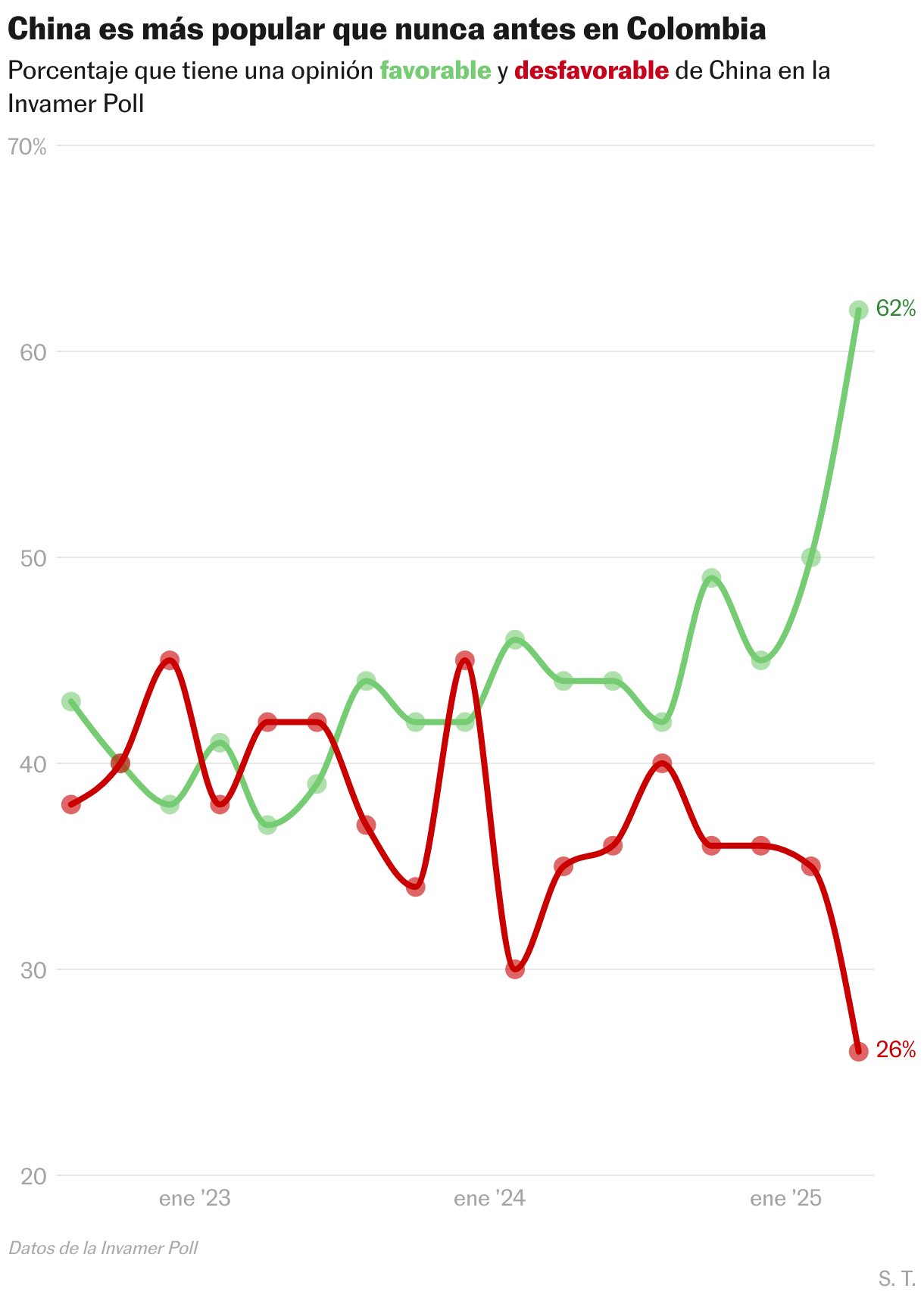
The Petro government, in any case, had already announced in October its purpose of joining the initiative of the Strip and the Route, the infrastructure megaprogram with which China seeks to connect to the world, waiting for the corresponding negotiation. The president has maintained a cordial relationship, and appointed the filmmaker Sergio Cabrera, with deep ties with the People’s Republic of China. As in the rest of the region, the Chinese influence is on the rise and its image has rebounded (see graph). The largest infrastructure projects in transport and mining in recent years have gone to companies of the Asian giant, including the first line of the Bogotá Metro. The exchange moves about 17,000 million dollars a year, but with obvious imbalances. Colombia exported 2,377 million dollars in 2024 and imported 15,936 million dollars.
“The eventual approach must be guided by a fundamental question: what do we win and what we risk? Decisions must be based on verifiable realities, not yet to materialize,” says the president of the American Colombo American Chamber of Commerce, María Claudia Lacouture. “In a context of high geopolitical and commercial sensitivity, where the United States expresses concerns in the face of China’s expansion in the region, every high -level political gesture requires a responsible evaluation, based on national interest and a long -term vision,” adds the ex -business minister.
Although the Foreign Relations Advisory Commission did not meet, the episode allowed to ventilate opinions found. “My government never agreed to subscribe to Colombia in that initiative,” said former right-wing president Iván Duque (2018-2022), Petro’s predecessor. “It could not only fracture and shatter 200 years of relationship with the United States, but to put the interests of our country in serious situation,” he warned. Several observers remember the case of Panama, which withdrew from the strip and the route in February to the US pressures to limit Chinese influence on the Panama Canal.
In the opposite direction, another former president, Ernesto Samper (1994-1998). Gústele or does not like the United States and the guilds, Petro’s trip is “a historical opportunity for our country to enter the Strip and Route (BRI) initiative, which seeks to increase trade, investments, financing and cooperation between China, Asia and the rest of the world,” said Samper. “As president of the CELAC, he could present a series of initiatives that interest the region, such as the diversification of its trade, at a time when the United States closes doors to our exports,” he valued, in addition to advancing in key programs such as the energy transition, a new financial architecture that incorporates the Bank of the BRICs or the development of infrastructure works, among others. “We cannot put ideology to international relations,” he warned.
Petro has not sold it as if it were a concerted, thought or strategic step, points Sergio Guzmán, director of the Colombian consultant Risk Analysis. “It should be a state decision, and transcend Gustavo Petro’s government as a result of a consensus in which he is beneficial for the country. The president has not concentrated on working that, but in doing so as a personal whim, a rematch for his confrontation with Trump,” says the analyst. He also points out that he has healed efforts to listen to entrepreneurs or opposition sectors that ask for more prudence. Petro has tried to emerge as a leader who speaks in Latin America, but his speech is divisive, Apuntilla.
The president’s visit to China “must promote diplomatic relations, while preserving our strategic autonomy and national interests, based on a broad national consensus,” the Colombian Council of International Relations (CORI) agreed, in which several excazilleres participate, in a statement. “Our foreign policy must be exercised from the construction of a broad national consensus and a plural and fluid dialogue with different civil society actors, the private sector and the academy.”