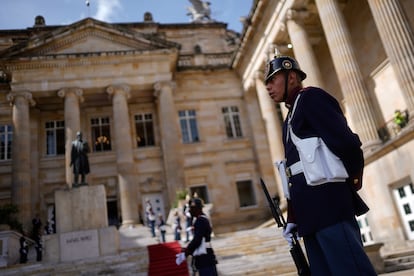
From the elliptical hall of the National Capitol, President Gustavo Petro went to the Legislative this Sunday, in the installation of the last period of the Congress of the Republic, for almost three hours. He did not take a single sip of water. The president presented an extensive balance of what, in his opinion, are the achievements of his government. With a progressive bench sitting on his left and an opposition visibly upset by his statements, he resumed the flags that characterized him in his time as a senator: his complaints of paramilitarism, false positives, massacres, chuzadas or illegal interceptions of the state. “They no longer discuss whether young people should be massacred. We now discuss the problems of the people, and that is called democracy,” he said.
The Head of State started with a reflection on democracy in Colombia, one that did not begin in the nineteenth century after independence, he says, if a good part of the population was enslaved; nor in the times of the twentieth century in which political leaders such as the liberal Jorge Eliecer Gaitán were murdered. But entered the 21st century, not to mention his name, he toured the scandals of former president Álvaro Uribe, starting with parapolitics.
“It cannot be called a democracy when the opposition ends up persecuted by the DAS, even for its own escorts. It cannot be called democracy when magistrates are persecuted to intimidate them and force them to issue sentences of impunity, or when the press is intimidated because journalists murdered,” he said retaking the anti -urbist tone that characterized him for years. He did not mention, among the threats to democracy, the recent attack on the Uribista senator, Miguel Uribe Turbay, who is still in the process of recovery in a clinic.
Then it was time to show the figures. With ovations on the one hand and boos of the other, the president stressed that he arrived at the House of Nariño with an inflation of 13.8 %, and that it was reduced to 4.82 %, a result that sees as its own although it is also related to external dynamics. In any case, Petro announced that, thanks to the minimum wage increases, the economy has grown 2.7 %. “I uploaded the minimum wage like none. I still have a year, I will take advantage of,” he said.
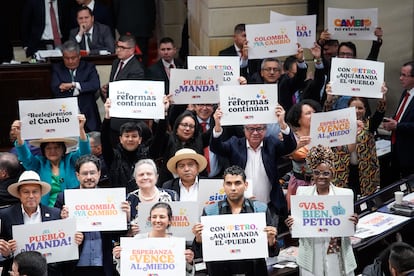
In the last legislative year of his mandate, Petro took the opportunity to insist on what has been his main political cause: social reforms. “I want to thank the majorities of Congress for their attitude when they decided to approve the labor and pension reforms. A congress that tuning with the general interest and social justice,” he told parliamentarians. “This congress is a magnificent congress. We had not had times.” He also put his priorities on the table for the year, such as health reform.
The president defended that health reform, one of his most controversial and that begins his third debate in this legislature. “We have launched the preventive system, which I consider the most relevant aspect of the reform. If Congress approves it, this model will run entirely. Law 100 never contemplated a preventive health approach,” he said about the reform that wants to end the figure of health providing entities, or EPS, public resources managers. When the opposition shouted that the country is running out of insulin, the head of state said it is “because you have monopolized it, and I have ordered the police to rescue it.”
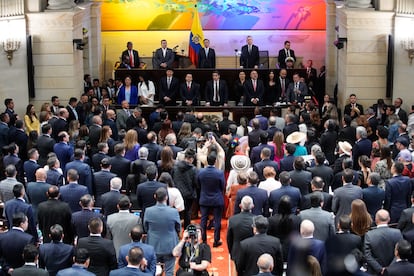
Petro, who usually complains that his ministers do nothing like him asks them, dedicated a few seconds to recognize the Minister of Health, Guillermo Alfonso Jaramillo, to receive applause from the official bench. “You, Minister, have implemented the preventive system, of which we both had an experience in the human Bogotá (in the Mayor’s Office of Bogotá, in 2011) with identical results, it has managed to reduce the number of children under five who die,” he said while the government bench cheered him.
The president also referred to other nerve themes of his agenda, such as the export of coal to Israel. He mentioned the Israeli attacks on Palestinian territory of Gaza and reiterated that, according to him, Colombian coal is used in the manufacture of war explosives in Israel, something that the two large coal exporting miners in Colombia, Drummond and Glencore, have denied. “I will use the instrument that the World Trade Organization treaty allows outside the FTAs and any commercial contract, when the contractor is causing or complicit of genocide against humanity,” he warned against companies.
A year ago Petro started this same speech asking the country to have appointed Olmedo López as director of the National Risk Management Unit (UNGRD), in the center of the largest corruption scandal of the government. This year he did not mention a word in this regard, despite the fact that his Minister of Finance is being investigated for justice for the same scandal and, recently, the Prosecutor’s Office requested arrest warrant against Carlos Ramón González, his former administrative director in the Presidency, for the same subject.
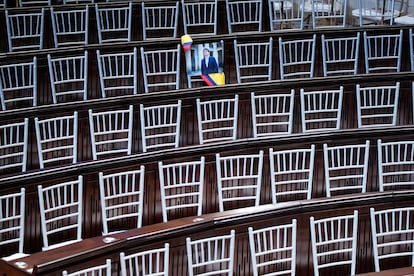
The president put several figures on the table with which he sought to show that infant mortality has been reduced during his government. The opposition did not pass that Olmedo López recognized before justice a plan to divert public resources from a contract that sought to bring drinking water to the most vulnerable communities of La Guajira, the department with more child malnutrition in Colombia.
Then came the thorny issue of security, which not only the opposition but several independent analysts see very deteriorated: the kidnappings, children’s recruitment, have increased, and the murders of peace signers and social leaders follow. The president did not focus on that. “There has been a historical reduction of thefts, and 662 municipalities of Colombia have no homicides; success of this government,” he said amid shouts against him. The president made reference to the sustained rise in the crops of illicit use, which has been far from decreasing in his mandate, but attributed it to the recent drug consumption peak in Europe, and the alleged intervention of foreign. “Those who control the Colombian territory in coca cultivation areas are foreigners,” he said.
In a kind of confession, the Head of State acknowledged that the one that was the flag of his government, the total political peace project with which he intended to negotiate simultaneously with all armed groups and criminal gangs, has not had good results. “This government has not achieved total peace,” he said without giving details about the stumbling blocks of the dialogue tables. What he did, once again, was the alleged link of Iván Bite, the head of the central General Staff of the FARC dissidents, what he has called the new drug trafficking board in Dubai, a group on which the Prosecutor’s Office has no evidence of its existence in that emirate, but to which the president points out of being the brain of the crime in Colombia. On that Board, he made a shy allusion to the attack on the Senator of the Democratic Center, Miguel Uribe Turbay, on June 7. “If there came the order to attempt against a senator, such as the order to kill the president … The Secondons operated, but the intellectual authors live in Dubai,” he said.
The president devoted his last minutes to talk about education, and took the opportunity to launch former ministers in that portfolio, whom he has already pointed out of having betrayed him, especially the economist Alejandro Gaviria. “They ended up being more from the right than progressive.” He assured that the Government has managed to open 155 thousand new quotas in the public university, and that in its mandate does not want to give priority to the educational credits of the Government, managed in the Icetex, that they go to private institutions: “We do not want with the public treasury to subsidize the private university.”
Petro entered the enclosure without his vice president, France Márquez, and also abandoned him without her, who sat at a prudent distance of the head of state. The relationship has reached its worst point after this questioned it in a Council of Television Ministers in February, where she alluded to a possible blackmail from the Interior Minister, Armando Benedetti, the president. Petro did not forgive his offense, and things got worse when he heard Álvaro Leyva audios mentioned to Márquez. The president did not speak today, the Ministry of Equality, or the Vice Presidency. He only left a phrase for those who continue to think that someone extorts him: “I have no chains, I don’t owe anyone, and no one can extort myself or blackmail myself.”
For more updates, visit our homepage: NewsTimesWire
https://elpais.com/america-colombia/2025-07-21/petro-defiende-las-cifras-de-su-gestion-ante-el-congreso-sufro-gobernando-este-pais.html