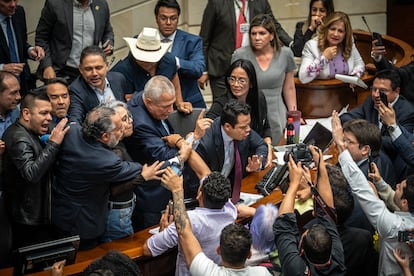
This Wednesday has been a difficult day, politically, for Gustavo Petro’s government. After raising for more than two months the right to a popular consultation, which sought to relive 12 points of a labor reform that the legislature sank in last March, the Senate plenary has denied its endorsement to take the polls. It was a fraud, the government denounces. An opportunity, weigh voices of the political center. A total victory, celebrates the opposition. “It was time for the people,” the president replied in a brief speech from China, where he advances a diplomatic mission. He summoned citizens “to gather in open council in all the municipalities of Colombia” to demand the defense of the consultation. And he closed with a petition: “I ask the Senate to put the popular consultation again.”
The president has compared what happened in the Legislative with another key historical moment in his political history: the presidential elections of April 19, 1970, in which an alleged fraud that created the guerrillas of which the president today, the M-19 today was pointed out. With the comparison, Petro does not call the insurgency, he clarified in his speech, because he asked to protest without breaking a glass. But he did claim that defeat, 49 to 47 in the Senate, was a fraud. That he was not allowed to vote for one of his allies, Senator Martha Peralta (who was absent); that the secretary of the Senate would have changed the vote of an opposition senator in the last minute (the congressman disputes that version); That the president of the Senate, the conservative Efraín Cepeda, closed the vote suddenly. “Mañoso,” he said, “believing that the story of Colombia is made, and so they are only clown.” Senator María José Pizarro, of the Historical Pact, appealed the vote, which will give rise to a legal debate.
Politically, the Senate’s decision has several implications. Some analysts have considered it an opposition error because in recent months it has been clear that public opinion would vote for the popular consultation and, above all, would overwhelmingly support the 12 questions the government proposed in this. The president understands that this has been the flag that has mobilized the most public opinion in his favor, so he invites people to discuss the importance of their proposals in open councils. Do not approve the consultation feeds the president’s narrative that the legislative opposes any social reform proposed by the Executive, thus being popular. And deny the request to vote it again, so I do not have a legal support to do so, endorse it.
For other analysts, the decision is an opportunity, although risky, of the Legislative. Since the seventh commission of the Senate sank the labor reform in March, the Liberal Party presented its own mini-reform, taking up some points that rejected the government. This Wednesday, before denying the popular consultation, the senators decided to make another decision: if they gave free way to an appeal that could resurrect Petro’s labor reform. The majority voted in favor, and the reform revived. With this, the opposition assumes the political cost of sinking the consultation, but recognizes that public opinion requires changes in labor matters. Open the door to remove the flag from the government by approving the liberal mini-form or even Petro’s, perhaps with adjustments.
The Interior Minister, Armando Benedetti, insisted on the debate on Wednesday that the opposition revives the reform to sink it again, because they will not approve it in both of them discusses before June 20, when the legislative period ends.
Senator Angélica Lozano, of the Green Party and one of those proposed by the appeal in March, points out, on the contrary, that time is enough. “The appeal is to play clean and hard, and well to the workers, to approve the labor reform. Or it will also be clear what the objective (of the government) was: to do the labor law or to campaign?” He said, remembering that a consultation does not transform the law, and that if the questions are approved, the Congress should then process a reform to put them into practice. For Lozano, as for the opposition and several analysts, the call for consultation was a vehicle that would help Petrism in the presidential 2026 and that is why they defended it by cape and sword (literally citing Bolivar’s sword).
What remains after the resurrection of labor reform and the death of popular consultation is a fight for political prominence. The president starts with an advantage in credibility against workers, because the Senate has sunk his reform in March and his popular consultation in May. And, if Benedetti is right, possibly sink the reform again in June, which would justify that Petro asks today that the Senate returns to vote the popular consultation. The opposition can only fight prominence if you can carry out any law.
“If there is true will on the part of the opposition, it has the opportunity to demonstrate that it is not dedicated to institutional blockade. The non -systematic is not an alternative,” said Petro’s former Minister Juan Fernando Cristo, after the vote. “If today’s vote was just a hoax on the part of the opponents, the government can insist on the popular consultation to summon citizens,” he added. Something similar asked for Roy Barreras, former Petro -expire who aspires to the presidency next year. “Nobody has lost. Nobody has won. You can still win the wisdom,” he wrote in his X account.
Humberto de la Calle, a former centrist and critical senator of Petro, but who does not commune in the opposition, agrees that, whatever, “a labor reform in Congress must be approved. Time is short, multiple political plays, and the fight for workers’ rights remains at stake.
For more updates, visit our homepage: NewsTimesWire