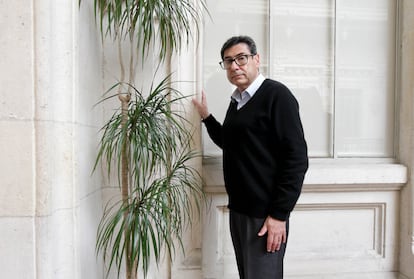
The Swedish Academy of Sciences has awarded Joel Mokyr, Philippe Aghion and Peter Howitt with the Nobel Prize in Economics, officially known as the Bank of Sweden Prize in Economic Sciences in Memory of Alfred Nobel, “for having explained economic growth driven by innovation.” The award, which since 1969 has honored outstanding work, research and discoveries in the economic field, has highlighted Mokyr’s ability to identify the prerequisites for sustained growth through technological progress, and highlights that Aghion and Howitt have promoted the theory of sustained growth through creative destruction.
Mokyr (1946), economic historian and professor at Northwestern University in Illinois (USA), was born in the Netherlands, but has Israeli and American nationality. His greatest achievement, according to the jury, is the use of historical sources to discover the causes why sustained growth is the new normal. “He showed that, for innovations to happen in a self-generated process, we not only need to know that something works, but also have scientific explanations as to why. The latter was often lacking before the industrial revolution, making it difficult to develop from new discoveries and inventions. He also emphasized the importance of society being open to new ideas and allowing change.”
The Frenchman Aghion (1956), who teaches at the Collège de France, the London School of Economics and Harvard, and the Canadian Peter Howitt (1946), professor at Brown University in Rhode Island (USA), will share the other half of the prize. Both touch on a different leg of the explanation of the mechanisms that govern economic growth. “In a 1992 article, they built a mathematical model for what is called creative destruction: when a new and better product enters the market, companies that sell older products lose out. Innovation represents something new and, therefore, is creative. However, it is also destructive, since the company whose technology becomes obsolete is overtaken by the competition,” the academy emphasizes in the ruling, published on the edge of the noon.
At a time when artificial intelligence seems destined to change the internal processes of companies, and give a technological change that some compare with the birth of the internet, the theses of Aghion and Howitt, his collaborator, who won the Frontiers of Knowledge award in 2021 given by the BBVA Foundation, are more relevant than ever. In an interview with EL PAÍS on the occasion of his award, Aghion denied that obtaining the Nobel Prize was in his mind one day. “I don’t think about that. For me this award is magnificent and enough.”
With the shock of the pandemic still fresh at that time, Aghion lamented the European technological lag compared to the United States. “The crisis has revealed that Europe is not as good as the United States for innovation. It is a fact. Vaccines have emerged above all in the United States. And this despite the fact that messenger RNA is a technology developed earlier in Europe.”
The author of The power of creative destruction (Ed. Deusto), He also sees a less friendly side in this American innovation factory: he believes that the hegemony of giants like Google, Amazon, Facebook or Apple blocks the growth of other companies and discourages them from competing because they know that if they enter the market they can be harmed. dumping (sell a product below the market price). “The problem in the United States is that Competition policy is not adapted to the digital age, the only criterion is market share, and not whether they hinder the emergence of new firms.”
Regarding the other great geopolitical rival, China, he saw chiaroscuro. “They invest massively in research, they give enormous resources that we do not give in Europe. They are very good at imitating or improving technologies, but they have not made fundamental innovations, in part because the lack of freedom has consequences. Political power is afraid that companies are too powerful and question their power.”
After the awarding of the Nobel Prizes in Medicine, Physics, Chemistry, Literature and Peace, this Monday it was the turn of the last of the six awards, that of Economics, officially known as the Bank of Sweden Prize in Economic Sciences in Memory of Alfred Nobel. Like the rest, the reward is 11 million Swedish crowns, almost one million euros. Although the Economics Prize has its own particularities: it is awarded by the Royal Swedish Academy of Sciences, and although it is not officially a Nobel Prize, it is awarded following the same principles as the Nobel Prizes awarded since 1901.
In its short history, the award has had 96 winners in 56 editions, the first in 1969. Only three of them have been women: Elinor Ostrom in 2009, Esther Duflo in 2019, and Claudia Goldin in 2023, the only one who won it alone. Precisely, Duflo is also the youngest person to have won it, at 46 years old, while Leonid Hurwicz was the oldest, at 90 years old, a few months before his death.
In the last 2024 edition, the winners were Daron Acemoglu, Simon Johnson and James A. Robinson for their work on how to understand the differences that arise in prosperity between nations.
(Breaking news. There will be an update)
For more updates, visit our homepage: NewsTimesWire