Congratulations on your new home! As a first-time homeowner in Bowie, you’re likely juggling a dozen new responsibilities at once. From learning about your HVAC system to figuring out which day the trash gets collected, the to-do list can feel endless. Amidst all this excitement, there’s one crucial task you might not have considered: testing for radon gas.
If you’ve never heard of radon, you’re not alone. Many new homeowners are unaware of this invisible threat. Radon is a radioactive gas you can’t see, smell, or taste. It originates from the natural breakdown of uranium in the soil and can seep into your home through cracks in the foundation, gaps around pipes, and other openings. The Bowie area, with its specific soil composition, is in a zone where radon levels can be elevated.
The thought of an invisible health hazard in your new sanctuary can be unsettling. But knowledge is power. This guide will walk you through the straightforward process of Radon Gas Testing Bowie MD, transforming a potentially overwhelming task into a simple, manageable project. Taking this one step protects your most important investment—your family’s health.
What Exactly is Radon and Why Should You Care?
Understanding the “why” makes the “how” much more meaningful. Radon is a naturally occurring gas that is present in the air all around us, usually in harmless, low concentrations. The problem begins when it gets trapped inside a building.
As the air pressure inside your home is often lower than the pressure in the soil surrounding the foundation, your house can act like a vacuum, drawing radon in. Once inside, it can accumulate to dangerous levels. When you breathe, this radioactive gas can damage the cells lining your lungs. The U.S. Environmental Protection Agency (EPA) and the Surgeon General have classified long-term exposure to elevated radon as the second leading cause of lung cancer in the United States, after smoking.
This isn’t meant to scare you, but to empower you. The key fact is this: radon-related lung cancer is completely preventable. And it all starts with a simple test.
Your Step-by-Step Guide to Radon Testing
Testing for radon is easier than programming your new garage door opener. You have two main paths: a do-it-yourself kit or hiring a professional.
Step 1: Choose Your Testing Method
Option A: The Do-It-Yourself (DIY) Test Kit
This is a popular and cost-effective starting point for many homeowners.
- What it is: You can purchase a short-term test kit at a local Bowie hardware store or online for between $15 and $30. These are typically charcoal canisters or alpha-track detectors.
- The Process: You place the kit in the recommended location in your home (see Step 2) for a period of 2 to 7 days. After the testing period, you seal it and mail it to a laboratory for analysis. You’ll receive your results via email or a website login within a few days.
- Pros: Inexpensive and convenient.
- Cons: The responsibility for proper placement and handling is on you. Any mistakes can skew the results. There’s also a waiting period for lab results.
Option B: Hiring a Professional Radon Tester
For the most accurate and tamper-resistant results, many homeowners, especially during real estate transactions, opt for a professional.
- What it is: You hire a certified Radon Experts Bowie MD to conduct the test. They use continuous radon monitors—sophisticated electronic devices that measure radon levels hour-by-hour.
- The Process: The professional will place the monitor in your home for 48 hours. They will ensure all closed-house conditions are met. After the test, they provide you with a detailed, printed report on the spot.
- Pros: Highly accurate, tamper-proof, and provides immediate results. It eliminates user error.
- Cons: More expensive, typically costing between $150 and $300.
Step 2: Prepare Your Home for Accurate Results
For a short-term test to be valid, you need to create “closed-house conditions.” This doesn’t mean you have to leave your home, but it does require some simple adjustments for 12 hours prior to and during the entire test.
- Keep Windows and Doors Closed: Avoid opening exterior windows and doors any more than necessary. A brief, normal entry and exit is fine, but don’t leave the front door open while unloading groceries.
- Maintain Normal HVAC Use: You can and should run your heating or air conditioning system to maintain a comfortable temperature. However, do not use window unit air conditioners that vent air outside.
- Avoid Drafts: Do not run whole-house fans, fireplace drafts, or high-volume attic fans, as these can draw radon in from the ground at a higher rate.
Step 3: Execute the Test with Precision
Where you place the test device is critical.
- Location: Choose the lowest level of your home that is suitable for occupancy. For most Bowie homeowners, this is the finished or unfinished basement or a ground-level slab. If you have a walk-out basement where you spend time, that’s the perfect spot. The goal is to test the air in the area where you and your family would be living and breathing.
- Placement: Put the test kit at least 20 inches off the floor (away from the radon that may be settling) and away from drafts, doors, windows, and exterior walls. A table in the center of the room is often ideal. Keep it away from high heat or humidity, like a bathroom or kitchen.
Set a reminder on your phone for when the test period ends so you don’t forget to retrieve or send off the kit.
Understanding Your Results and Next Steps
Once you have your results, you’ll get a number measured in picocuries per liter of air (pCi/L).
- Below 2.0 pCi/L: While no level of radon is considered completely safe, this is a low result. The EPA recommends considering mitigation if levels are between 2.0 and 4.0 pCi/L, but a result below 2.0 is generally seen as very good.
- Between 2.0 and 4.0 pCi/L: This is a gray area. You may want to consider a follow-up test, either a long-term test (90 days to a year) to get an average, or a second short-term test to confirm the reading.
- At or Above 4.0 pCi/L: This is the EPA’s official action level. If your result is 4.0 pCi/L or higher, you should take steps to mitigate the radon in your home. Don’t panic. This is a common and fixable issue.
If Your Results Are High: The Mitigation Solution
A high radon level is not a reflection on your home’s cleanliness or your skills as a homeowner. It’s a geological issue with a proven engineering solution.
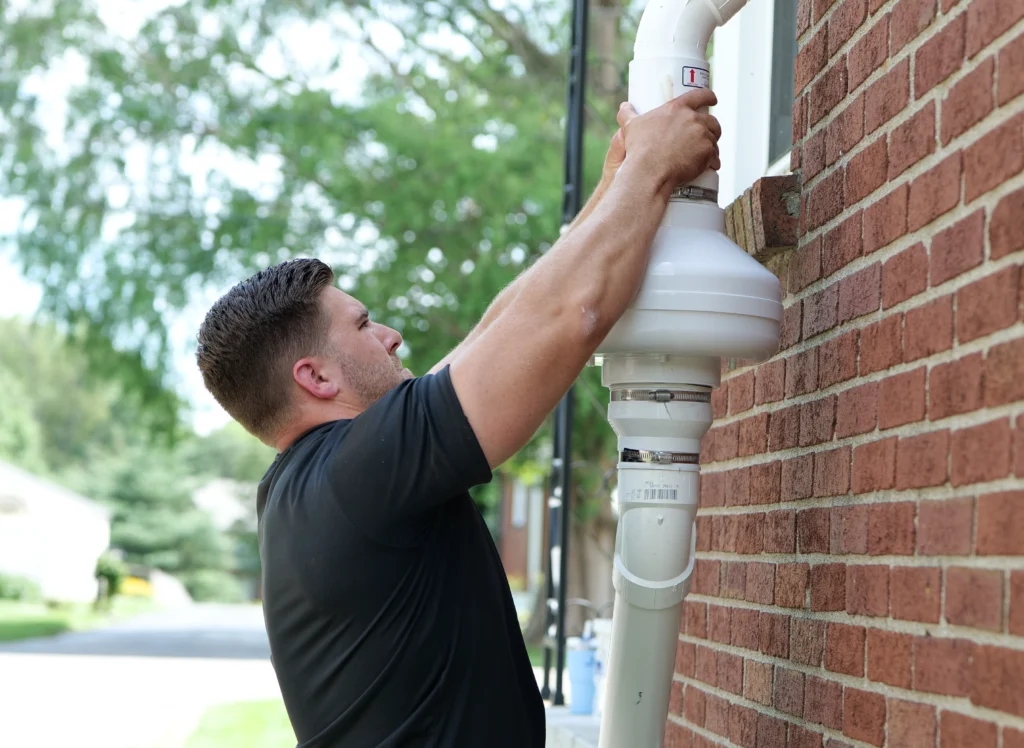
The most common and effective method is called Active Soil Depressurization (ASD). A certified radon mitigation professional will install a system that includes a vent pipe and a special fan. This system actively pulls radon gas from beneath your home’s foundation and vents it safely above the roofline, where it quickly dissipates. These systems are remarkably effective, often reducing radon levels by over 90%. The process is typically completed in a day and is not overly disruptive.
The Peace of Mind That Comes with Knowing
Completing your first radon test is a rite of passage for a responsible homeowner. It’s a simple action that delivers profound benefits:
- Health Security: You are proactively safeguarding your family’s long-term health, reducing the risk of radon-induced lung cancer.
- Financial Protection: Your home is your largest investment. Addressing radon protects its value and prevents potential complications during a future sale.
- True Peace of Mind: You can rest easy, knowing the air your family breathes in your new Bowie home is safe. The uncertainty is replaced with definitive knowledge.
Taking this first step is a powerful demonstration of care for your new home and the people who live in it. By understanding and executing Radon Gas Testing Bowie MD, you’ve gone beyond being a homeowner—you’ve become the guardian of your family’s well-being.