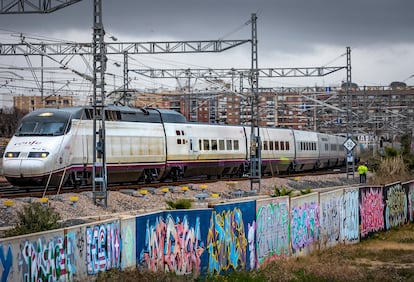
Almost 40 million travelers used high commercial speed in 2024, 22% more than the previous year and 77% more than in 2019, the last year pre -candidia and pre -liberalization, according to the annual report of the 2024 rail sector that has just published on Wednesday the National Commission of Markets and Competition (CNMC). In all runners the train has gained fee to the plane, much more polluting. Ecologist entities highlight that each train trip saves emissions regarding the road and the plane: according to the EcopasSenger calculator, a trip between Madrid and Barcelona by train is up to 18 times less CO₂ emissions than the plane, measured in kilos of carbon dioxide issued by passenger.
José Luis García, responsible for the area of Climate, Energy and Mobility of Greenpeace, explains: “The greenhouse gas reduction effect is clearly positive, because everything that is changing flights to trains saves emissions.” And it continues: “These data indicate that there is an will of the people to use the train when reasonable and cheap options are given. But you have to put facilities: it cannot be that we continue to subsidize flights or airlines, which also do not pay the kerosene or the VAT” (only VAT is applied to domestic flights, to a reduced rate of 10 %).
The CNMC emphasizes that the total number of passengers in all rail services reached 549 million in 2024, 3% more than in 2023 and 5% more than in 2019. The vast majority (82%) were nearby users, which are used for daily mobility.
As for high speed, the document indicates that “the competition drives trips and lowers tickets.” If in 2019 only Renfe operated, with his AVE brand, there are now four companies: ouigo – of French capital -, Iro -italian – and Avlo, a low -cost company. The price war between them has benefited users, according to the public body.
Thus, all competition runners beat traveler record in 2024: in Madrid-Barcelona it reached 14.6 million (6% more); In Madrid-Valencia, 5.6 million (upload of 10%), while in Madrid-Sevilla and Madrid-Málaga/Granada, five million were achieved in each, with a rise of 28%. Finally, in Madrid-Aliante the four million travelers were reached, with a rise of 33%.
“The competition was also noticed in ticket prices,” says the report. In the Madrid-Barcelona corridor, prices were 35% lower than in 2019. In Madrid-Valencia, 42% lower than on the same date. Meanwhile, in the Madrid-Seville, Madrid-Málaga and Madrid-Aliante, where 2024 was the first full year with competition, the ticket price fell around 20% between 2023 and 2024.
The modal high speed fee with respect to the plane has risen in 2024 in all routes, except in Madrid-Barcelona, in which it has remained stable in 82% (compared to 65% before liberalization). That is: 82% of trips are made in high speed and only 18% in airlines. This confirms that the passenger transfer of the air sector to the railway sector is being carried out naturally. In fact, air traffic on these routes is mostly limited to serving those passengers in connection with other international destinations.
Even so, García, from Greenpeace, demands to ban short flights that have an alternative by train of less than two and a half hours, as has already happened in France: “The train is a good, comfortable, efficient alternative, which also leaves you normally in the city center and saves time and emissions. But with that natural transfer it is not enough, you have to ban short flights.”
Renfe retained between 50% and 73% market share in competition runners. Iryo reached a share of 27% in the runners to Andalusia, the same as Ouigo in Madrid-Aliante, after winning eight percentage points last year.
Meanwhile, subsidies to public services remained in force in 2024, contributing to the demand for medium distance exceeding 2019 by more than 50%. Cercanías travelers increased by 1%.
The transport of merchandise continues to fall
In contrast to the growth of passenger services, the transport of merchandise retreated around 3% in 2024, both in net tons (2.6% less) and in tons per net kilometer (low 3.4%). The activity was below the 2020 registry. The Renfe Mercado Mercado quota descended four percentage points to 42%, half of the one in 2011.
To stop this trend, the Ministry of Transport is promoting railway highways, longer trains that carry goods and can mount trucks directly from the port. The first in operation is that of Madrid-Valencia, but the state manager Adif works to boost another 20 paths. With that transport plan it wants to increase the railway quota of merchandise of the meager 4% to 10% in 2030. ADIF calculates that this means of transport generates five times less emissions than the road.
For more updates, visit our homepage: NewsTimesWire
https://elpais.com/clima-y-medio-ambiente/2025-07-23/record-de-viajeros-en-la-alta-velocidad-40-millones-un-77-mas-que-hace-un-lustro-gracias-a-la-liberalizacion-del-sector.html