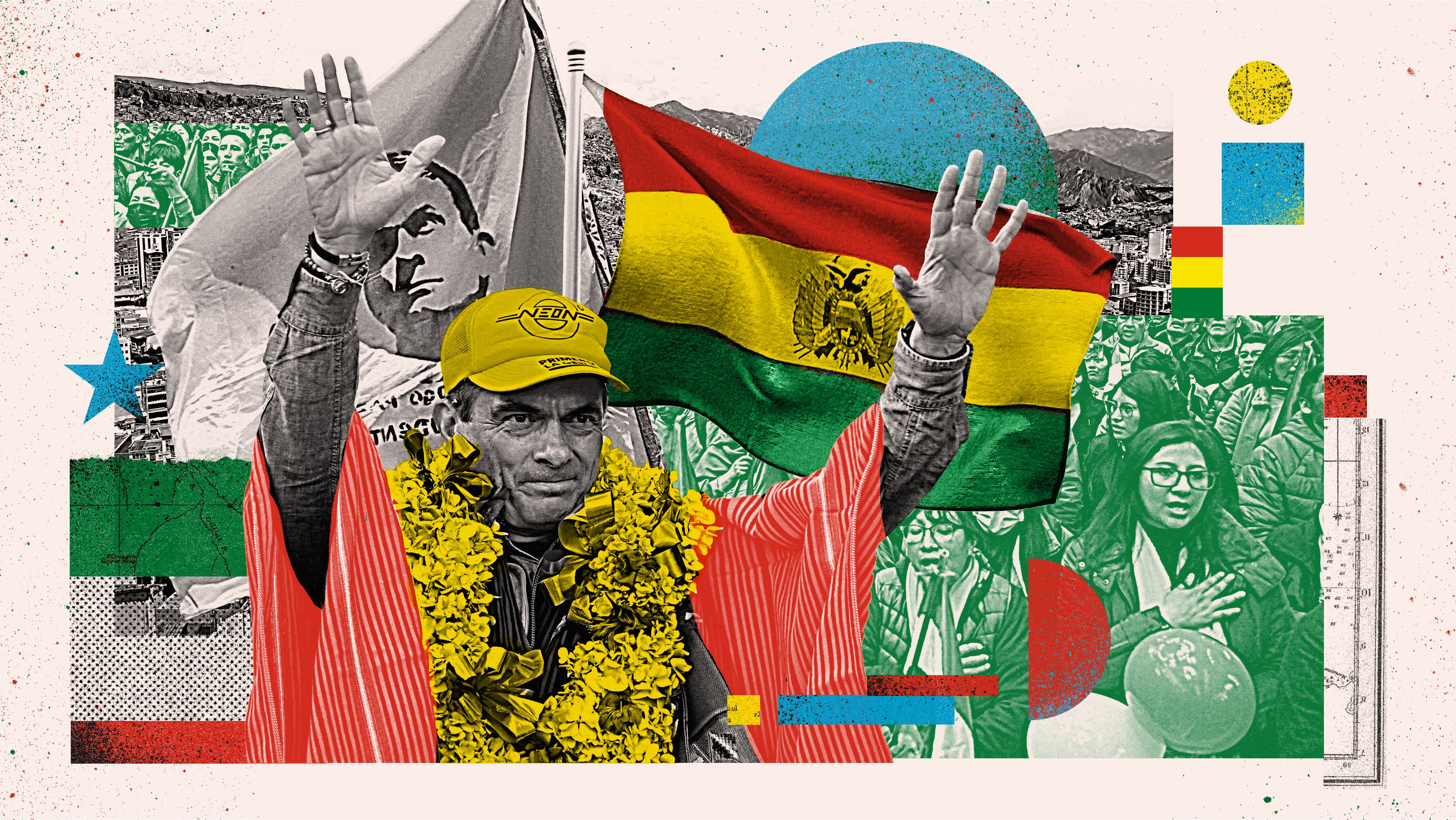
Rodrigo Paz Pereira likes to present himself as a new face in politics, but he is not. His father is former president Jaime Paz Zamora (1989-1993), one of the main leaders of the historic Revolutionary Left Movement (MIR), and at 58 years old he has already been a councilor, deputy and mayor of the southern city of Tarija. Today he is still an active politician: he holds a senator’s seat for the opposition Citizen Community party, led by former president Carlos Mesa (2003-2005). With that long history behind him, Paz emerged as an unexpected candidate, almost invisible in the polls. Under the wing of the Christian Democratic Party (PDC), a dead acronym recovered for the occasion, Paz went on the hunt for those voters who distanced themselves from the Movement towards Socialism, the MAS of Evo Morales. He did not do badly: he won the first round for the presidency in August with 32% of the votes, six points ahead of the conservative Jorge Tuto Quiroga.
This Sunday, Paz won the presidency in a second round against Quiroga by obtaining more than 54.4% of the votes, according to the preliminary count offered by the Supreme Electoral Tribunal (TSE). Although he avoids ideological definitions, he could be considered a social democrat closer to the right than to the center. If consulted, he prefers to present himself to the electorate as a moderate reformist who seeks “capitalism for all.” That has been their workhorse to seduce the indigenous sectors that ascended the social scale during the 20 years of MAS governments and now do not feel represented by the movement.
A victory for Paz, pointed out the economist and analyst Armando Ortuño, would be a “triumph for plebeian Bolivia, which is the heart of masism.” “All the Peace measures are for the self-employed. It says ‘we are going to liberalize, but not for the rich; we will do it for the poor,'” he told EL PAÍS. Political analyst Raúl Peñaranda, director of Brújula digital, agrees. “Bolivia is a country where 80% of the economy is informal. Paz has managed to enter with his speech declaring himself a capitalist of small entrepreneurs,” he says. “There are so many informal ones because being formal in Bolivia is hell. Paz offers a way for people affected by bureaucracy to normalize their activity,” explains Peñaranda.
At the closing of the campaign in Cochabamba, last Tuesday, Paz said that in Bolivia “there will no longer be smuggling because everything will be legal.” “We will lower tariffs to put an end to that State blockade that does not allow us to bring in products, technology. We need low-interest credits,” he said.
As a Christian Democrat candidate, Paz offered to end the “Tranca State,” but he did not speak to big businessmen, like his rival Tuto Quiroga. He has even promised a tax “forgiveness” that condemns debts and fines to taxpayers as part of a “small money plan” that mobilizes the economy, currently in recession. Unlike Tuto, Paz says that he will not ask the Monetary Fund for money, because it will be enough to finance himself by settling accounts and fighting corruption.
Paz was born in Galicia to a Spanish mother in 1967, during his father’s exile, persecuted by the dictatorship. Before returning to Bolivia at the age of 15, I had lived in a dozen countries. He is an economist and has a master’s degree in Political Management from American University, in the United States. There he met María Elena Urquidi, his wife, with whom he has four children.
Two years before deciding his presidential candidacy, Paz toured more than 200 Bolivian towns, where he even participated in patron saint festivals and folkloric parades alongside union leaders. Those around them recognize that those tours were decisive in the August triumph. “People look at him and listen to him, they say ‘this guy knows us, he likes what’s popular,'” they say.
Paz’s popularity definitely skyrocketed when he chose Edman Lara, a former right-wing police officer who was very popular on social media for his strong anti-corruption speech, as his running mate. “Lara has a speech against the lack of justice and the abuse of the powerful. And the powerful in this case are both the traditional oligarchs and the masistas,” says Ortuño. When the elections arrived, the pair won “because if you didn’t want to vote for the traditional right or the MAS, there was no other option,” he adds. On Sunday it will be known if that strategy will also be enough to win in the second round.
For more updates, visit our homepage: NewsTimesWire