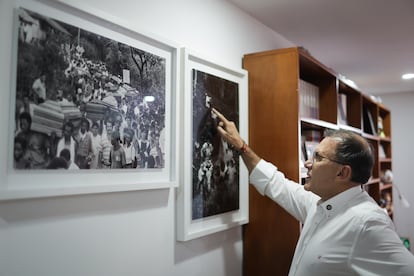
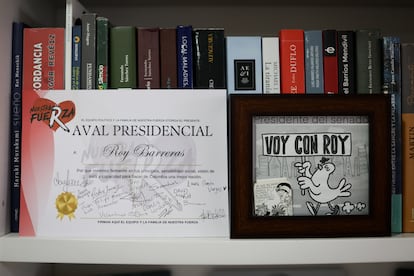
Roy Barreras (Cali, 62 years old) is convinced that the real presidential campaign begins in January. He anticipates her agile, fast, very intense. The first president of Congress in the Gustavo Petro period projects the consultation of the so-called Broad Front, still under construction, as a competition between him and Senator Iván Cepeda, the left’s own candidate.
A doctor by profession, he remembers his credentials as a builder of legislative majorities in the first year of Government to highlight his differences. At that time, the chemotherapies he underwent to treat colon cancer that he considered over did not stop him. “The Presidency of the Republic is going to be won in the second round by whoever is capable of building majorities,” he tells EL PAÍS in the living room of his apartment, full of books, photographs and works of art, in the northeast of Bogotá.
Ask. You formally announced your intention to participate in a cross-party consultation in March. Who do you plan to compete with?
Answer. In my political life I do not have intentions, but decisions. I plan rigorously, in advance. I don’t improvise. Three years ago I built a party to participate in the consultation. More than a year ago, we established a scenario in which the left could choose a legitimate candidate in October. I did not participate there, because I am a liberal, social democratic, progressive center-left man, but I have not been active in the Communist Party, but in parties of liberal origin. Once the left’s decision was made on October 26, by choosing Senator Iván Cepeda as its candidate, I expect him on Sunday, March 8 to compete with him. The consultation will involve a center-left candidate who will win the Presidency.
Q. Why are you so convinced?
R. Because it will gather a very powerful and revitalized current of a left that has fought for decades for rights and freedoms, which has cost them their lives and they have been persecuted. And he is going to join a historic left in Colombia, popular liberalism, which is the history of progressivism in recent decades: Gaitán, Galán, before Uribe Uribe, the agrarian reform…. the liberal flags with which I toured the country with Gustavo Petro 3 years ago so that he would win the election. It is a similar contest, it will once again be the combination of that sector of popular liberalism, the independents and the center, with these leftist currents, to defeat a retrograde right.
Q. Do you rule out the participation of other candidates of liberal origin, such as Juan Fernando Cristo?
R. I am certain that this competition in practice will be between Iván and me, but other candidates are welcome.
Q. Other candidates have closed the door to participating in a consultation…
R. Our will has always been to use it to join forces. That’s where Professor (Sergio) Fajardo is wrong, who recently said that the consultations divided, a completely misleading phrase. It is quite the opposite, they are like primary elections in countries where this happens. They are to unite. I understand that the teacher wants to position himself in the center as the man who unites. It is impossible, it is clear that he is one of the 90 candidates of the right. Former President (Álvaro) Uribe has said it with absolute propriety: “From Abelardo to Fajardo,” that is the range of the right. And no one on the right can unite the country.
Q. Carlos Caicedo and Luis Carlos Reyes have launched their own left-wing coalition, outside the Broad Front. What do you respond to those who criticize you as a “chameleonic” politician?
R. I regret that Carlos Caicedo has decided to contradict Petro and divide the left. It is a historical error to the extent that we have a common purpose, that the country does not retreat towards an obscurantist, vengeful and violent right. I’m not exaggerating. The main spokesperson for that right has announced that he is going to “gut” the opposition. Any progressive leader, and Caicedo undoubtedly is one, should read the historical moment and instead of dividing, unite.
Q. Returning to the Frente Amplio, Cepeda leads the polls. What is your strategy to overcome it in the consultation?
R. Colombian progressivism has two paths. One is the path of Ivan, legitimate, that of the pure left. Another is Roy’s, which is the path of inclusion, of growing. We have many things in common, we have been walking the path of peace together for 15 years, but we also have differences. First, the ideological history. I am a progressive liberal, he is a man of the authentic left. Another difference: I am a builder of majorities, it is proven, majorities that solve governability problems and carried out Petro’s agenda in the first year of the Government. I built the largest coalition of any president. I know how to govern with everyone and for everyone. The Presidency of the Republic will be won in the second round by whoever is capable of building majorities.
Q. Is a new progressive cycle viable without Petro as a central figure?
R. Colombian democracy has that strength. Here there is a transfer of powers, elections every four years, there are no dictatorships. Gustavo Petro will have all my respect and also all my protection in my Government. In Colombia there is more progressivism than left. On the right, if you look at the resumes of the applicants, almost all of them are ignorant. I don’t say this as a disqualification but as a diagnosis.
Q. You have been critical of the president’s idea of proposing a Constituent Assembly. Why do you think Petro insisted?
R. This responds to frustration over the fact that Congress has not approved the reforms it has presented. That has led him to believe that Congress does not work and that a constituent assembly must be held, but Congress does work, it works for me. My Government will not need a new Constitution.
Q. The person who reaches the Casa de Nariño will have to deal with Donald Trump for at least two years. How do you propose to rebuild those relationships?
R. Through the diplomatic, institutional and official channels that Colombia has with friendly countries. When it all started, I requested that the diplomatic missions accredited in Colombia be convened because I have no doubt that there are interests from Spain, England, Germany, France, who want Colombia, which is in the center of Latin America, not to exacerbate a crisis with the United States that would destabilize the region. Colombia has a huge opportunity to establish multipolar relations.
Q. What achievements do you claim from this Government and where does it deviate?
R. I recognize social inclusion. This priority of recognizing the invisible, the vulnerable, the poorest, cannot be denied. No president has been more persecuted than this one, including inclusion on the Clinton list, and that has generated a very aggressive defense reaction. Regarding the challenges, the first is in terms of security. What sets me apart are the methods. If the State is weak, criminals abuse it and that happened the first year, when 20 negotiation tables were opened with different illegal groups, as if they were all equal. The idea of treating them the same implies inexperience. Other important challenges are reestablishing the health system and assuming the enormous challenge in energy and fiscal matters.
Q. Would you continue with the peace talks?
R. The path is submission to justice. For criminal drug trafficking gangs there is no transitional justice but submission with benefits. The ELN, for example, has degenerated due to drug trafficking. And if they behave like drug traffickers, they must be treated like drug traffickers.
Q. What decisions would you make regarding security?
R. My proposal is total security. For example, I would not buy more Gripen aircraft. I am going to liquidate Inpec and build five megaprisons that have factories so that inmates can work to produce their food and provide for their families. We need 10,000 drones that work with artificial intelligence in the neighborhoods where the greatest number of crimes are committed and that, with facial recognition, help capture the criminal. That is using technology for cities. 140 helicopters must also be repowered with remote-controlled missiles so that they can reach high-value targets that have decided not to submit to justice.
Q. In this idea of attacking the groups, will the bombings continue?
R. At any dialogue table about submission to justice, the first thing must be laying down weapons. Any conversation with someone who holds arms to violently control a territory is doomed to failure. Regarding the bombings, I will use all legal tools within the framework of IHL to attack and subdue the violent people who do not submit to justice. That even implies combat.
Q. Four years ago you promoted a motion of censure against Guillermo Botero for having bombed a camp with children, something that was already repeated in this Government…
R. What I said is that that Minister of Defense lied to the Colombians. After announcing the loss of 14 guerrillas, alias Guacho It did not fall and all the victims were small children. The minister hid the evidence of the minors in Forensic Medicine, he did not assume political responsibility. In this Government there were bombings, but the same day the president assumed responsibility. It is a fundamental difference. A head of state has to make tragic decisions. Any death is painful, and even more so that of a minor, but anyone who does not have the character to fight the criminals who subjugate families, does not feel in the sole of Colombia.
Q. To reduce crops for illicit use. Would glyphosate return?
R. That is an obsession of the North American Government that is quite inefficient. I am a doctor, and before being in politics I discussed a lot about insecticides and pesticides that harm human health. It’s not really useful, because there have been advances in coca growing technology. Substitution is more effective, but for that you have to build infrastructure. Ground and focused fumigation are more efficient than aerial fumigation. There would be manual fumigation if replacement is not achieved.
Q. Let’s talk about the crisis of the health system, to which you are no stranger as a doctor. Would you propose a new reform? What do you think of what the Government presented?
R. The EPS should disappear to make way for the administrators of the benefits regime. We must prioritize a service network that has to be public-private, because in any company in the world if you need to control someone external it has to be the audit. Petro tried to do it the first year and Minister (Carolina) Corcho wanted to run over that reform, and also exaggerate it without even proposing a transition period. Consequence: there is no health reform.
For more updates, visit our homepage: NewsTimesWire