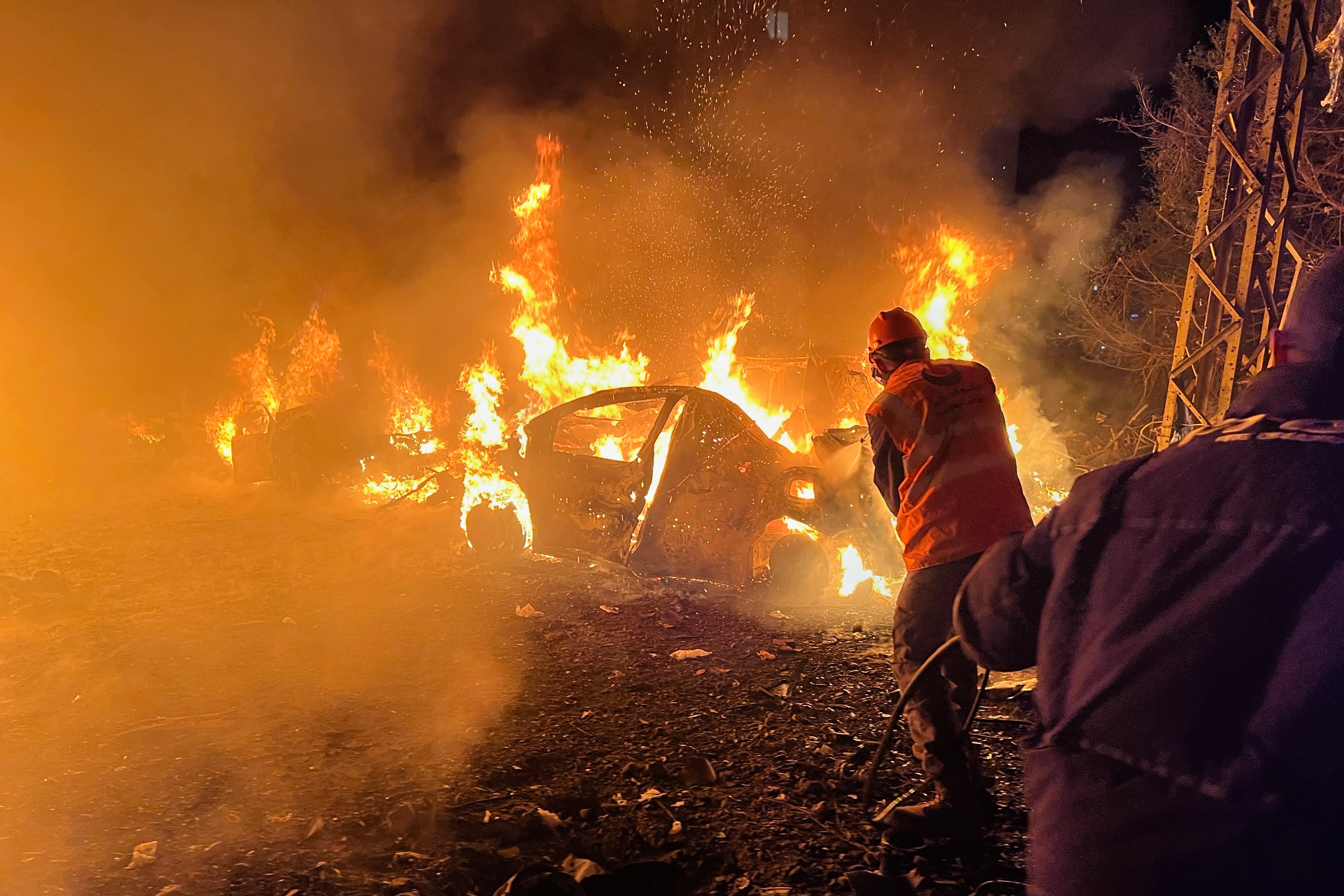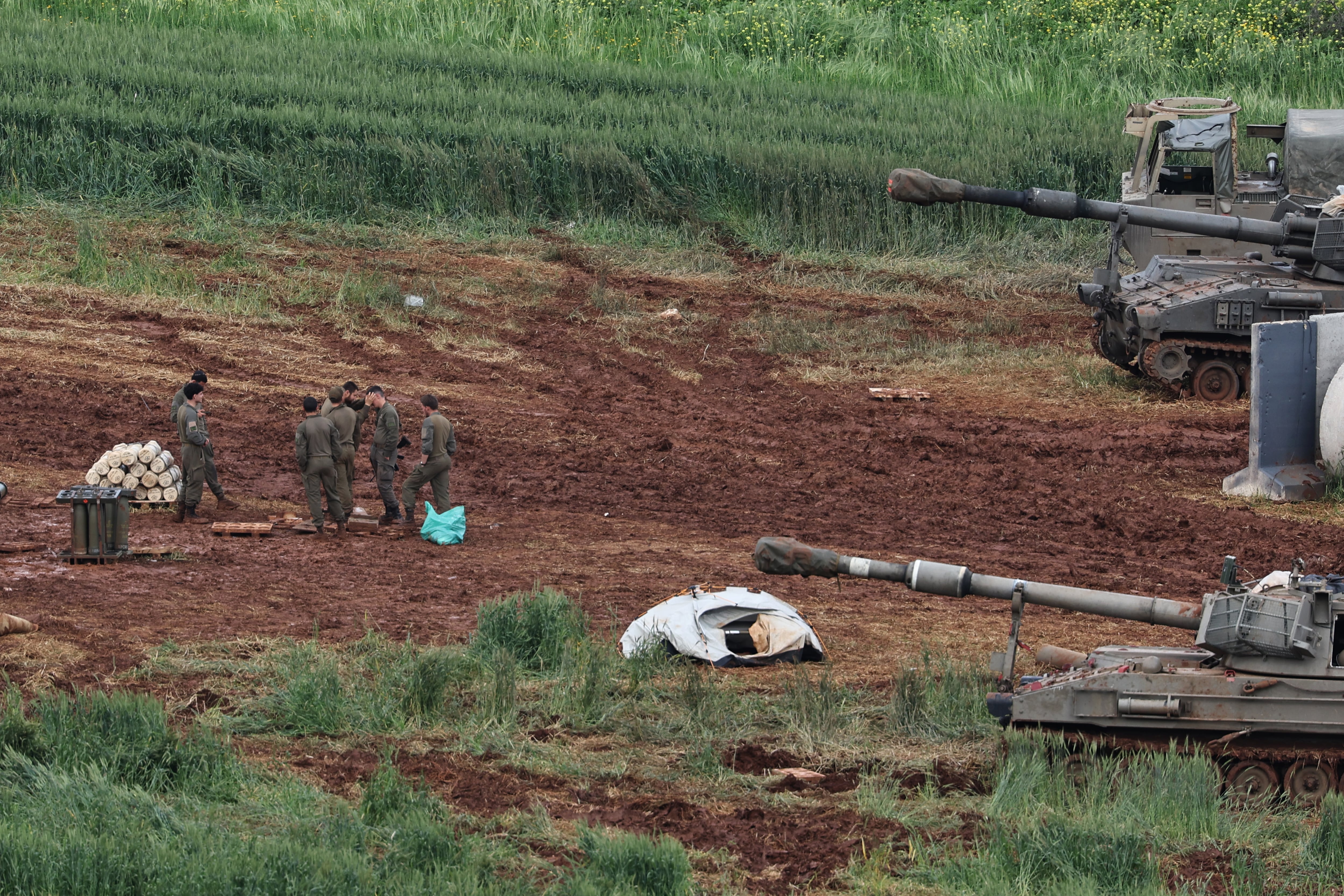
A dozen Russian attacks have hit the gas station where Lilia, 45, works as the only employee, on the road that leads to the disputed and strategic Ukrainian city of Pokrovsk (Donetsk) from the Dnipropetrovsk region. The impacts have turned the service station into a movie set, with one of the pumps charred, shrapnel splashes everywhere and the metal overhang turned into an accordion. As if she were closing, the woman serves with a slight smile from behind a small wooden door that she opens only to collect. It is surprising that businesses like this last until such a late hour operating on a road where little more than military personnel pass. “As soon as the fuel we have runs out, we close,” explains Lilia. It is 30 kilometers from the Russian positions.
With an estimated deployment of some 11,000 men – according to the Ukrainian army’s own calculations – the invading soldiers are putting local troops in trouble, who are barely maintaining control of Pokrovsk. In addition to having infiltrated the urban area in small groups, they are trying to surround the entire area. “The most critical situation is now in the Pokrovsk axis. As in previous weeks, it is there where the fighting is most intense and where Russian forces are most concentrated,” Ukrainian President Volodymyr Zelensky said on Wednesday night.
The president already acknowledged on Monday that the military ratio is eight Russian soldiers for every Ukrainian soldier: the numerical inferiority of the defending army is obvious. And the General Staff of the Armed Forces reported this Thursday that in the last few hours this is the fiercest front, with up to 55 enemy attacks.
The head of the Ukrainian army, General Oleksandr Sirski, has traveled to the area. From there he acknowledges that “the situation is complicated,” although he calls the alleged blockade of his men aired by Moscow “Russian propaganda,” as he has written on his social networks. In any case, he warns that urban clashes are taking place. Pokrovsk is an essential logistics and communications enclave for the control of Donetsk, the eastern region of Ukraine desired by Moscow since 2014 and of which kyiv, at this time, only controls 30%.
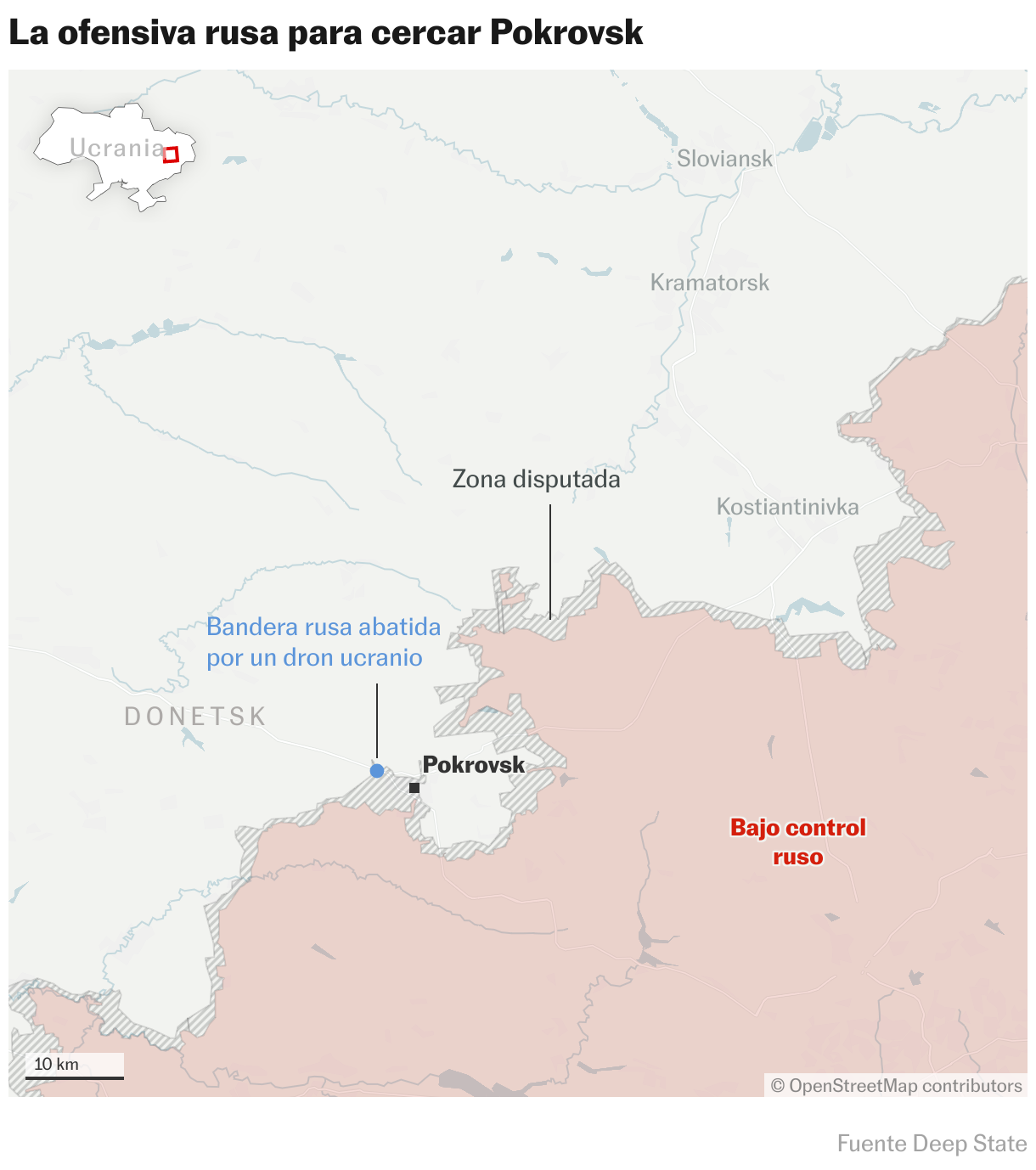
That road from the gas station advances towards the red zone that delimits the Russian positions and that has been drawing an almost closed circle around the city, according to the map on the Deep State website that Ukrainian military analysts are updating. The siege is not completely complete—despite what Russian President Vladimir Putin maintains, even referring to the blockade of thousands of local soldiers that Zelensky has denied—but it does reflect the advance of the invader.
In fact, on Wednesday morning the Russian army even placed its flag at the western entrance to Pokrovsk, although the flag was shot down shortly after by a drone by Ukrainian soldiers who have been trying to defend the square since the summer of 2024, as shown by the video images released.
That afternoon, Putin offered a ceasefire of several hours in Pokrovsk and Kupiansk—a town in the Kharkiv region also under siege—so that reporters could check the situation of those supposedly surrounded Ukrainian soldiers. Although kyiv denies an immediate fall, some local analysts believe that Pokrovsk is on its way to becoming a new Bakhmut or Avdiivka, towns devastated in this region before falling.
Підарська ганчірка як з’явилася — так і зникла
Ганчірка на стелі Покровськ була виявлена приблизно о 9:40 і вже о 10:40 була знищена.
Situate in the most залишається складною, оскільки ворог продовжує затягувати піхоту. Станом на зараз Сили Оборони України докладають великих… pic.twitter.com/rRBAdoJFzF
— DeepState UA (@Deepstate_UA) October 29, 2025
“When Putin talks about those thousands of surrounded Ukrainians, if Ukraine really had a dozen battalions there, I think the Russians would have very little chance of success,” argues Oleksiy Melnyk, former Ukrainian soldier and director of the Razumkov Center for Analysis. From the Institute of War Studies (ISW) they agree: the Russians have advanced in the east of Pokrovsk, “but it is unlikely that these advances will cause an immediate collapse” of the city.
The fact of having placed that flag does not give the Russian soldiers “full control,” Melnyk maintains in a telephone conversation. “There is no control on the Ukrainian side and there is no total control on the Russian side,” according to their information. At this moment, “the main challenge (for the two armies) is the logistical crisis.” “If logistics cannot be guaranteed to soldiers, they cannot receive ammunition, weapons, food or water.” Both sides try to bring these supplies with unmanned vehicles by air and on land, although sometimes, Melnyk adds, the military has to walk for kilometers, travel by bicycle or in civilian cars.
Events such as those of these last few hours have increased pessimism in kyiv in the face of the enemy advance, which, according to soldiers cited by local media, have managed to infiltrate some 200 infantry troops in small groups in Pokrovsk; some of them, even to the railway station. These sources report fighting within the city. The roads that cross the town—which had 60,000 inhabitants before the great invasion launched in 2022 and where there are now just over a thousand people left—separate the positions of the Ukrainians, to the south, and the Russians, to the north.
“For the first time, I can say that there is a risk that Pokrovsk will be lost during the month of November,” Ukrainian military analyst Denys Popovych told a radio station, maintaining that, although the Russians have not consolidated positions inside the city, they are doing so in the surrounding area.
For Ukraine, “losing any town or city is a great tragedy,” says Oleksiy Melnyk. “It’s true, Pokrovsk used to be one of the logistics centers of the east, but I don’t know if it can still be considered that way, because it is practically devastated. I repeat, it is a big loss for Ukraine, but what does the other party gain? That area is devastated,” adds this former military man.
From the ground, there are local units that try to paint a less gloomy picture. “Urban battles are taking place in Pokrovsk with enemy groups, which, thanks to a numerical advantage in forces and means, have managed to sneak into the city and position themselves in different areas while the defenders carry out active resistance,” the 7th Rapid Reaction Corps of the Airborne Assault Forces of Ukraine explained on Monday on their social networks. And it reported the arrival of reinforcements such as assault troops, artillery and drones.
The railway station is the same one from which the Doctors Without Borders (MSF) hospital train evacuated wounded civilians two years ago during the battle of Bakhmut, in Russian hands since 2023. The reality has changed radically since then. The appearance, in recent days, of bodies of civilians murdered near these railway facilities has been a cause for serious concern. The head of the regional military administration of Donetsk himself, Vadym Filashkin, recognizes that the handful of residents remaining in the urban area – 1,256, he specifies – cannot even be evacuated due to the conflict that plagues this important communications hub, fundamental for the logistics of the Ukrainian army.
Pokrovsk, along with neighboring Mirnograd, has become the fiercest front in the Donetsk region, which also includes Konstiantinivka, another city almost besieged at the gates of Kramatorsk, and Sloviansk, another critical scenario. Clashes occur in the streets of the city, while Russian drones gain supremacy in the sky. In a new war strategy, the devices are placed in the passage routes of local troops to detonate them when they approach.
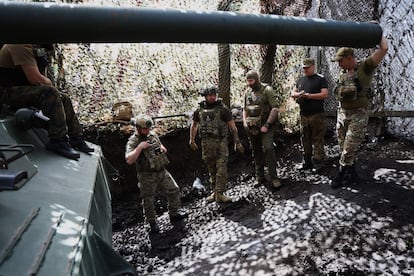
“Many drone operators have already died in the city,” he warns through messages published by Ukrainian Pravda a drone pilot, who does not rule out that “the brigades defending Mirnograd could be surrounded” as well. “There are dead Ukrainian soldiers on our roads, but no one can recover them,” he remarks. This medium collects testimonies from exhausted and unassisted brigades, to which is added the complicated evacuation of the wounded.
The siege of Pokrovsk began in the summer of last year, but it was not until a year later that the horizon became darker for kyiv. In August, the Russians dealt a surprise blow, which in September local troops tried to counter by forcing the Russians to retreat. But that offensive seems to have not been enough.
For more updates, visit our homepage: NewsTimesWire