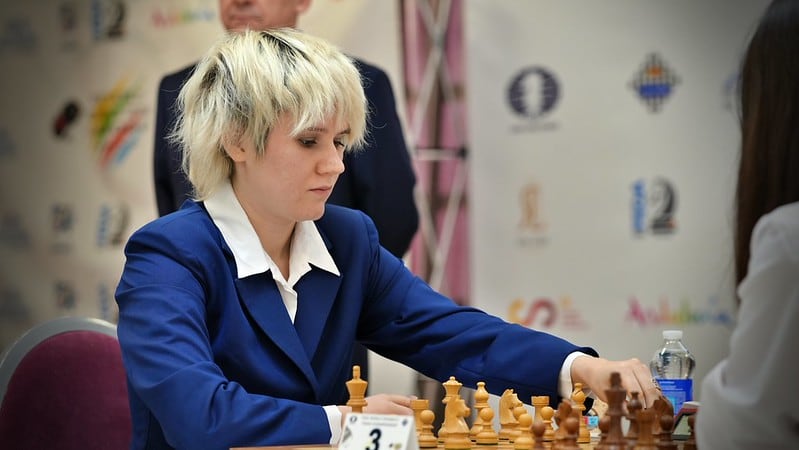
That Russia, with the neutral flag of the International Chess Federation (FIDE), wins the gold of the Women’s World Cup of Nations is only the confirmation of a clear forecast. But it is news, and of impact, that its third board, Polina Shuválova, 24 years old, absent from the super elite until now, wins nine games in a row and draws without fighting in the last one. The Russians have been able to compete as a team thanks to special permission from the International Olympic Committee (IOC). The silver went to Azerbaijan and the bronze to China (without its big stars).
Except for what Shuválova may explain at the closing of the tournament (after this chronicle is published), before receiving the gold medal for the best individual result, ambition and complete self-confidence are some of her strongest virtues, judging by her interviews in the last two years. “I come here to play well, and if I do I should be among the top three” is the type of phrase he usually says in the first rounds of very strong tournaments. Under-18 world champion in 2018 and under-20 in 2019, everything indicates that the pandemic first and the sanctions against Russia later stopped her meteoric progression. But now, with the 30 Elo points she has gained in Linares, Shuválova surpasses the 2,500 barrier and is 10th in the world.
In principle, the IOC limits its special regulations to individual competitions so that Russian and Belarusian athletes can compete under a neutral flag and anthem, and expressly excludes team competitions in the official documentation. But FIDE requested a special permit for Linares, and the IOC granted it with two arguments: it is not an Olympic competition; and each international sports federation enjoys a certain degree of autonomy.
Certainly, the dominance of the Russians has been indisputable. If Alexandra Goryáchkina (6th in the world) and Kateryna Lagno (9th) on the first two boards already guarantee enormous potential, Shuválova’s amazing performance has cleared up the few doubts about the ownership of the gold at the end of the tournament. The situation would have been very different if China had aligned itself, together with the number one —but almost inactive because she is dedicated to her work as a professor at a university in Beijing— Yifán Hou, to the next three on the world list: Jiner Zhu, Tingjie Lei and Wenjun Ju (current champion), or to the 7th, Zhongyi Tan. But without those four, and although the young stars are formidable, China could not worry the Russians. And neither does India, without Humpy Koneru, Deshmuj Divya, Rameshbabu Vaishali and Harika Dronavalli.
From the Spanish point of view, the World Cup has been a sporting failure, not so much because the women’s team did not advance to the round of 16 (it was predictable), but because of the terrible performance of Khadem on the first board and the inability of Prado, García Castany and Calzetta to replace the absent Marta García with good performance. Only Sabrina Vega and Matnadze were up to the required level.
However, this World Cup can revitalize the city of Linares as the scene of major international tournaments fifteen years after the disappearance of its famous tournament, the Wimbledon of chess, in 2010 due to the global economic crisis and the simultaneous closure of the Santana Motor factory, which was the economic lung of the entire region. Subsequent unemployment reached 50%. It seems that there are now green shoots in the local economy, and that Linares is among the candidates to host more official FIDE championships. In addition to the Spanish Absolute Championships, already granted for the next four years, as confirmed by the mayor, Auxi del Olmo, at the opening ceremony.
For more updates, visit our homepage: NewsTimesWire