“I’ve tried to hold on, but this is too depressing,” says Alina Sorochka, a Ukrainian woman from kyiv province. On Monday he had only four hours of light at home. Since November it has suffered similar daily blackouts, but the thermometer that night read -22 °C. During the day, the average temperature this week is -12 °C. Sorochka returned to her country after three years residing in the Spanish Levant. He wanted to stay in Ukraine until March, to take care of his parents. But this January she will pack her bags again with her daughters, ages 6 and 11: “The girls constantly ask me to march, because of the explosions, because of the cold.” The Russian bombing campaign against the energy system makes his life an ordeal.
Volodymyr Zelensky, president of Ukraine, warned the population last November that this could be “an extremely difficult winter.” He was right. This January, Russian missiles and drones have left millions of people without electricity, hot water, or heating, especially in densely populated cities such as kyiv, Dnipro, Odessa, Zaporizhzhia and Krivi Rih.
The moment is so difficult in kyiv that its mayor, Vitali Klitschko, insists that anyone who can leave the city during the cold months should do so. But not everyone has an alternative in safer places, or the option to leave Ukraine like Sorochka and 6 million other Ukrainians who have fled to Europe. She has family in Spain and a job in the tourism sector awaits her starting after Easter. Svitlana Melnikova does not have the resources to emigrate, she also has a husband whom she does not want to leave alone in Brovarí, her city, adjacent to kyiv. Adults of military service age cannot cross the border.
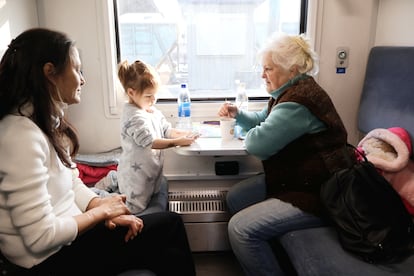
Melnikova was spending Monday with her 2-year-old daughter and grandmother in a compartment of some relief cars that the state railway company, Ukrzaliznytsia, has chartered at several of its stations in the province of kyiv. These carriages are used so that the population can have electricity, charge their electronic devices, drink and eat hot (thanks to the NGO World Central Kitchen of Spanish chef José Andrés) and even sleep.
“For the girl it is better to be on the train, at home it is too hard because there is no electricity and we do not have hot water, the cistern without electricity does not work,” explains Melnikova. The last four nights there have been Russian bombings and Miroslava, the daughter, begins to understand that the situation is not normal. “When the air raid alarms sound I tell him it’s music, but then the explosions come,” he says with tears in his eyes.
“This winter we are really screwed, but I will still be here,” says Katerina, another woman who takes the opportunity to have lunch on the train. She is an employee in a supermarket and her husband has been an infantry soldier since the start of the war. “I’m not going to leave him here alone,” adds this 36-year-old woman. “Aren’t you asking me about the war?” he adds, “I’ll tell you what I think about the war, we’re also really screwed.”
Children who have left school run through the corridors of the cars and play there instead of staying at home in the dark (the sun sets before five in the afternoon). “We usually toast to a better life when a new year begins, but I’m already feeling low,” says Melnikova. Her wish for 2026 is that her husband is not drafted into the army.
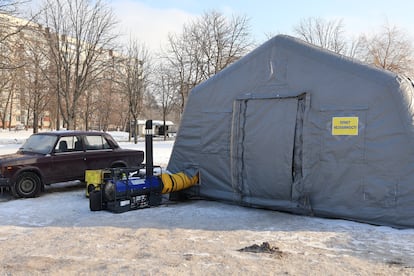
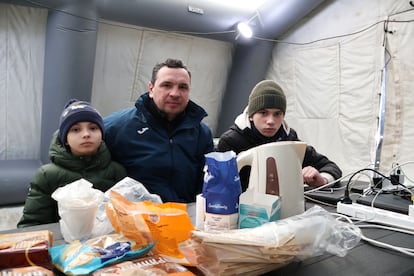
The Ukrainian Emergency Service is deploying thousands of energy first aid tents across the country. One of these is located in front of the Brovarí municipal stadium. Inside, the Kisilichin family spends their hours. Mijailo’s wife, who does not want to give her name, works on her computer, covered from head to toe. On the table they have a water heater, tea and cookies. The Kisilichin are from Bakhmut. She was a municipal official and fled with her two children from this Donbas city in 2022, when the Russian invasion broke out. The husband waited until the spring of 2023, when life there was already unsustainable and Russia was close to conquering the ruins of the city. In Bakhmut they lost everything except their lives.
The Kisilichin have settled in the store because there are not enough hours of electricity at their home to recharge their electric generators. They also don’t have hot water. The disadvantage of high-rise buildings in cities, compared to a rural house, a single-family home or street-level businesses, is that they cannot install gasoline-powered electricity generators.
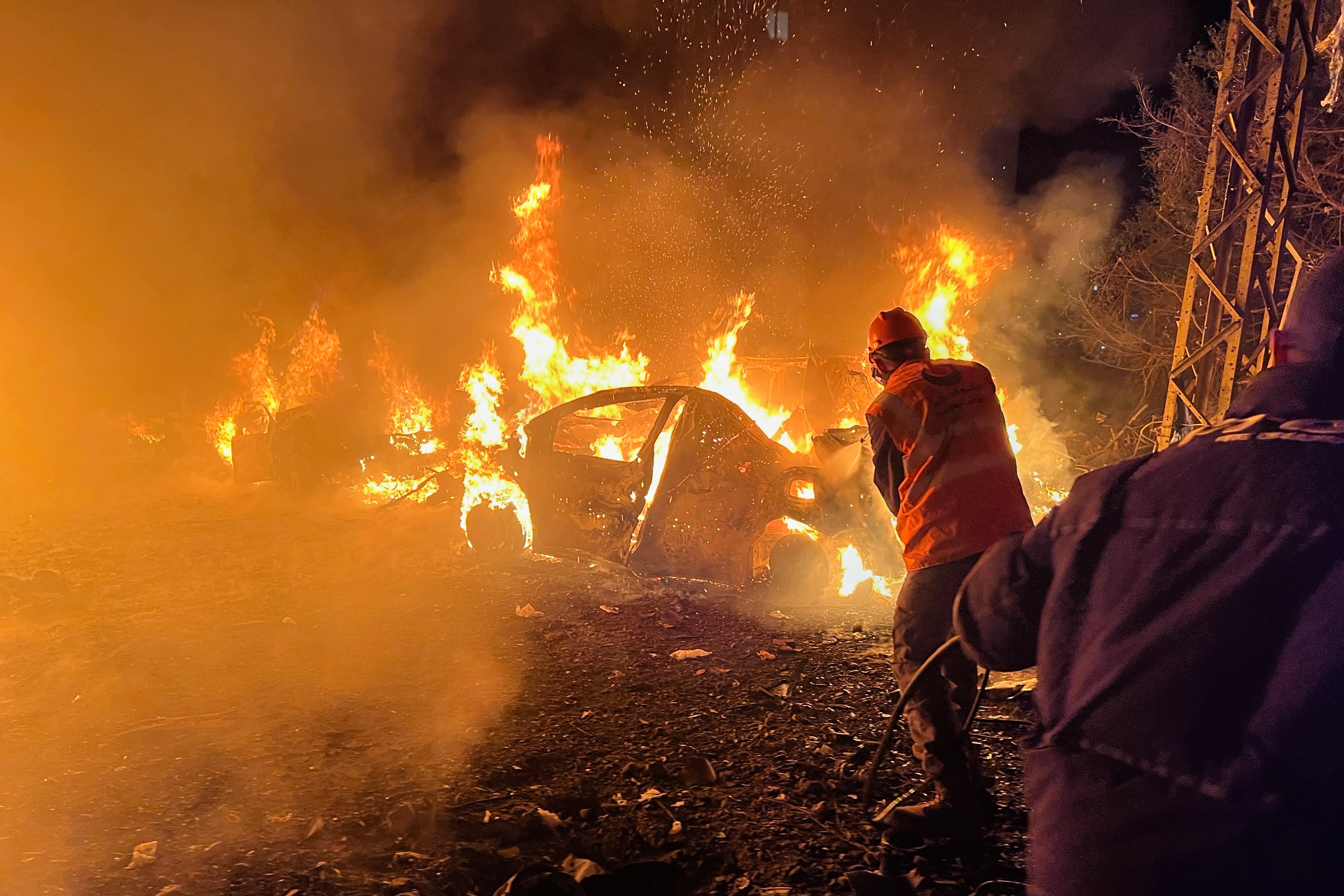
The father and children spend time distracted by the phone. “We have started a new life in Brovarí and we will continue here, this is for sure,” says Mijailo. Half an hour later, an explosion surprises outside. About 300 meters away, from an industrial park, a column of smoke rises. Anti-aircraft alarms had sounded due to the arrival of Shahed long-range bomb drones. “Despite everything, Brovari is safe,” Mijailo says again. These are the words of someone who survived eight months in the siege of Bakhmut.
One solution that electrical companies have found to protect their substations is to cover the most fundamental machinery, such as transformers, with concrete sarcophagi. These sarcophagi have proven useful in preventing damage from a Shahed, but not from the ballistic missiles periodically fired by Russia.
Zelensky has shown on more than one occasion his discomfort with the Ministry of Energy for his Government’s inability to better protect the electrical grid from Russian attacks. The ministry, also plagued by corruption cases, has had five different ministers in the last year alone. Zelensky’s choice this January to be the new head of Energy is former Prime Minister Denis Shmihal.
Disunity
The Rada, the parliament, voted against Shmihal’s appointment this Tuesday, proof of the turbulent political moment. His election was finally ratified a day later. The energy crisis has sparked the first public protests in Ukraine. On January 11, after four days of complete blackout, residents of several municipalities in kyiv province coordinated to cut off road traffic. In this way they wanted to show their discomfort, for what they considered the public administration’s apathy to provide them with a solution.
“Cutting the roads will not make the repair arrive sooner,” Mikola Kalashnik, head of the kyiv region’s emergency service, said in a statement. Kalashnik called for “unity”: “Being united will allow us to get out of this.” Political and social disunity is worsening in Ukraine, also under the demoralizing effect of the most difficult winter.
Zelensky and Klitschko got into a bitter public discussion on Wednesday over the energy crisis. Zelensky accused the capital’s City Council of “having done too little to prepare the city.” Klitschko replied that his government is doing the impossible and that he, unlike Zelensky, does not worry “about doing well in the polls or preparing for phantom elections.” The mayor also revealed that the president had not found the time in the almost four years of war to hold a meeting between them.
Oleksi Kuleba, Minister of Development (partially responsible for the energy network), caused a stir on January 7, when in an interview in the newspaper Pravda, He described the fragmentation he detected in the country with these words: “The only thing that unites our country right now is the cemetery.” Kuleba later specified that he was referring to the fact that, despite all the differences, Russian violence continues to be everyone’s problem.
For more updates, visit our homepage: NewsTimesWire