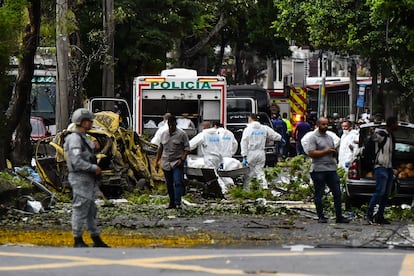
The streets surrounding the Marco Fidel Suárez air base, in the middle of the urban area of the Northeast of Cali, were bathed in glass and rubble. This Thursday, around three in the afternoon, strangers launched two cylinders bomb against the entrance of the military complex. They exploded outside, in the midst of the civilian population that inhabits and travels through the neighborhoods La Base and Villa Colombia. The suspicion of a second vehicle loaded with explosives, which would not have reached to detonate, joined the sadness, paralyzed the city and kept its inhabitants in suspense for more than four hours, in one of the busiest areas of the third city in the country. At nightfall, President Gustavo Petro landed at Cali Airport, located about twenty kilometers outside the city, and pointed to the dissidents of the extinct Farc known as central general, of being responsible for the attack.
Andrés Monroy lives there and has one of the bomb cylinders, which flew more than 30 meters and fell on a chair next to his living room when his wife and mother -in -law were inside. “My mother -in -law had stopped two minutes before that chair in the bathroom,” he says pointing out the artifact that destroyed the facade and could fall on his relatives. “We got the war to the room of the house.” He says it while recovering the security chamber cables that flew with the pump. The anti -explosive police arrive at their home two hours after the attack to verify if the artifact kept explosives without detonating. With the windows marked by glass splinters, the neighbors have closed the streets of the surrounding neighborhoods with sticks, wood and stones, to prevent strangers from entering. There is fear, distrust smells. The most serious attack in recent years in the third city of Colombia has left seven dead and at least 70 injured.
Jesús Martínez and Amelia Muriel de Martínez, residents of Villa Colombia for 46 years, received the impact of the bombs when they were in their main room. The house they have raised for their whole family remained a kind of skeleton, without facades, doors or windows. “We chose this neighborhood because we felt safer next to the air base. We did not expect that closeness to leave us without housing,” claims the 78 -year -old woman from the Antejardín de la Casa. His daughter Deisy collects the debris of the ground and holds the government responsible for what happened. “I hope that President Petro takes care of the damages that civilians suffer for their policies.”
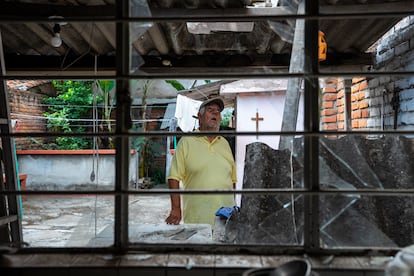
In the streets, the neighbors have gathered to help the elderly who live alone in one of the most traditional neighborhoods of the city, which raised their first homes in 1930. Mercedes Zambrano says without repair that the attack “was seen coming”, and that since the persecution against police in the city stations began, they knew they could attempt against the base. “They had to reinforce security. It is located in a residential and popular area.” Remember that another of the targets of attacks has been the barracks of the Pichincha Battalion, in the popular Meléndez neighborhood. It is the headquarters of the Third Army Brigade, head of the Valle del Cauca, El Cauca, Nariño and Chocó, departments whipped by illegal crops, illegal mining and the presence of dissidents of the FARC and the ELN.
The capital of the Valle del Cauca is the entrance to the violent Cauca, where the dissidents under Iván Bite, to which the Carlos Patiño Front belongs, and also its rivals of the second Marquetalia, the dissent that Iván Márquez commands. The two groups dispute the control of drug trafficking routes. Last June, the dissidents attempted with explosives against the population in the East and South of Cali, and in the neighboring municipality of Jamundí. The impact of the armed conflict, which rarely touches urban areas, has been taught with the city that was a bastion for Gustavo Petro in his campaign to the presidency.
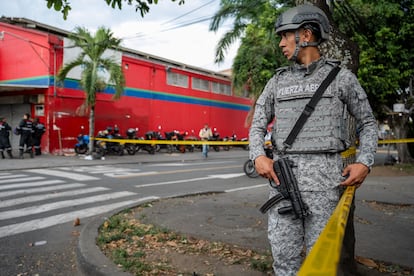
Entrance at night, the echo of the detonations still resonated in the memory of the inhabitants. The authorities kept the area cordoned off and looked for more explosive remains. With the phones high, several neighbors walked, registering what was left of the only attack they have lived in the neighborhood. At least ten blocks remained blocked, while the helicopter propellers sounded that fly over the sector. The besieged neighborhood became temporarily, in a scenario of a war that now seems to make way in the cities.
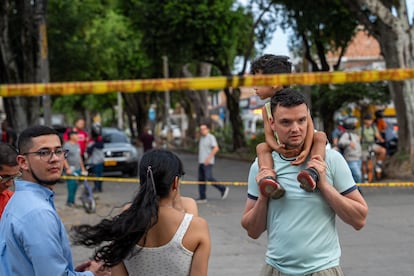
Mayor Alejandro Éder and the Governor of the Valley, Dilian Francisca Toro, have announced a reward of 800 million pesos (about 200,000 dollars) for information that allows those responsible for the attacks. He has also said that those responsible are the dissidents of Jaime Martínez who, according to him, ordered the attack from the north of Cauca. Two people have been retained, but the authorities have not confirmed their judicialization or given more information. The president met with the local leaders in a security council held at Alfonso Bonilla Aragón airport, outside the city, and refrained from giving statements to the press.
Hours before, through his X account, he said that “terrorism is the new expression of the factions that are directed by Iván Bite, and that they have subject to the control of the drug trafficking board.”
It is not the first time that the president is responsible for a fact to the alleged brain of the crime that, he says, operates from Dubai and has said that he sends almost all Colombian armed groups: the second marquetalia, the EMC, the Gulf clan. Without evidence of its existence or impact, Petro raised his calls to the international community to consider them as a “terrorist organization with armed bands in Cauca, Guaviare, Antioquia and the Colombian Caribbean”.
The second focus of this Thursday’s attacks in Colombia was in the department of Antioquia, where another group of dissidents knocked down a police helicopter in the rural area of the municipality of Amalfi. The balance, until Thursday night, was 12 dead uniformed. The president expressed his regret for the tragedy and assured that it is a strategy of illegal groups in rejection of operations against drug trafficking.
In Cali, after the attacks, the security device was reinforced with the arrival of Army troops and special police units. The city, which seeks to resume normality in the midst of tension, restricted the passage in the streets surrounding police stations and military garrisons. The atmosphere remembers what happened 17 years ago, when the now extinct Farc made a carbomb exploded in front of the Palace of Justice and another against the police command. It is the same city with seals, with partially closed streets at night and with neighbors who prefer to keep distance from the public force for fear of being trapped in violence.
For more updates, visit our homepage: NewsTimesWire