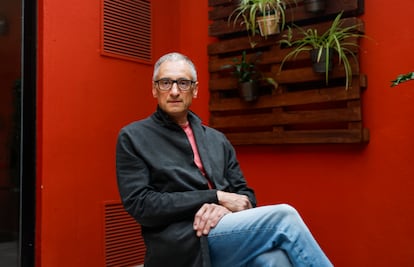
It may be courage, tiredness or determination. Or a little of everything. Naturalness has the journalist, professor and essayist Moscovita Serguéi Medvedev, 58, who is not only that the Kremlin considers him “foreign agent”, but that there is an arrest warrant against him; that they can fall between 10 or 20 years in jail in a Russian court for crimes of “defamation” against the army of their country, and that there are already places to which they cannot travel for fear of being arrested. “But you can’t care less,” he says in a conversation held on Thursday in Madrid.
Medvedev lives exiled in Prague, where he taught at Charles University. He left his homeland in March 2022, shortly after the start of the great Russian offensive on Ukraine. But he assures that the exile is no longer part of his identity. “I will not return to Russia,” he says, “although there is a resurgence of democracy, it is too toxic.” He does not want to share a place with people who supported a war with thousands of dead.
Warns that his words are hard. “For me,” he continues, “being Russian today is responsibility, guilt. How to be German in 1945,” Medvedev has participated this Friday at a conference on Russian exile organized in Madrid by the Cidob Analysis Center and the Friedrich Ebert Foundation.
Ask. Do you better understand the reasons after the Russian invasion of Ukraine three years later?
Answer. I learned more about Russia than about Vladimir Putin. Putin’s reasons are not new to me. They are the same as three, five or maybe 15 years. I learned how Russia has easily accepted this war, has normalized it and is willing to live with it. People identify it as a continuation of World War II 80 years ago, believing that Russia is again at war with the world and the West, that we have to stand up to fascism. That is Putin’s thought when it refers to the disintegration of the Soviet Union as the largest geopolitical catastrophe of the twentieth century. The reasons are evident: Russia is a sick, decadent and decomposition empire, and does not want to accept its end.
P. What is this collapse from Russia?
R. It is mental. Many empires went through this, such as Spain, the United Kingdom or France. It is the loss of a great empire of more than 100 years. He collapsed first in 1917; Then, in 1991. But it still exists. A great country is believed with a great past, a great nation, the great European civilization. People grew with this imperial nostalgia. We think that, 30 years after the fall of the USSR, the country would have been normalized, becoming more global and trade oriented, but no. The country and the political class are driven by resentment and nostalgia. The Ukraine War is part of this and people accept it. They do not see Ukrainians as an independent nation, but as a part of Russia that has betrayed them.
P. Can you think of the invasion of Ukraine without the support of Russian society?
R. No. It is no longer Putin’s war, but Russia’s war. There is a country behind Putin that supports this war and benefits. There are dissident voices, but they are very few, very limited and easily punishable. There is a parallel with Germany in World War II: it was not Hitler’s war, but the German war. Putin himself is a product of Russia, it is one of the culminating moments of Russian history. It is no accident that it is in the Kremlin, which governs, that threatens the world. It is a kind of natural development of Russian history. The period after the USSR, the brief stage of democracy, was probably an exception, a window of opportunity that was later closed.
P. Who closed that window?
R. It closed both from Russia and from the West. The change was not complete, Russia never really transformed. It is a matter of disappointment. We had too many illusions in the 1990s. We thought that the world had changed, that there would be no more war, that there would be no great expansion. In Russia we had illusions about Russia, that communism was over. We are wrong.
Communism had ended, but the elites remained in their place. They privatized their assets, but they were the same people who ruled the USSR. There was a thin layer of Democrats such as (Mikhail) Gorbachev or (Andrei) Sájarov, the famous dissident. (Boris) Yeltsin was part of the old elite, transformed power into the new era. The kgb stayed as FSB; the Soviet army also and the entire administrative apparatus.
P. Can war continue in Ukraine without Putin?
R. Yes. Even if Putin leaves, if he dies suddenly, if there is a coup d’etat, if they kill him, there would be no immediate or easy transition. There is a second step and a third step. The power is in the hands of those who have gone through the war, who benefit from it. Even if you leave, this war will not end from one day to another: they will say that the objectives were not achieved, which Russia will never be defeated. In addition, the economy now works with this war impulse.
After three years, the inertia of war, the dynamics of the world is such that Putin cannot stop it. And I’m afraid they also have the Great West in the spotlight. There is a much larger plan for world war, not necessarily nuclear, but hybrid to destabilize Europe. Putin is happy with war, that is his natural state, which allows him to govern.
P. Many people think they are crazy.
R. No, I think it is quite rational in its way of thinking. It may seem crazy to foreigners because it goes beyond the rules. He was the first in the world to demonstrate that they can be transgressed without being punished. Russia invaded Georgia in 2008 and nothing happened; Crimea was annexed in 2014 and either, everything remained the same. Some minor sanctions, but then the 2018 World Cup arrived. West continued to buy oil, continued to trail with Russia. Putin was the first to demonstrate that great nuclear power can completely ignore international law without punishment.
It is very rational, calculating, intelligent enough to build the entire Russian political system around it. To appropriate the entire Russian political sphere; Infuse fear in the elite, control it.
P. What would Russian citizens accept for peace with Ukraine?
R. They will accept what Putin tells you. You can tell them that they have won, that they retire from Ukraine, but that it is weakened and will seem good. In Russia there is no public opinion, or public awareness or mentality. It is just a mass of people willing to accept everything that propaganda tells them. So, if they inform them that Washington will be bombed, they will say it is worth. Or if they are told to do business with China. They don’t care about politics much. They care about their daily lives, they are very conformist people.
P. Is there alternative to this regime abroad?
R. If there is any alternative, it is within the country. I don’t think it can be changed from the outside. The Russian opposition in exile has enormous respect for many people like (Alexéi) Navalni or (Gari) Kaspárov. But no illusions are made, they are nobody in Russia. The only person who represented a serious threat to the regime and who could gather people behind him was Navalni and was killed.
P. It is, therefore, to find a way to face the nature of this Russia.
R. In the last 400 years, Russia is the same colonial state, the state that colonizes the country. It sounds hard, but it is a somewhat servile society, which has no independence. People in Russia have not separated from the State, which now governs through absolute fear. There are no independent cities, universities or communities, nor a feeling of national identity. Society remains repressed as in the era of Ivan the terrible, Pedro El Grande, Nicolás I, Lenin and Stalin. There have been brief periods of freedom, but then, the State returns.
For more updates, visit our homepage: NewsTimesWire