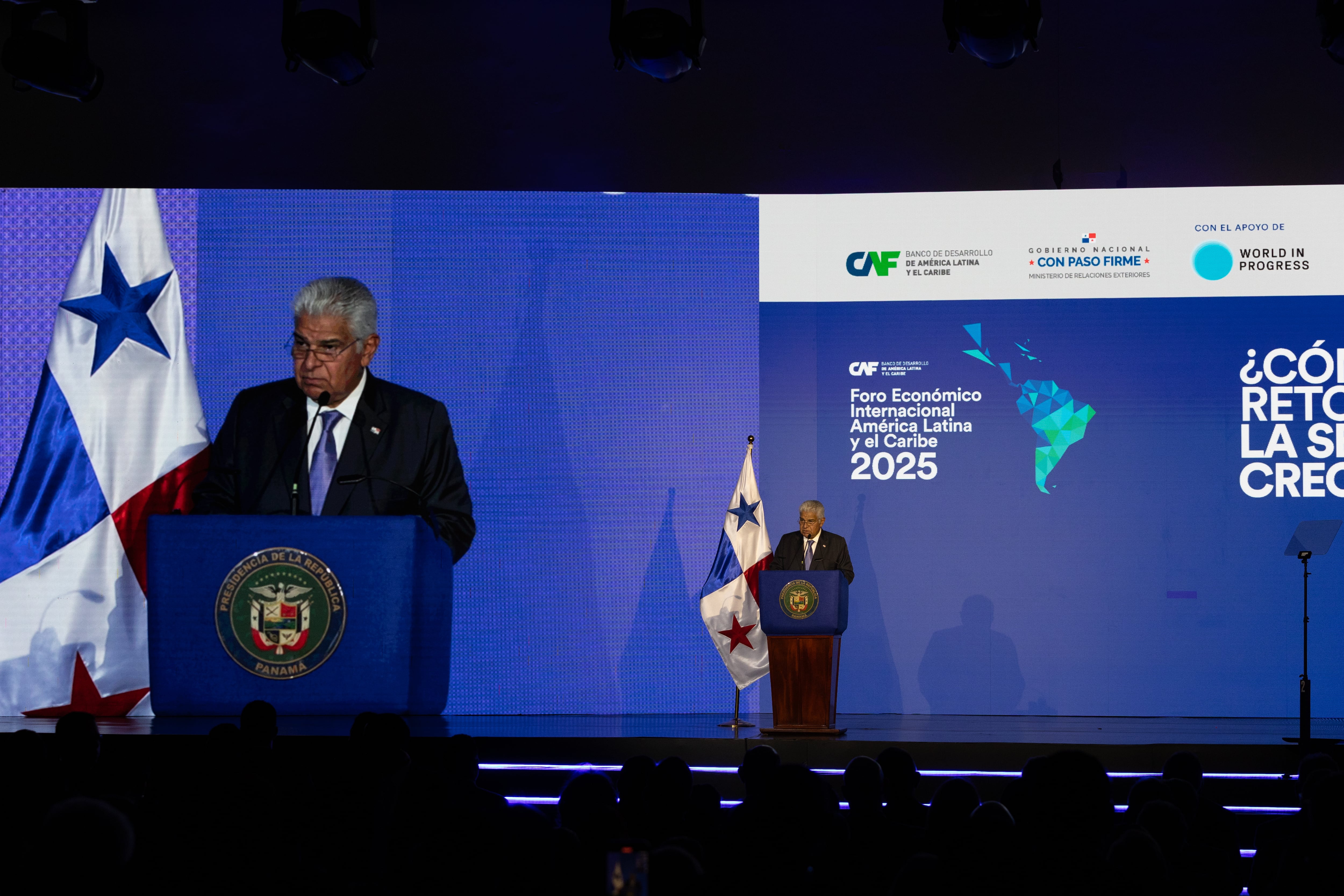
Latin America seeks its place in the new world order. With this purpose, seven heads of state, an elected president, ministers of Economy and Finance and more than 2,500 businessmen, political leaders, representatives of international organizations and experts will debate between this Wednesday and Thursday in Panama City at the International Economic Forum Latin America and the Caribbean 2026. The host of the event, informally considered a Latin American Davos due to its dimension, is CAF-development bank of Latin America and the Caribbean, in collaboration with the PRISA Group (publisher of EL COUNTRY), through World in Progress, which will feature, among others, the participation of its president, Joseph Oughourlian; its vice president, Fernando Carrillo, and the director of EL PAÍS, Jan Martínez Ahrens. In addition to these interventions, three members of the WIP Advisory Council, Julissa Reynoso, Josep Borrell and Juan Manuel Santos, will participate in the forum.
By blowing up the bridges of multilateralism by the United States, the Forum will serve to showcase the potential of a region eager to find an alternative path to the agenda imposed by the White House, which has once again considered Latin America its “backyard” after decades of studied strategic distance.
The executive president of CAF, Sergio Díaz-Granados, will give way early on Wednesday to an unprecedented debate of more than two hours between Latin American leaders of different political colors. So urgent and challenging is the agenda imposed by the new international policy. The presidents of Panama, José Raúl Mulino, have said yes to the meeting; from Brazil, Lula da Silva; from Bolivia, Rodrigo Paz; from Colombia, Gustavo Petro; from Ecuador, Daniel Noboa; from Guatemala, Bernardo Arévalo; of Chile (elected), José Antonio Kast and the Jamaican premier, Andrew Holness.
The Minister of Economy and Finance of Ecuador, Sariha Moya, and her counterpart from Bolivia, José Gabriel Espinoza Yáñez, will also appear on the Forum panels. The 2024 Nobel Prize winners in Economics, James Robinson, and 2025, Philippe Aghion, will share their visions on development, institutions, innovation and economic growth.
The opening of the second day will be the responsibility of the mayor of Panama City, Mayer Mizrachi, and the president of PRISA, Joseph Oughourlian. Three members of the WIP Advisory Council will also participate in the Forum: the former United States ambassador to Spain Julissa Reynoso, the former head of European diplomacy Josep Borrell and the former president of Colombia Juan Manuel Santos. Jan Martínez Ahrens, director of EL PAÍS, meanwhile, will speak in one of the sessions with the president of Bolivia, Rodrigo Paz.
The intention of the Forum is to become a fixed event in the calendar of major regional events. In the previous call, some 2,000 people attended, more than 150 world leaders from 15 countries, 50 panels and special sessions were held and some 350,000 people joined the streaming. As on that occasion, the Forum can be followed live on the headlines of the newspaper EL PAÍS and through its social networks.
The Forum’s agenda will address issues such as economic growth and macroeconomic stability, energy and climate transition, digital transformation, productive investment and cohesion. Sergio Díaz-Granados, executive president of CAF, referred to the meeting as “a cooperative of and for Latin Americans” that accelerates the most urgent solutions in a world that is moving at full speed towards a new world order. “Inhabited by more than 650 million people, owner of 15% of the earth’s surface and incomparable biodiversity, we are an indispensable source of solutions for the great global challenges,” the Colombian wrote in a column in EL PAÍS. “This potential currently coexists with a global context marked by the rise of unilateralism and fragmentation. Therefore, we need Latin America and the Caribbean to generate new spaces for reflection that help it align positions, add geopolitical prominence and become a region with its own voice to provide concrete solutions,” he said.
In parallel to the sessions, CAF has organized a meeting to bring participants together, inspired by the concept of speed dating or speed dating: 25-minute talks between attendees. At the Latin America and Caribbean Business Roundtable, 150 international buyers will be able to sit in front of 300 Latin American exporters in more than 4,000 one-on-one meetings designed to connect regional supply with global demand. “Networking is an essential point for this meeting and we will have a cutting-edge app to facilitate appointments and specialized personnel to guide you,” commented Andrés Zamora, director of strategic communication at CAF, last October, when the Forum was presented. The call was opened to companies in strategic sectors such as agri-food, manufacturing, textiles, chemicals, life sciences and technological services.
The Forum has a preview this Tuesday, with CAF Festival: Voices for our region, culture that moves the world, a space that promoted the cultural and artistic potential of Latin America and the Caribbean. Among the main objectives was the preparation of a document with the contributions and proposals arising from the dialogue, as well as recommendations for future initiatives and cultural policies.
For more updates, visit our homepage: NewsTimesWire