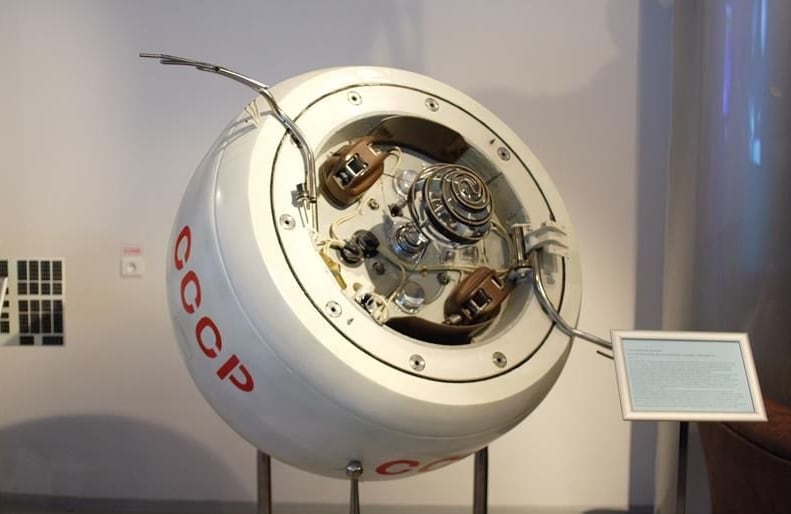
The Soviet probe Cosmos 482 It has finally fallen to land. After wandering more than half a century by the Earth’s orbit, the ship, launched in 1972 in the framework of a mission to Venus, has resent the atmosphere this Saturday and, according to Roscosmos, the Russian space agency, has crashed into the Indian Ocean shortly before half past eight in the morning (Spanish peninsular time). In a message from Telegram, the Russian agency has indicated that, according to the calculations of the specialists of the Russian Center for Rocket and Space Saves Tsniimash, which is part of Roscosmos, the device entered the atmosphere at 9:24 Moscow time – a less hour in peninsular Spain – “560 kilometers west of the island of the middle Andaman West of Yakarta ”. The centers of spatial surveillance and monitoring of the European Union have also confirmed that, according to their analysis, the probe disintegrated into a time window that coincides with the time indicated by the Russian agency.
The main spatial agencies of the planet were following the uncontrolled resentment of the Soviet probe Cosmos 482 For days and although the predictions have been refining as the planned date was approaching, the uncertainty about the exact place and time of re -entry has been high until the last moment. After a few minutes of the morning of this Saturday, the radars of the Space Waste Office of the European Space Agency (ESA) detected the ship over Germany. According to its forecasts, the German country should have come again around 9.30, but the radars did not capture anything. “Since the ship was not detected by Radar on Germany at the planned time of 09:32 (Time of Peninsular Spain) it is very likely that the reentry has already occurred,” said the European agency in a blog where they were monitoring the re -entry.
The Soviet probe Cosmos 482 It is an artifact released 53 years ago that never reached its destination: Venus. This is the main reason why the fall of this object of space scrap to the earth is special. The ship was designed to endure the huge pressures of the warmer planet of the solar system, so it could survive from a piece to its reentry in the Earth’s atmosphere, scheduled for the morning from Friday to Saturday.
A few days ago the monitoring protocol of the International Committee for the Coordination of Space Garbage was activated, an organism in which 13 space agencies are represented including ESA, its American homologue, NASA, in addition to the agencies of the United Kingdom, France, Italy, Russia, Ukraine, China and Japan, among others. Although all of the committee is all, the exchange of information between some of them is practically null. Russia, for example, takes time without providing data, although its radars follow up the space objects that periodically fall to Earth. The largest source of information for the western world is provided by NASA with its radar network, although both ESA and some of the European agencies have their own instruments.
The uncontrolled probe completes an orbit to the earth every hour and a half. Each radar can observe this object about four times a day and estimate when and where it will fall. The problem is that it is very difficult to predict the behavior of this object in the layers of the atmosphere that are between 100 and 200 kilometers of altitude. To this is added the uncertainty of solar activity and other unknown factors, as if the capsule has a parachute, and if it will be deployed, or if it has already done so, explains the engineer Benjamín Bastida Virgili, who works in the space garbage surveillance service of the ESA in Darmstadt, Germany. All these factors make the margin of error on the date of fall were almost a day before or after, and that almost all the earth was inside the fall trajectory.
The Cosmos 482 It was launched in March 1972. It never managed to escape the low terrestrial orbit. After reaching a parking orbit around the earth, the ship apparently tried to launch towards a transfer trajectory to Venus. However, it separated into four parts: two of them remained in low land orbit and decayed within 48 hours, while the other two pieces, presumably the landing probe and the motor unit of the separate upper stage, entered a higher orbit to between 210 and 9,800 kilometers of the earth, according to NASA. It is believed that a failure caused the ignition of the engine not to reach the necessary speed for transfer to Venus, leaving the payload in this elliptical terrestrial orbit that has been declining over time until it falls in the next few days.
The 495 kilos landing module was designed to endure 300 times the acceleration of terrestrial gravity and a pressure 100 times higher than that of our planet, explains ESA. As a result, it could survive its reentry in the atmosphere.
Space agencies have been taken as a valuable experiment. The aerodynamic form of this ship makes it an ideal object to measure air density in very low terrestrial orbits. Every time the elliptical orbit passes through the perigee, its closest point to the earth, loses height in the peak, its highest part. This altitude difference allows you to infer the atmospheric resistance faced by the object just to the reentry. The design of most spacecraft is too complex to carry out these studies, but the almost spherical form of the descent capsule makes it possible, turning its reentry into a “accidental” scientific experiment of Reentrada.
The fall of large parts of space garbage is common. Parts of moderate size rockets resent almost daily, while smaller objects of traced space waste do it even more frequently. The pieces that survive rarely cause damage to the ground. With the growing space traffic, the frequency of these resentments is expected to increase in the future.
The risk that the reentry of a satellite causes injuries is extremely remote, explains ESA. The annual risk of a person being injured by space waste is less than 1 between 100,000 million.