The course towards disaster of a Europe in alleged decline, harassed by immigration and on the verge of losing its identity as a beacon of Western culture, has become one of the most persistent obsessions of the MAGA ideology (Make America Great Again) during Donald Trump’s second presidency. That obsession crystallized with the publication on Thursday night (early morning this Friday in mainland Spain) of the National security strategy of the United States of America, a controversial document signed by the president himself.
Its 33 pages set the priorities of the new Administration in foreign policy and provide an overview of the interests of the United States in the world. Regarding Europe, the text points out its “economic problems”, but warns that these are “overshadowed by a greater concern: the real prospect of the disappearance of its civilization” in “the next 20 years or less.” When that happens, the text adds, it will not be clear that “certain European countries continue to have economies and militaries strong enough to remain reliable allies” of Washington. “Our goal should be to help Europe correct its current trajectory,” he says.
The text lists several culprits for this supposed decline: “The European Union and other transnational organizations that undermine political freedom and sovereignty, the immigration policies that are transforming the continent and creating conflicts, the censorship of freedom of expression and the suppression of political opposition, the fall in birth rates and the loss of national identities and confidence (of the different countries) in themselves,” says the United States Government.
This is a priority document that is traditionally published at the beginning of each new Administration. What is unprecedented this time is the aggressiveness of his rhetoric. Not only against Europe: the section on Latin America (the “Western Hemisphere”, in Washington jargon) also stands out for its break with the status quo diplomatic and with the recent history of the relationship with the continent.
“After years of neglect, the United States will reaffirm and apply (interventionist) Monroe Doctrine to restore its preeminence,” promise the drafters of the text, which speaks of a “Trump Corollary” to that doctrine, necessary to achieve “a sensible and forceful restoration of American power and priorities.”
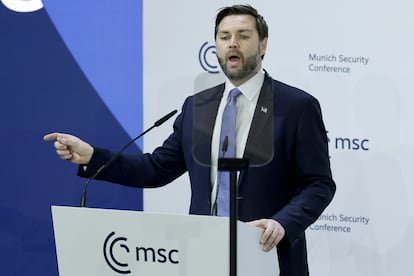
Back in Europe, the text adopts the theses of the far-right political parties. The MAGA movement, and Trump himself, have defended the objectives of these political groups in elections such as those in Germany or the United Kingdom. Washington’s European partners already heard some of these ideas in February, during the Munich Security Conference, in which the Vice President of the United States, JD Vance, offered an incendiary speech and an apocalyptic vision of the Old Continent.
The text sets out the priorities of the Trump Administration with Europe, to which, it says, “the United States, logically, has sentimental ties.” These priorities include opening its markets to American goods and services and “restoring stability” internally, also in its relationship with Russia, which it defines as “lack of trust.”
It proposes encouraging the continent to assume “primary responsibility for its own defense”—in what can be interpreted as a reference to pressure from Washington for NATO members to increase their contribution to 5%—or ending the expectation that the Atlantic Alliance is “in constant expansion.”
Regarding the war in Ukraine, the document warns that “the Trump administration is at odds with European officials with unrealistic expectations about the war.”
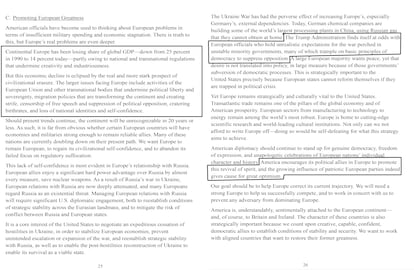
The ultra parties have their own point on that list, which calls for “cultivating resistance to Europe’s current trajectory” from within. Elsewhere you can read the following: “The United States encourages its political allies in Europe to promote this revival of the (Western) spirit, and the growing influence of European patriotic formations certainly gives reason for great optimism.”
“This document is a roadmap to ensure that the United States remains the greatest and most successful nation in the history of humanity and the home of freedom on Earth,” says the text signed by Trump in its explanatory statement, which proposes a fierce defense of the theses of the America First (America first). “In the years ahead, we will continue to build every dimension of our national strength and make America safer, richer, freer, greater and more powerful than ever.”
To achieve these objectives, the text sets the following priorities: ending the “era of mass migration” and guaranteeing the “protection of fundamental rights and freedoms” (“granted by God to American citizens”), as well as the “sharing of (geopolitical) burdens,” because “the days when the United States propped up the entire world order like Atlas are over.”
It also advocates achieving “peace through strength,” promoting “economic security” and “balanced trade”—through tariffs—and “ensuring access to supply chains and critical materials.” “As (Founding Father) Alexander Hamilton argued in the early days of our republic,” the document notes, “the United States should never depend on any outside power for its basic needs.”
Regarding the Middle East, the Trump Administration celebrates that “the days when (that region) dominated American foreign policy, both in long-term planning and daily execution, are behind us, not because it no longer matters, but because it is no longer the constant nuisance or potential source of imminent catastrophe that it once was.”
He promises Africa to stop “promoting liberal ideology” to focus on an extractive vision of the relationship, based on “fostering mutually beneficial trade relations and moving from a paradigm of foreign aid to one of investment and growth capable of taking advantage of abundant natural resources and latent economic potential.”
For more updates, visit our homepage: NewsTimesWire