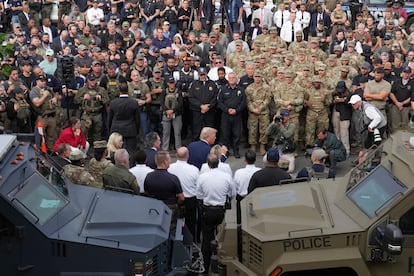
The president of the United States, Donald Trump, wanted to breastfeed his decision to deploy soldiers and federal agents in the streets of Washington, despite the unease that the measure generates among the residents. The Republican, who adopted the measure ten days ago with the argument of an alleged escalation of violence, moved to the operations barracks of this deployment to greet military and police and maintain that these troops “are going to stay a long time.” The legislation allows you to maintain this measure for 30 days, but Trump points out that it is proposed to extend it.
The president ordered the deployment ten days ago, as part of his control of an overwhelming city, which describes – against statistics – as “covered by the violent and criminal gangs thirsty for blood, hordes of violent young people, maniac out of themselves for the drug and homeless people.”
Trump had declared hours before he would leave Patrol “with the police and the military” at night, in statements to the Radio de Todd Starnes program, a conservative commentator.
The president’s evening excursion becomes a triumphal walk, one more than the administration of the Republican has occurred since ten days ago ordered the deployment of the National Guard and federal agents in the US capital, in response to what he considered such an increase in crime that had become a national emergency case. Initially, the White House indicated that some 800 military would reinforce the local police. Since then, six republican majority states have sent soldiers to that mission, which expands its original mission to devote itself in an irregular immigrants arrest.
The order, partially limited days later in the courts, is possible by the peculiar status of the capital, which does not have the privileges of a State. A law of the seventies, which recognizes autonomy to the city, includes a clause that allows the local police to be directly in presidential hands in case of “special conditions of an emergency nature.” Trump has applied that clause, with the argument that the levels of violence meet these “special conditions.”
Trump visited the headquarters of the Parks Police in Anacostia, in southeast Washington and now converted into the center of operations of the deployment ordered by the president, accompanied, among others, of his Secretary of National Security, Kristi Noem; Interior Secretary, Doug Burgum, and his main internal policy advisor, Stephen Miller.
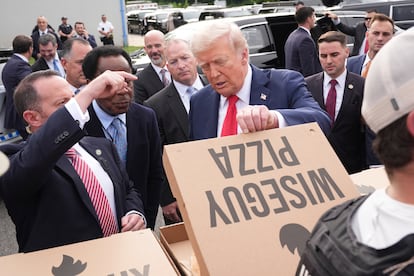
A day before, his vice president, JD Vance, his Secretary of Defense, Pete Hegseth, and Miller had come to the Central Train Station of the capital, Union Station, to greet the troops deployed there, offer them hamburgers and call “take DC out of their situation as a city without law”, between beeps and boos of the public.
Trump argues that since he gave the order on August 7 Washington has become “the perhaps safer city in the country, and improves for minutes.” According to him, so far the capital -a tourist magnet thanks to its free monuments and museums -was a wasteland that many avoided but now “people are going mass again.”
The White House broadcasts newspapers in which it lists the arrests practiced since the order entered into force. So far it counts 630, for crimes that range from homicide to driving driving, although it does not need if those arrests include only those carried out by federal agents or also the local metropolitan police. Yes it indicates that a third of the detainees, about 250, are irregular status immigrants. Although the deployment is especially visible in the city’s tourist center and in its best -known monuments, where the level of violent crime is minimal or non -existent, the greatest number of arrests has occurred, according to the presidential office, in districts seven and eight, part of the Anacostia neighborhood, among the poorest areas of the city – and mostly African -American population.
In reality outside the White House walls, statistics indicate that, although historically the level of violence in the capital has been high, a remarkable reduction had been produced. Violent crimes decreased by 35% in 2024 with respect to the previous year and stood in the lowest figures of the last 30 years, according to a report by the Department of Justice published in January. And the population of this mostly Democratic city, where only 6% voted in favor of Trump last November, is against presidential measures to take control.
A poll published by the Washington Post He finds that 79% of the capital’s residents oppose the presidential order, while only 17% support it. Only 31% believe that the level of crime is serious or very serious and 21% consider that the streets of their neighborhoods are not safe. On the other hand, 78% declare to feel reasonably or very safe in their areas of residence. Two thirds of the population affirms that the police and military presence makes him feel less safe.
For more updates, visit our homepage: NewsTimesWire