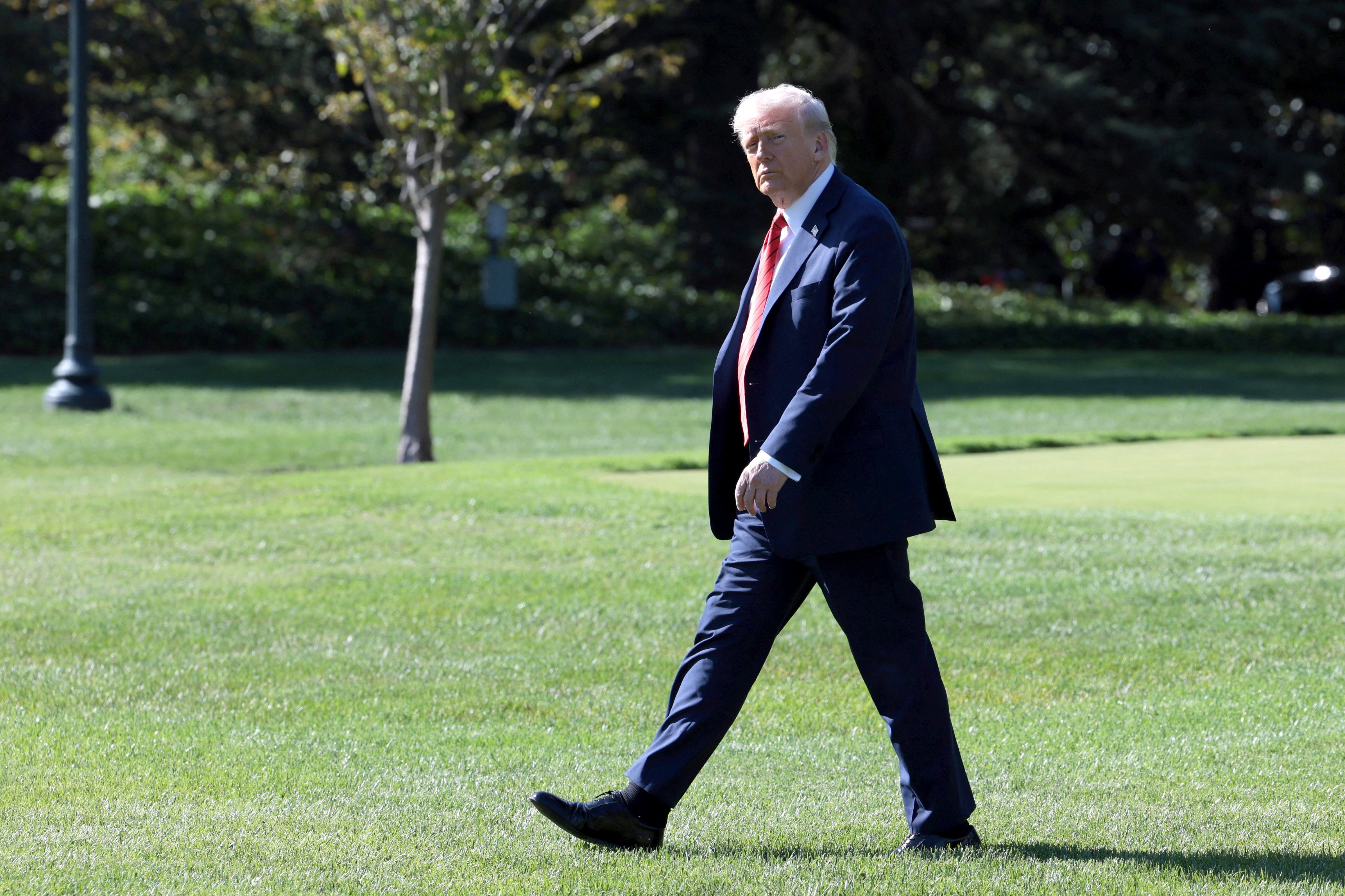
The president of the United States, Donald Trump, has assured that he will raise tariffs on China to 130% following Beijing’s decision to tighten control over rare earths. A decision that Trump has described as “sinister and hostile.”
The president has responded harshly to Beijing after threatening this morning to impose massive tariffs. “The United States will impose a 100% tariff on China, in addition to any tariff it is currently paying (30%). In addition, on November 1, we will impose export controls on all critical software,” Trump wrote on his social network, Truth, this Friday afternoon after having threatened in the morning with “massive tariffs” on China.
The announcement has unleashed fear on Wall Street. The main stock indices that were trading positively have turned around after hearing the news: the S&P 500 fell 2.71% and the Nasdaq technology index lost 2.74%. The dollar, for its part, appreciates 0.5% against the euro.
Trump also plans to suspend the scheduled meeting with Chinese President Xi Jinping, scheduled for the end of this month. China’s decision and Trump’s response raise the tone of the trade dispute to levels not seen since last April, when the US president imposed indiscriminate tariffs on everyone and pushed the world to the brink of a trade war.
If he carries out his threat, Trump would raise taxes on the import of Chinese products to 130%, since the new 100% tariff would be added to the 30% that currently exists. The rate, however, would remain below the 145% it imposed on April 2, the day it named Liberation Day. After the escalation of trade tensions, both powers agreed to lower taxes while granting a truce to advance trade negotiations.
Trump’s decision comes after learning that Beijing authorities are tightening control over rare earths, critical resources for the development of technology and Artificial Intelligence. “It is impossible to believe that China would have taken such a measure, but it did, and the rest is history,” Trump wrote on his social network in the afternoon,
Trump’s response to Beijing’s maneuver has been forceful. The American president has noted: “Very strange things are happening in China! They are becoming very hostile,” according to a publication on his social network.
Beijing announced on Thursday a tightening of restrictions on the trade of rare earths and other instruments and machinery for their extraction and processing, such as magnets. With this move to take advantage of its near-monopoly dominance in the global supply chain of these critical elements, the Asian giant has raised the tone in its trade negotiations with Trump.
China’s decision has been received with particular displeasure in the White House. The president has threatened retaliation: “Depending on what China says, I will be forced to financially counteract their movement,” he wrote on Truth, the social network created by himself, which serves as a voice for him to express his opinions.
“One of the policies we are calculating at this time is a massive increase in tariffs on Chinese products entering the United States. There are many other countermeasures that, likewise, are being seriously considered,” he added.
Beijing’s move comes as Trump is savoring recognition for his intervention to end the Gaza war. And just two weeks before the scheduled meeting with President Xi Jinping at the Asia-Pacific Cooperation summit to be held at the end of this month in South Korea, where they were expected to approach positions to tone down the trade escalation. All eyes were on this meeting because, in theory, the tariff truce granted by the White House to China ends in November.
But, after Beijing’s move, Trump has taken it upon himself to freeze the meeting: “I was going to meet with President Xi in two weeks, at APEC, in South Korea, but now it seems there is no reason to do so,” he wrote in Truth.
Rare earth elements, produced mostly by China, are crucial for the manufacture of chips and other materials used in technological products, such as smartphones, computers, electric cars or military equipment with high-tech components. These critical materials have long been the subject of tensions between the United States and China. When Trump unleashed the trade offensive with indiscriminate tariffs on the entire world last April, Beijing responded by limiting mineral exports for American auto and defense manufacturers, causing significant distortions in global supply chains.
The new restrictions imposed by China also affect the development of Artificial Intelligence (AI), one of the strategic policies of the United States, where large technology companies have already announced investments of more than 300 billion dollars.
“No one has seen anything like it, but, in essence, it would congest markets and make life difficult for virtually every country in the world, especially China,” Trump wrote. “Other countries have contacted us, outraged by this great commercial hostility, which arose out of nowhere,” he continued.
China’s new restrictions on rare earths were announced without prior notice to the United States and appear to be an attempt to control global technology supply chains, a White House official said, according to the report. Wall Street Journal.
Trump has elaborated on this idea with his particular rhetoric: “I have always felt that they have been lying in wait, and now, as usual, I have been proven right! There is no way that China should be allowed to hold the world “captive”, but it seems that this has been their plan for quite some time, starting with the “magnets” and other elements that they have been quietly accumulating until they are in a kind of monopoly position, a quite a move. sinister and hostile, to say the least.”
And he has warned the authorities in Beijing: “The United States also has monopoly positions, much stronger and more far-reaching than those of China. I have simply decided not to use them, there was never a reason to do so… UNTIL NOW!”.
China has tried to anticipate the crucial negotiation that the two world powers must hold to try to resolve trade tensions. The People’s Republic controls the world’s supply of rare earths, both through production in its territory and in the mines that it has purchased, or over which it has influence, around the world.
That’s a negotiating card that China appears willing to play. “These measures are not directed against any country or region in particular,” the Chinese authorities said yesterday in a statement, but the truth is that the most affected will be the large American technology companies.
For more updates, visit our homepage: NewsTimesWire