An Iranian court has sentenced Nobel Peace Prize winner Narges Mohammadi to seven and a half years in prison for several charges of conspiracy and propaganda against the system, in the tenth sentence against the imprisoned activist since 2021. “She was sentenced to six years in prison for charges of congregation and collusion, to one and a half years in prison for propaganda activity, and as a complementary sentence, to a two-year ban on leaving the country,” her lawyer, Mostafa Nili, reported this Sunday in X.
The legal representative has explained that he received a call from the 53-year-old activist in her first communication after 59 days in detention in which she informed him that yesterday she was transferred to the first room of the Revolutionary Court of Mashad (northeast of the country) and after the hearing a sentence was handed down against her. Nili has said that Mohammadi also told him that three days ago she was taken to a hospital due to her poor health and that when she began to tell him the circumstances of her arrest the call was cut off.
Mohammadi began a hunger strike last Monday to protest his imprisonment, according to a statement published this week. “The prolonged detention of Narges Mohammadi occurs at a time when her state of health is extremely worrying,” the Narges Foundation warned and detailed that the human rights defender needs specialized medical attention due to having a history of heart problems, high blood pressure and acute spinal problems.
Nili has indicated that since the sentence has been handed down, the activist should be transferred to a prison, according to Iranian law, and that in his opinion she should be released. “In view of his illnesses, it is expected that his temporary release on bail will be ordered so that he can receive medical treatment,” the lawyer said. The Narges Foundation reported this week that the Iranian authorities have prevented him from having visits and communication with his relatives, except for a call he had with his brother on December 13. Members of the activist’s inner circle have claimed that they have been under constant pressure from the Iranian regime.
Mohammadi was violently detained on December 11 along with other activists during the funeral ceremony of Khosrow Alikordi, a human rights lawyer found dead that same month in his office in the northeastern city of Mashad, according to his family. The winner of the Nobel Peace Prize in 2023 had been on parole since December 2024, when she was released due to medical problems, and at the end of November she reported that the Iranian authorities had “permanently” prohibited her from leaving the country and that they had not issued her a passport to be able to visit her two children, whom she had not seen for 11 years.
The Tehran regime has acknowledged that at least 3,117 protesters died during the protests that began last December. Several NGOs have managed to document between 4,000 and 6,500 deaths, although they have indicated that thousands more are being investigated, which would raise the figure to between 20,000 and 30,000 deaths, according to international media and independent experts.
The activist has been arrested 13 times, convicted nine and was last imprisoned in 2021. Then, she had been released more than a year ago due to her health problems. Despite convictions and imprisonment, the human and women’s rights activist has continued to denounce violations of fundamental rights in Iran, including the use of the death penalty and violence against women who do not wear the Islamic headscarf.
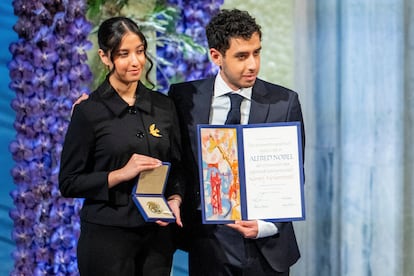
The Norwegian Nobel Committee awarded the prestigious award to Mohammadi in 2023 “for her fight against the oppression of women in Iran and to promote human rights and freedom for all.” The activist was unable to attend the award ceremony in Oslo, the capital of the Scandinavian country. The Government of Iran described the granting of the award as a “political act” and a “pressure measure” by the West.
The conviction against Mohammadi came just a few days after Iran and the United States concluded the first round of negotiations since the bombings ordered by US President Donald Trump last June. Although no concrete progress was announced, the dialogue has reduced tensions between both countries, although a Washington fleet remains partially deployed in the vicinity of Iranian territory.
For more updates, visit our homepage: NewsTimesWire