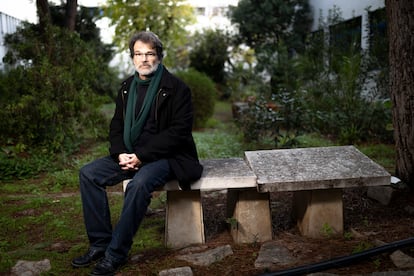
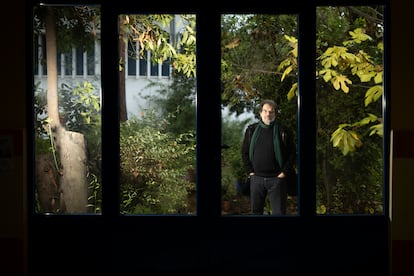
Víctor Bermúdez returned in September to his public institute in Mérida, where he teaches Philosophy, after five years in the Ministry of Education, where he has coordinated the writing of the current curricula for his subject and several others, such as History. Just published with other authors Defense of the teaching of Philosophy: trajectories in Latin America (Humanities Classroom), a book in which he explains that to understand why Philosophy is taught in secondary school in Spain, and the same does not happen in central and northern Europe, we must go back to the religious wars of the 16th century. During an hour of interview, Bermúdez reviews the history and characteristics of his subject, and then launches into talking about how he sees kids and school, the part that, given the choice, is included here. Born 57 years ago in Barcelona and raised in Triana, Seville, he answers questions by video call from his home studio. The camera shows the cozy space where someone who is not exactly a neat freak works.
Ask. He states in the book that one of the concerns of teachers in Spain is that students present “general difficulties in attention, understanding and expression.” Do you share it?
Answer. It is a very complicated question. It is not something alone or specific to the subject of Philosophy. As a teacher, I believe that we are in a moment of great educational confusion. We have almost totally lost control of the educational process of boys and girls, of future citizens. And to a large extent the education that we continue to provide in educational centers is a bit of a simulation.
Q. Because?
R. Firstly, the channels for obtaining information have become uncontrolled. There is no one to control them, because to a large extent they belong to private spheres. Starting with companies that provide tools not only for obtaining, but now for producing information through artificial intelligence. The school does not know how to update the educational language so that it can compete with that. Secondly, I believe that the school is giving up its fundamental objective, which was to generate a kind of general culture common to all citizens, which could serve not only to obtain a job, but to generate community ties, common references, and a moral formation that would allow people to face the world. Education is failing in this and not because there is no will. I see my colleagues working like crazy to try to engage the students. But we don’t know how to compete with, how to reach, nor what to impart. And we don’t know how to recover that background of general culture, of common cultural references that the kids don’t get to share with us.
Q. But do they have more difficulties with understanding and expression?
R. There are difficulties, that is undeniable, in understanding written texts and in expressing complex content in writing in a complex and broad way. That is to say, there are difficulties expressing oneself in the language in which you and I have been educated.
Q. Do you think this is influenced by the environment in which they are growing up outside of school: screens, cell phones, social networks…?
R. Yes, and now artificial intelligence. It’s not that they generally understand less; They understand less and express themselves worse in certain codes. With this I do not want to be relativistic; I don’t think any form of communication is equally good, I think verbal language is much better than others, because we think with it. As I tell my students, if you don’t write well and speak well, you can’t think well either. But I also don’t want to say that boys are stupid. They are very smart and have enormous potential. In my opinion, wasted because they are not learning all the languages that they should be learning and mastering.
Q. What worries you about their use of AI?
R. What I fear is no longer that kids use artificial intelligence, they use it a lot. But many now use it without mischief because they really believe that it is a tool so that they can express themselves better. A little like him autotunethe device that makes it seem like you sing in tune even if you don’t. They come to believe that this expression is the result of their collaboration with the machine, when deep down the machine does practically everything. Many are fooling themselves with that. The school would have to take advantage of the tools that artificial intelligence provides to educate, which is very useful, although the very concept of evaluation would have to change. But I don’t think that is the fundamental element of the confusion.
Q. Which is it?
R. That that area that we used to call general culture is rapidly disintegrating, and that made it possible for you to talk to any citizen of Cervantes or for a boy to know where Egypt is. A symbolic magma and ideas that can furnish coexistence. There are many kids who don’t know how, for example, to place themselves clearly historically, and I’m talking about kids in their second year of high school.
Q. What do you attribute it to?
R. I think it has to do with the fact that education in recent years has been focusing fundamentally on procedures. That the boy or girl is capable of developing certain skills. But this has the problem of losing that common language that was previously the culture of, I don’t know, the Europeans, to speak of a more specific cultural area. On the one hand, globalization has broken, and has its positive side, that cultural bubble in Europe and each of its countries. But on the other hand, it has not given anything to replace that cultural gap. That language of concepts, content, common problems at a cultural, philosophical, and political level. So we communicate worse and worse, we understand each other less and less. And this is also channeled by the phenomenon of political polarization and, in general, the superficiality of communication that is fundamentally carried out by global networks. A communication based above all on the consumption of very simple, very prefabricated products.
Q. What role does the school have?
R. This space of public training, dependent solely on the State, which is especially the public school, is an increasingly smaller pocket of interaction between citizens. It is becoming smaller compared to the global market for communication, training and now the production of information by private companies. Where there are no shared references, a common cultural language that allows you to raise deep problems and find an interlocutor. But there is a very superficial level of information, and basically a great individual, existential loneliness, especially among young people. And it’s not just here. At a global level, the school is losing prominence.
Q. Can philosophy do something about it?
R. Call me naive if you want, but I still have confidence that philosophy, philosophical competence, could be a certain stimulus for education to articulate something that would allow children to defend themselves a little from the aggression they continually suffer from the environment. What I don’t know is how they don’t have more mental problems. If they do not have conceptual tools, concepts with which to understand, categories with which to organize information, the ability to make mental maps integrating what comes from here and there, I do not know how these kids will be able to face not only what is there, but what is coming their way. Because a huge ecosocial crisis is coming upon them, I don’t know if it’s a pre-war or war context… Anyway, maybe I’m already very old.
For more updates, visit our homepage: NewsTimesWire