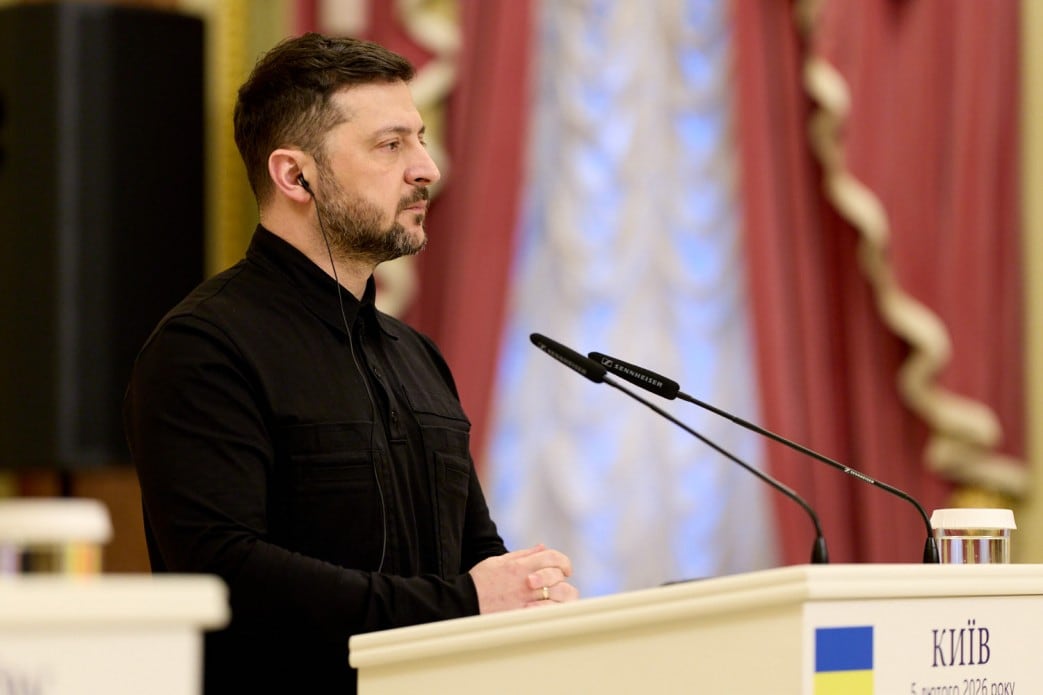
Ukraine is considering calling presidential elections and a referendum to ratify any peace agreement with Russia before the summer. The United States is pressing to reach a ceasefire this spring and the presidential elections are part of Washington’s conditions to grant the security guarantees that kyiv requests. The Ukrainian Government is willing and its parliamentary group is studying the legal issues necessary to hold the vote, sources close to the president, Volodymyr Zelensky, assure EL PAÍS, but they affirm that first “security must be guaranteed so that everything else is possible.”
The same sources confirm that May 15, a date that the newspaper has advanced Financial Times (FT) this Wednesday, is one of those on the table. The question is what comes first, the elections, as the US wants, or the security guarantees, as Ukraine requests.
The holding of presidential elections is one of the 20 points of the peace agreement on which the parties are working to reach a ceasefire. Zelensky, in turn, has insisted that any pact must be ratified in a referendum. Ukraine is willing to hold both votes on the same day — in fact, that would guarantee more participation, which plays in favor of both Zelensky and the legitimacy of the process.
“As long as Russia continues to kill people and destroy our infrastructure, there will not be enough public trust even in active diplomacy. And it is important that all of Ukraine’s partners – in the United States and in Europe – understand this,” Zelensky shared this Wednesday on social networks.
Among the difficulties in holding votes is a basic issue of security, which is not guaranteed as long as Russian bombing continues. The logistical and legal challenges are also huge, starting with an electoral roll that has been blown up in four years of war. Millions of people are displaced, internally or abroad, and no longer living at home. There are hundreds of thousands of soldiers on the front lines. And 20% of the territory is occupied by Russia.
Viktor Zamyatin, director of political and legal programs at the Razumkov analysis center, also recalls that martial law prohibits holding elections during war. “We don’t know how many voters there are in the country,” he points out. Furthermore, redoing the census takes time. Another problem is that “Parliament must vote on very clear terms for the electoral process and campaign.” And right now there is not enough majority, he says. “And most importantly, two-thirds of Ukrainian society is against calling elections during the war.” Zamyatin questions whether the United States understands “the trauma, conditions and public opinion in Ukraine.”
Speaking of the referendum, Zelensky estimated a few weeks ago that 60 days of preparations and a ceasefire would be needed to hold it. According to information published this Wednesday by the FTthe Ukrainian president would have planned to announce the call for elections on February 24, four years after the start of the large-scale invasion of Ukraine.
Zelensky, despite war fatigue and the corruption scandals that have plagued his inner circle, has the trust of around 60% of voters, according to Mykhailo Mishchenko, deputy director of Razumkov’s sociological service. The only candidate who could apparently surpass him in popularity right now is Valeri Zaluzhni, who was the commander in chief of the Ukrainian Armed Forces until February 2024. The military man, who is the Ukrainian ambassador in London at the moment, has not yet expressed any intention to take that political step.
Talks
The Donald Trump Administration, which acts as a mediator in the conflict, wants to close an agreement to end hostilities as soon as possible. Among other reasons, to focus on the midterm elections in the United States, which are held in November. The parties have held two rounds of three-way negotiations in Abu Dhabi (United Arab Emirates), and a third was planned this week in Miami, according to Zelensky. Now there is talk of next week, but there is no final date or confirmation from Moscow.
The peace talks have yet to produce tangible results beyond the exchange of prisoners of war. The negotiating teams affirm that progress has been made on military technical issues, such as the design of the exit strategy for the conflict, the withdrawal of troops and ceasefire control mechanisms.
They have also assured that “productive” conversations have taken place to reach consensus on many of the 20 points of the plan. There is a central obstacle, however, that is difficult to solve for now: the transfer of 22% of Donetsk, which together with Lugansk makes up the Donbas region, still in Ukrainian hands.
Moscow demands that it be given what it has not yet won through arms in that territory. Washington proposes that Ukrainian troops withdraw to create a demilitarized zone. To this counteroffer, kyiv responds that Russia should do the same in a proportional extension and interposition forces should control that it does not break the agreement.
Another complicated issue is the management of the Zaporizhia nuclear power plant, the largest in Europe, which is located in an area occupied by Russian troops. Additional issues being negotiated are that part of the war front be frozen in the provinces of Zaporizhzhia and Kherson and that the Russians withdraw from the areas they have occupied in the provinces of Sumi, Kharkiv and Dnipropetrovsk. Also, that the Ukrainian army cannot have more than 800,000 soldiers and that kyiv renounces being part of NATO.
The head of European diplomacy, Kaja Kallas, has expressed her opposition to the idea of holding elections in the middle of war, Silvia Ayuso reports from Brussels. The Estonian leader recalled at the beginning of a meeting of EU Defense Ministers in Brussels that most European countries prohibit, in their constitution, calling elections during a war conflict. From NATO headquarters, its secretary general, Mark Rutte, did not want to comment, limiting himself to indicating that it is an issue that “totally depends” on the Ukrainians and that he has “full confidence in leadership and democracy.”
Ukraine is juggling to show its best willingness to negotiate and end the war, as the United States wants, without giving up its basic interests. kyiv has limited room for maneuver, however, because it depends on Washington in both peace and war. But beyond these two capitals understanding each other, there is Moscow, which for now has good cards in the negotiations and little willingness to give in.
For more updates, visit our homepage: NewsTimesWire