
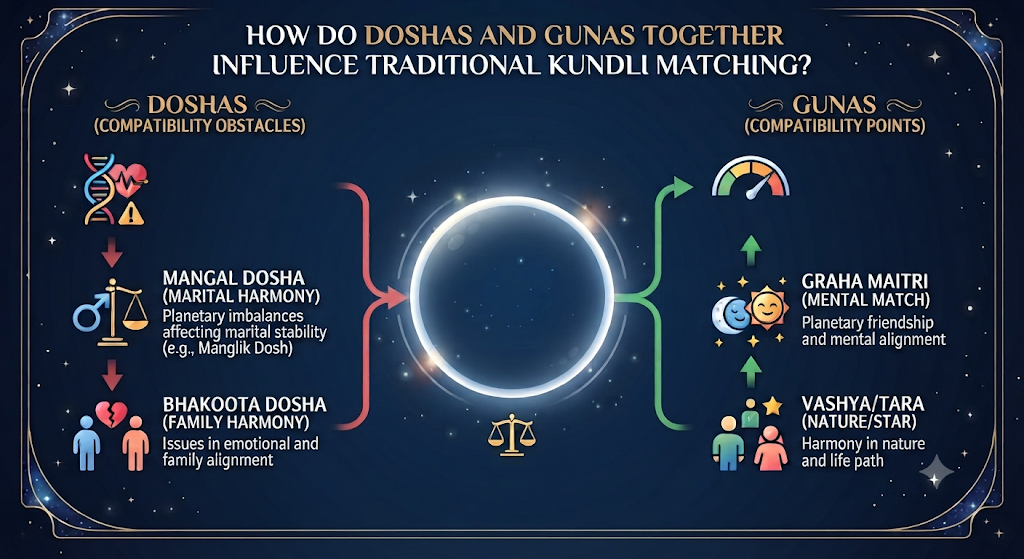
In Vedic astrology, kundali matching is a traditional way of comparing two birth charts before marriage. Two elements often discussed during this process are Gunas and Doshas. Gunas are used to assess selected areas of compatibility through the Ashtakoota system, while Doshas refer to specific planetary combinations that astrologers interpret in relation to marriage and other life themes.
Together, they offer a broader traditional reading than either factor alone.
What Are Gunas in Kundali Matching?
Guna Milan, also known as Ashtakoota matching, compares the Moon signs and birth nakshatras of two individuals. It evaluates eight categories, each carrying a specific number of points. Together, they make up a maximum score of 36.
The eight Kootas are Varna, Vashya, Tara, Yoni, Graha Maitri, Gana, Bhakoot, and Nadi. Traditionally, these categories relate to areas such as temperament, mental compatibility, attraction, and emotional understanding.
A score of 18 or above is commonly treated as an acceptable starting point in many matching traditions. The total score does not explain every detail; two couples can receive the same score with different category results.
What Are Doshas in Vedic Astrology?
Doshas are combinations or placements in a birth chart that are traditionally considered challenging or significant. In marriage readings, astrologers may examine certain Doshas to understand possible areas requiring attention.
Some commonly discussed examples include:
- Mangal Dosha: Associated with the placement of Mars in particular houses of the birth chart. It is traditionally examined in relation to marriage and partnership.
- Nadi Dosha: Identified through the Nadi category in Ashtakoota matching when both individuals are assigned the same Nadi.
- Bhakoot Dosha: Considered when the Moon signs form certain relationships under the Ashtakoota system.
- Other planetary afflictions: Astrologers may also assess influences on the seventh house, its ruling planet, Venus, and other marriage-related factors.
A Dosha does not automatically mean a person has a problem or that a marriage will be unsuccessful. Its interpretation depends on the complete chart and tradition.
How Do Gunas and Doshas Work Together?
Gunas and Doshas serve different purposes in traditional kundali matching. Guna Milan provides a structured compatibility score, while Dosha analysis examines specific combinations and planetary influences that may not be fully represented by that score.
For example, a couple may receive a high Guna Milan score, but an astrologer may still review Mangal Dosha or the condition of the seventh house in both charts. Similarly, a lower score may prompt a closer look at other supportive factors before drawing a conclusion.
The two are therefore interpreted together, with attention to the individual Kootas, planetary placements, and both complete charts.
Why Should Couples Look Beyond the Guna Milan Score?
A numerical score cannot describe the full nature of a relationship. A detailed reading may include other factors.
1. The Seventh House
The seventh house is traditionally associated with marriage and committed partnerships. Astrologers may examine its sign, ruling planet, occupants, and planetary aspects in both charts. These factors add context to the partnership themes considered during matching.
2. Mars and Mangal Dosha
When assessing Mangal Dosha, astrologers examine Mars’s placement and may consider its sign, aspects, strength, and relevant cancellation conditions. They may also compare both charts instead of interpreting one person’s placement alone.
3. The Navamsa Chart
The Navamsa, or D9 chart, is commonly studied alongside the main birth chart for marriage-related interpretation. Astrologers may consider the seventh house, Venus, Jupiter, and other relevant placements to add depth to the reading.
4. The Running Dasha Periods
Dasha periods are planetary cycles used in Vedic astrology. An astrologer may review the current and upcoming periods in both charts when discussing marriage timing. These periods are interpreted with the birth charts and transits, not as independent guarantees of an event.
Can Dosha Cancellation Change the Interpretation?
In some Vedic astrology traditions, specific conditions are considered to reduce or cancel the effects attributed to a Dosha. For example, astrologers may examine planetary strength, sign placement, aspects, or similar placements in both charts when assessing Mangal Dosha.
Cancellation rules vary. Couples can ask which condition is being considered and how it applies to both charts.
A Balanced Approach to Traditional Matching
Gunas and Doshas offer different kinds of information within traditional kundali matching. Guna Milan compares selected compatibility factors, while Dosha analysis looks at specific planetary combinations and their possible significance. Considering both can make an astrological reading more detailed, but neither can guarantee marital harmony or predict every challenge.
Couples can use the reading as one point of reflection while discussing practical matters such as family expectations, finances, career plans, communication, and shared values. Mutual respect, trust, and the willingness to work through differences remain important in building a healthy marriage.
