
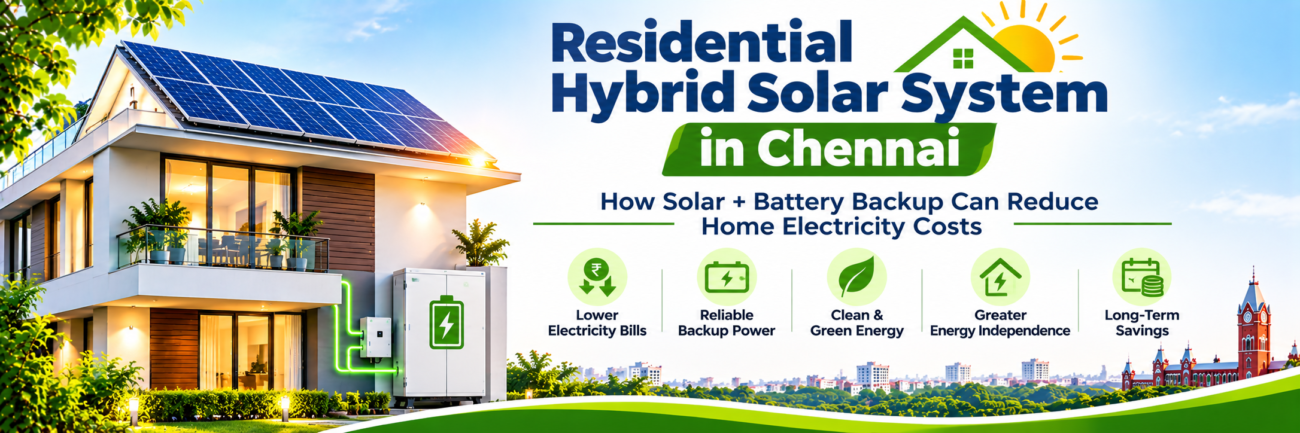
Electricity consumption in Chennai homes continues to increase as households depend on air conditioners, refrigerators, washing machines, water pumps, televisions, computers and other electrical appliances. For homeowners looking to reduce electricity expenses while maintaining reliable power, a residential hybrid solar system in Chennai offers an efficient combination of solar generation, battery storage and grid electricity.
Unlike a conventional rooftop solar system, a hybrid solar setup can store excess solar energy in a battery and make it available when solar generation is unavailable or insufficient. This gives homeowners greater control over how and when electricity is used.
What Is a Residential Hybrid Solar System?
A residential hybrid solar system combines three important components:
- Solar panels
- Battery energy storage
- Grid electricity
Solar panels generate electricity from sunlight during the day. The generated power can be used directly by household appliances. When solar generation is higher than immediate household consumption, the excess energy can be stored in the battery, depending on the system configuration.
When solar production falls, stored battery energy can be used for selected household loads. Grid electricity remains available when additional power is required.
The basic energy flow can be represented as:
Solar Panels → Hybrid Inverter → Home Appliances
and when excess energy is available:
Solar Panels → Battery Storage
During low-sunlight periods or power interruptions:
Battery → Selected Home Loads
This combination provides homeowners with greater flexibility than a conventional grid-dependent setup.
Why Choose a Hybrid Solar System for Your Home in Chennai?
Chennai receives substantial sunlight throughout much of the year, making rooftop solar a practical option for suitable residential properties.
A hybrid system can provide several potential advantages.
1. Reduce Home Electricity Costs
Solar energy generated during the day can be used directly for household electricity consumption. This can reduce the amount of electricity purchased from the grid, depending on household usage and the solar system’s capacity.
2. Store Excess Solar Energy
Instead of using solar energy only when the sun is available, a battery allows surplus energy to be stored for later use.
This can be useful for households that consume significant electricity during the evening.
3. Provide Battery Backup
A battery energy storage system can provide backup power to selected household appliances during a grid interruption.
Critical loads may include:
- Lights
- Wi-Fi routers
- Computers
- Security systems
- Fans
- Refrigerators
- Essential communication equipment
The actual backup duration depends on battery capacity and the connected electrical load.
4. Reduce Dependence on Grid Power
A hybrid solar system allows homeowners to generate and store a portion of their own electricity rather than depending entirely on grid power.
5. Support Clean Energy
Solar power is renewable energy. Installing a residential solar system can help households increase their use of clean electricity and reduce dependence on conventional energy sources.
How Does Residential Hybrid Solar Work?
A hybrid solar system uses an intelligent inverter to manage electricity from solar panels, batteries and the grid.
During the daytime, solar panels generate electricity. The system can prioritise household consumption first.
If solar generation exceeds the home’s immediate requirement, the surplus may be directed towards battery charging.
In the evening, when solar generation decreases, the system can use stored battery energy according to its operating configuration.
If the battery reaches its usable limit or household demand exceeds available solar and battery power, electricity can be drawn from the grid.
This creates a flexible energy-management cycle:
Generate → Use → Store → Use Later → Grid Support
Residential Hybrid Solar vs Conventional Solar
A conventional grid-connected solar system primarily focuses on generating electricity from solar panels and supplying it to the home and grid according to the system configuration.
A hybrid system adds battery storage to the setup.
| Feature | Conventional Solar | Hybrid Solar |
|---|---|---|
| Solar generation | Yes | Yes |
| Battery storage | Usually not included | Included |
| Energy storage | Limited | Yes |
| Backup capability | Depends on system | Can support selected loads |
| Grid connection | Possible | Possible |
| Energy management | Basic | More flexible |
For homeowners who want both solar energy generation and battery backup, a hybrid configuration may be worth considering.
How to Choose the Right Residential Hybrid Solar System
Every household has different electricity requirements. Therefore, selecting a system only based on the number of solar panels may not provide the right solution.
Homeowners should evaluate:
Monthly Electricity Consumption
Review electricity bills to understand average monthly usage and seasonal variations.
Daytime vs Evening Consumption
A home that uses more electricity during the daytime may have different solar requirements from a household with higher evening consumption.
Rooftop Space
The available rooftop area affects the number of solar panels that can be installed.
Battery Capacity
Battery size should be selected based on the appliances that need backup and the expected backup duration.
Inverter Capacity
The inverter should be appropriately sized for the solar array, battery and household electrical loads.
Future Electricity Requirements
Homes may add appliances such as electric vehicles, additional air conditioners, water heaters or other equipment. Future requirements should be considered during system planning.
Residential Hybrid Solar Installation Process
A professional residential hybrid solar installation in Chennai generally follows a structured process.
1. Site Assessment
The installation team evaluates the rooftop, available space, shading, roof condition and electrical infrastructure.
2. Energy Analysis
Electricity bills and household consumption patterns are reviewed to determine the appropriate system capacity.
3. System Design
Solar panels, battery storage and inverter capacity are selected according to the home’s energy requirements.
4. Equipment Selection
Suitable solar modules, hybrid inverters, batteries, mounting structures and protection equipment are selected.
5. Installation
The solar panels, inverter, battery and associated electrical components are installed according to the system design.
6. Testing and Commissioning
The system is tested for safe and reliable operation before commissioning.
7. Monitoring and Maintenance
System performance can be monitored to identify potential issues and maintain efficient operation.
Where Can Battery Backup Be Most Useful?
Battery storage is particularly valuable when homeowners want to maintain essential electricity during power interruptions.
Instead of attempting to power the entire house, a professionally designed system can prioritise selected essential loads.
For example, a home may configure backup power for:
- Lighting
- Fans
- Wi-Fi
- Refrigerator
- Television
- Security cameras
- Computers
- Essential charging points
Larger battery systems can support additional loads, but the required capacity increases according to energy consumption.
How Much Can a Home Save with Hybrid Solar?
The savings from a residential hybrid solar system depend on several factors.
These include:
- Solar system capacity
- Household electricity consumption
- Electricity tariff
- Solar generation
- Daytime energy usage
- Battery capacity
- Battery usage pattern
- System efficiency
- Maintenance requirements
Therefore, homeowners should avoid relying on a fixed savings figure.
A professional energy assessment can compare existing electricity consumption with the expected contribution from solar generation and battery storage.
Why Choose Sree Nandhee’s Technologies Pvt. Ltd.?
Choosing the right installation partner is an important part of a residential hybrid solar project.
Sree Nandhee’s Technologies Pvt. Ltd. provides solar and power solutions designed around customer energy requirements. For residential projects, understanding household electricity consumption, rooftop conditions, backup requirements and future energy needs is essential for developing a suitable system.
A professional solar provider can help homeowners evaluate system capacity, battery requirements, installation conditions and long-term energy management before investing in a hybrid solar solution.
Is a Residential Hybrid Solar System Worth It?
A hybrid solar system can be a suitable choice for homeowners who want to combine renewable energy generation with battery backup.
It can be particularly useful for homes that:
- Have suitable rooftop space
- Have regular electricity consumption
- Want to reduce grid dependence
- Experience occasional power interruptions
- Need backup for essential appliances
- Want to make greater use of renewable energy
- Are planning long-term energy savings
The ideal system, however, should be selected based on actual household electricity requirements rather than a standard package.
Conclusion
A residential hybrid solar system in Chennai combines solar panels, battery storage and grid electricity to create a flexible approach to household energy management.
Solar panels can generate clean electricity during daylight hours, while battery storage can retain surplus energy for later use and provide backup to selected household loads when required.
For homeowners considering rooftop solar, the best starting point is a professional site assessment and energy analysis. This helps determine the appropriate solar capacity, battery size and inverter configuration for the property.
With the right system design and professional installation, hybrid solar can become a practical long-term energy solution for modern homes in Chennai.
Sree Nandhee’s Technologies Pvt. Ltd. can help homeowners evaluate their residential solar and battery-storage requirements and explore suitable hybrid solar solutions.
