
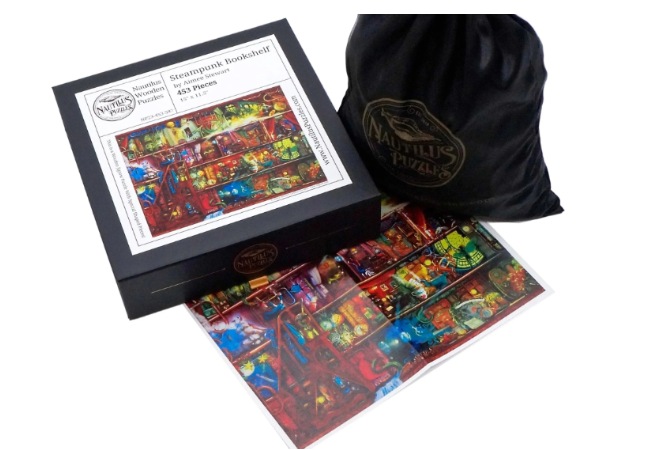
An illustrated jigsaw can feel like several small pictures joined inside one frame. A shelf, doorway, or landscape might contain tiny scenes that become apparent only when neighboring pieces fit together. Aimee Stewart puzzles give that kind of close looking a practical purpose. A small object, a repeated motif, or a shift in the direction of the light can help you figure out where a piece belongs. The experience changes as details that first seemed unrelated begin to form a recognizable setting.
Look for The Image’s Largest Divisions
Before sorting pieces, look at the reference image long enough to identify the main divisions. A picture may be structured around a foreground and background, several shelves or panels, or a central subject with smaller scenes around it. Notice whether the longest lines are straight or curved and whether they continue through changes in color. These divisions can help locate pieces whose subjects are hard to identify. A piece with a fragment of a shelf edge, for instance, can be useful even when the objects above it are still a blur. Give yourself room to assemble promising groups on separate trays.
Sort Recognizable Details Into Small Groups
Many Aimee Stewart puzzles reward an initial sort by subject. Collect pieces that show letters, faces, printed patterns, or distinctive objects. A first pass works best when the groups are broad enough to stay manageable. Within each group, use secondary cues such as the size of the lettering, the direction of shadows, or the colors around the subject. If you find three similar windows, for example, one may have a blue border, another a curved lintel, and the third a reflection. Setting a puzzling piece aside until those details become clearer can save time and keep the work surface organized. Check the finished size early if you intend to leave the work in place between sessions.
Pay Attention to Repeated Colors and Textures
An illustrated scene can use deep blues in both clothing and sky or repeat shades of gold in several parts of the picture. When broad color groups become too crowded, compare the texture in the printed image. A fabric crease, the grain of a wooden surface, and a fading area of sky can share a color while looking different up close. Look also for how line thickness changes. A sharp outline can indicate an object in the foreground, while a faint edge may belong to a more distant part of the scene. These secondary details help place pieces that would be hard to sort by hue alone.
Consider The Cut as Part of The Experience
The collection features wooden jigsaws, a format that can include irregular pieces and recognizable shapes. With Aimee Stewart puzzles in this format, check both the artwork and the cut before deciding how to begin. A distinctive outline can be a visual landmark, but its shape alone may give few clues about its place in the illustration. Confirm the printed details on both sides of every seam. Some people enjoy starting with the frame, while others build a major scene first and connect it to an edge later. Choose the method that gives you the clearest early reference points.
Match The Design to The Way You Solve
Piece count is one measure of challenge. A compact picture with repeated textures can require more concentration than a larger image with several obvious color blocks. Before choosing a puzzle, check its finished dimensions and consider how much sorting space you have. A shared table works well when the picture contains regions that different people can assemble independently. For a project you will revisit on several evenings, use trays or another flat surface that lets you keep those regions separate between sessions. A clear reference image and steady light make it easier to distinguish similar details across the whole table.
Conclusion
The illustrated collection at Nautilus Puzzles offers examples of how layered artwork changes the way a jigsaw is assembled. Compare the density of the scene, the range of colors, the piece cut, and the space needed for the finished picture. During assembly, look for lines or textures connecting one small scene to another. Those connections are often what make the final image feel coherent after hours of looking at it in fragments.
